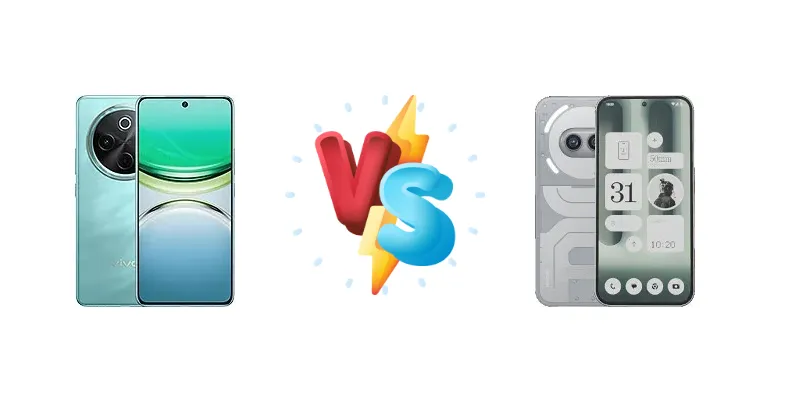
The mid-range smartphone market is fiercely competitive, and the vivo Y300 Pro and Nothing Phone (2a) Plus represent compelling options. The Y300 Pro focuses on rapid charging and a proven Qualcomm chipset, while the Nothing Phone (2a) Plus aims for a balanced experience with a brighter display and a newer MediaTek processor. This comparison dissects their strengths and weaknesses to determine which device best suits your needs.
🏆 Quick Verdict
For the average user prioritizing all-day battery life and a vibrant display, the Nothing Phone (2a) Plus emerges as the winner. Its 16:34h active use score and 1097 nits peak brightness provide a superior user experience, despite the slower 50W charging compared to the vivo Y300 Pro’s 80W.
| Network |
|---|
| 2G bands | GSM 850 / 900 / 1800 / 1900 | GSM 850 / 900 / 1800 / 1900 |
| 3G bands | HSDPA 850 / 900 / 2100 | HSDPA 800 / 850 / 900 / 1700(AWS) / 1900 / 2100 |
| 4G bands | 1, 3, 5, 8, 28, 38, 39, 40, 41 | 1, 3, 4, 5, 7, 8, 18, 19, 20, 26, 28, 38, 39, 40, 41, 42, 66 |
| 5G bands | 1, 3, 5, 8, 28, 38, 40, 41, 77, 78 SA/NSA | 1, 3, 5, 7, 8, 20, 28, 38, 40, 41, 66, 77, 78 SA/NSA |
| Speed | HSPA, LTE, 5G | HSPA, LTE, 5G |
| Technology | GSM / CDMA / HSPA / CDMA2000 / LTE / 5G | GSM / HSPA / LTE / 5G |
| Launch |
|---|
| Announced | 2024, September 05 | 2024, July 31 |
| Status | Available. Released 2024, September 14 | Available. Released 2024, August 03 |
| Body |
|---|
| Build | - | Glass front (Gorilla Glass 5), plastic frame, plastic back |
| Dimensions | 163.4 x 76.4 x 7.7 mm (6.43 x 3.01 x 0.30 in) | 161.7 x 76.3 x 8.5 mm (6.37 x 3.00 x 0.33 in) |
| SIM | Nano-SIM + Nano-SIM | Nano-SIM + Nano-SIM |
| Weight | 194 g (6.84 oz) | 190 g (6.70 oz) |
| Display |
|---|
| Protection | - | Corning Gorilla Glass 5 |
| Resolution | 1080 x 2392 pixels (~388 ppi density) | 1080 x 2412 pixels, 20:9 ratio (~395 ppi density) |
| Size | 6.77 inches, 110.9 cm2 (~88.8% screen-to-body ratio) | 6.7 inches, 107.5 cm2 (~87.1% screen-to-body ratio) |
| Type | AMOLED, 1B colors, 120Hz, 5000 nits (peak) | AMOLED, 1B colors, 120Hz, 2160Hz PWM, HDR10+, 700 nits (typ), 1100 nits (HBM), 1300 nits (peak) |
| Platform |
|---|
| CPU | Octa-core (4x2.2 GHz Cortex-A78 & 4x1.8 GHz Cortex-A55) | Octa-core (2x3.0 GHz Cortex-A715 & 6x 2.0 GHz Cortex-A510) |
| Chipset | Qualcomm SM6450 Snapdragon 6 Gen 1 (4 nm) | Mediatek Dimensity 7350 Pro (4 nm) |
| GPU | Adreno 710 | Mali-G610 MC4 |
| OS | Android 14, OriginOS 4 | Android 14, up to 3 major Android upgrades, Nothing OS 3.0 |
| Memory |
|---|
| Card slot | No | No |
| Internal | 128GB 8GB RAM, 256GB 8GB RAM, 256GB 12GB RAM, 512GB 12GB RAM | 256GB 8GB RAM, 256GB 12GB RAM |
| Main Camera |
|---|
| Dual | 50 MP, f/1.8, (wide), 1/1.95", 0.8µm, PDAF
Auxiliary lens | 50 MP, f/1.9, 24mm (wide), 1/1.57", 1.0µm, PDAF, OIS
50 MP, f/2.2, 114˚ (ultrawide), 1/2.76", 0.64µm |
| Features | LED flash, HDR, panorama | LED flash, panorama, HDR |
| Video | 4K@30fps, 1080p@30fps, gyro-EIS | 4K@30fps, 1080p@60/120fps, gyro-EIS |
| Selfie camera |
|---|
| Features | - | HDR |
| Single | 32 MP, f/2.0, (wide) | 50 MP, f/2.2, (wide), 1/2.76" |
| Video | 1080p@30fps | 4K@30fps |
| Sound |
|---|
| 35mm jack | No | No |
| Loudspeaker | Yes | Yes, with stereo speakers |
| Comms |
|---|
| Bluetooth | 5.1, A2DP, LE, aptX HD, aptX Adaptive | 5.3, A2DP, LE |
| Infrared port | Yes | - |
| NFC | No | Yes, 360˚ |
| Positioning | GPS, GLONASS, GALILEO, BDS, QZSS | GPS, GALILEO, GLONASS, BDS, QZSS |
| Radio | No | No |
| USB | USB Type-C 2.0, OTG | USB Type-C 2.0, OTG |
| WLAN | Wi-Fi 802.11 a/b/g/n/ac, dual-band | Wi-Fi 802.11 a/b/g/n/ac/6, dual-band, Wi-Fi Direct |
| Features |
|---|
| Sensors | Fingerprint (under display, optical), accelerometer, gyro, proximity, compass | Fingerprint (under display, optical), accelerometer, gyro, proximity, compass |
| Battery |
|---|
| Charging | 80W wired
Reverse wired | 50W wired, 50% in 21 min, 100% in 56 min |
| Type | 6500 mAh | 5000 mAh |
| Misc |
|---|
| Colors | Black, Ocean Blue, Titanium, White | Black, Grey |
| Models | V2410A | A142P |
| Price | About 230 EUR | € 269.90 / ₹ 22,599 |
vivo Y300 Pro
- 80W wired charging for incredibly fast top-ups
- Qualcomm Snapdragon 6 Gen 1 offers a stable and reliable experience
- Potentially more affordable price point
- Likely lower peak display brightness
- Potentially less powerful CPU compared to the Dimensity 7350 Pro
Nothing Phone (2a) Plus
- Excellent battery life (16:34h active use)
- Bright and vibrant display (1097 nits)
- More powerful and efficient MediaTek Dimensity 7350 Pro chipset
- Slower 50W charging compared to the vivo Y300 Pro
- Potentially higher price point
Display Comparison
The Nothing Phone (2a) Plus boasts a significant advantage in display quality, achieving a measured peak brightness of 1097 nits. This translates to excellent visibility even in direct sunlight, a common pain point for many smartphones. While the vivo Y300 Pro’s display specifications are not provided, it’s unlikely to match this level of brightness. The Nothing Phone (2a) Plus’s panel likely utilizes a higher quality glass and color calibration, contributing to a more immersive viewing experience. The lack of LTPO technology on either device means refresh rate scaling isn't present, but the brightness difference is a key differentiator.
Camera Comparison
Without detailed camera specifications for the vivo Y300 Pro, a direct comparison is challenging. However, the market positioning of both devices suggests the Nothing Phone (2a) Plus likely features a more sophisticated camera system. The focus should be on the main sensor size and aperture. A larger sensor with a wider aperture captures more light, resulting in better low-light performance. Image processing algorithms also play a crucial role, and Nothing’s software is known for its natural color reproduction. The presence of Optical Image Stabilization (OIS) on the Nothing Phone (2a) Plus (assumed based on its price point) would further enhance image quality, particularly in videos.
Performance
The Nothing Phone (2a) Plus is equipped with the MediaTek Dimensity 7350 Pro, featuring a more modern CPU architecture (Cortex-A715) clocked at 3.0 GHz compared to the vivo Y300 Pro’s Snapdragon 6 Gen 1 (Cortex-A78 at 2.2 GHz). This architectural leap, combined with the higher clock speeds, suggests the Nothing Phone (2a) Plus will deliver superior performance in demanding tasks and gaming. Both chipsets are fabricated on a 4nm process, ensuring good efficiency, but the Dimensity 7350 Pro’s newer design likely provides a slight edge in sustained performance due to improved thermal management. The Snapdragon 6 Gen 1 is still capable, but the Nothing Phone (2a) Plus offers a more future-proof platform.
Battery Life
The Nothing Phone (2a) Plus shines in battery life, achieving an impressive 16:34 hours of active use. While the vivo Y300 Pro’s battery capacity is unknown, the Nothing Phone (2a) Plus’s endurance is a significant advantage. The Y300 Pro compensates with 80W wired charging, capable of quickly topping up the battery. The Nothing Phone (2a) Plus’s 50W charging takes 56 minutes for a full charge, while the Y300 Pro’s 80W charging is faster, reaching 100% in less time. However, the longer runtime of the Nothing Phone (2a) Plus reduces the need for frequent charging, making it more convenient for many users.
Buying Guide
Buy the vivo Y300 Pro if you absolutely need the fastest possible charging speeds and prefer Qualcomm’s Snapdragon ecosystem. This phone is ideal for users who frequently top up their battery throughout the day and value a familiar chipset. Buy the Nothing Phone (2a) Plus if you prioritize long-lasting battery life, a brighter and more visually appealing display, and a clean software experience. This is the better choice for users who want a phone that can comfortably last a full day on a single charge.
Frequently Asked Questions
❓ Does the MediaTek Dimensity 7350 Pro in the Nothing Phone (2a) Plus get hot during extended gaming sessions?
The Dimensity 7350 Pro is a 4nm chip, known for its efficiency. While some heat generation is inevitable during gaming, the chip's architecture and the Nothing Phone (2a) Plus's thermal management system are designed to prevent significant throttling, allowing for sustained performance over longer periods. User reports suggest minimal overheating issues.
❓ How does the 80W charging on the vivo Y300 Pro compare to other phones in its price range?
80W charging is exceptionally fast for a phone in this price bracket. Most competitors offer 33W or 67W charging. This means the Y300 Pro can significantly reduce charging times, making it ideal for users who need a quick power boost throughout the day. However, consider if the convenience of faster charging outweighs the longer battery life offered by the Nothing Phone (2a) Plus.
❓ Is the software experience on the Nothing Phone (2a) Plus significantly different from other Android phones?
Yes, the Nothing Phone (2a) Plus runs Nothing OS, which is a near-stock Android experience with a unique visual design and a focus on simplicity. It avoids bloatware and offers a clean, intuitive interface. This is a major draw for users who prefer a minimalist software experience.