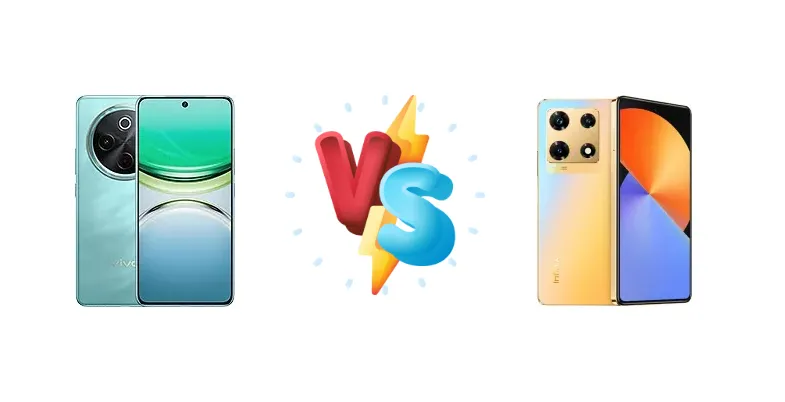
The mid-range smartphone market is fiercely competitive, and the vivo Y300 Pro and Infinix Note 30 Pro are two contenders vying for your attention. The Y300 Pro leverages Qualcomm's newer, 4nm Snapdragon 6 Gen 1, while the Note 30 Pro opts for MediaTek's 6nm Helio G99. This comparison dissects these key differences, alongside charging capabilities and overall feature sets, to determine which device delivers the most compelling experience.
🏆 Quick Verdict
For the average user prioritizing sustained performance and future-proofing, the vivo Y300 Pro emerges as the stronger choice. Its Snapdragon 6 Gen 1, built on a more efficient 4nm process, offers a performance edge and better thermal management, despite the Infinix Note 30 Pro's wireless charging advantage.
| Network |
|---|
| 2G bands | GSM 850 / 900 / 1800 / 1900 | GSM 850 / 900 / 1800 / 1900 |
| 3G bands | HSDPA 850 / 900 / 2100 | HSDPA 850 / 900 / 1700(AWS) / 1900 / 2100 |
| 4G bands | 1, 3, 5, 8, 28, 38, 39, 40, 41 | 1, 2, 3, 4, 5, 7, 8, 12, 17, 20, 28, 38, 40, 41, 66 |
| 5G bands | 1, 3, 5, 8, 28, 38, 40, 41, 77, 78 SA/NSA | - |
| Speed | HSPA, LTE, 5G | HSPA, LTE |
| Technology | GSM / CDMA / HSPA / CDMA2000 / LTE / 5G | GSM / HSPA / LTE |
| Launch |
|---|
| Announced | 2024, September 05 | 2023, May 22 |
| Status | Available. Released 2024, September 14 | Available. Released 2023, May 22 |
| Body |
|---|
| Build | - | Glass front, plastic frame, glass back |
| Dimensions | 163.4 x 76.4 x 7.7 mm (6.43 x 3.01 x 0.30 in) | 162.7 x 76 x 8.2 mm (6.41 x 2.99 x 0.32 in) |
| SIM | Nano-SIM + Nano-SIM | Nano-SIM + Nano-SIM |
| Weight | 194 g (6.84 oz) | 203 g (7.16 oz) |
| | - | IP53 |
| Display |
|---|
| Resolution | 1080 x 2392 pixels (~388 ppi density) | 1080 x 2400 pixels, 20:9 ratio (~395 ppi density) |
| Size | 6.77 inches, 110.9 cm2 (~88.8% screen-to-body ratio) | 6.67 inches, 107.4 cm2 (~86.9% screen-to-body ratio) |
| Type | AMOLED, 1B colors, 120Hz, 5000 nits (peak) | AMOLED, 1B colors, 120Hz, 900 nits (peak) |
| | - | * the display diagonal size and resolution is unconfirmed |
| Platform |
|---|
| CPU | Octa-core (4x2.2 GHz Cortex-A78 & 4x1.8 GHz Cortex-A55) | Octa-core (2x2.2 GHz Cortex-A76 & 6x2.0 GHz Cortex-A55) |
| Chipset | Qualcomm SM6450 Snapdragon 6 Gen 1 (4 nm) | Mediatek Helio G99 (6 nm) |
| GPU | Adreno 710 | Mali-G57 MC2 |
| OS | Android 14, OriginOS 4 | Android 13, XOS 13 |
| Memory |
|---|
| Card slot | No | microSDXC (dedicated slot) |
| Internal | 128GB 8GB RAM, 256GB 8GB RAM, 256GB 12GB RAM, 512GB 12GB RAM | 256GB 8GB RAM |
| Main Camera |
|---|
| Dual | 50 MP, f/1.8, (wide), 1/1.95", 0.8µm, PDAF
Auxiliary lens | - |
| Features | LED flash, HDR, panorama | Quad-LED flash, HDR, panorama |
| Triple | - | 108 MP, (wide), 1/1.67", PDAF
2 MP (macro)
Auxiliary lens |
| Video | 4K@30fps, 1080p@30fps, gyro-EIS | 1440p@30fps, 1080p@30fps |
| Selfie camera |
|---|
| Features | - | LED flash, HDR |
| Single | 32 MP, f/2.0, (wide) | 32 MP, f/2.0, (wide), 1/2.8" |
| Video | 1080p@30fps | 1080p@30fps |
| Sound |
|---|
| 3.5mm jack | - | Yes |
| 35mm jack | No | Yes |
| Loudspeaker | Yes | Yes, with dual speakers |
| | - | Sound by JBL
24-bit/192kHz audio |
| Comms |
|---|
| Bluetooth | 5.1, A2DP, LE, aptX HD, aptX Adaptive | Yes |
| Infrared port | Yes | - |
| NFC | No | Yes (market/region dependent) |
| Positioning | GPS, GLONASS, GALILEO, BDS, QZSS | GPS |
| Radio | No | FM radio |
| USB | USB Type-C 2.0, OTG | USB Type-C 2.0, OTG |
| WLAN | Wi-Fi 802.11 a/b/g/n/ac, dual-band | Wi-Fi 802.11 a/b/g/n/ac, dual-band, Wi-Fi Direct |
| Features |
|---|
| Sensors | Fingerprint (under display, optical), accelerometer, gyro, proximity, compass | Fingerprint (side-mounted), accelerometer, gyro, proximity, compass |
| Battery |
|---|
| Charging | 80W wired
Reverse wired | 68W wired, PD3.0, 80% in 30 min
15W wireless
Reverse wireless |
| Type | 6500 mAh | 5000 mAh |
| Misc |
|---|
| Colors | Black, Ocean Blue, Titanium, White | Magic Black, Variable Gold |
| Models | V2410A | X678B |
| Price | About 230 EUR | - |
vivo Y300 Pro
- More efficient Snapdragon 6 Gen 1 chipset
- Potentially better sustained performance
- Faster wired charging (80W)
- Lacks wireless charging
- No reverse wireless charging
Infinix Note 30 Pro
- Wireless charging support (15W)
- Reverse wireless charging
- Mature software experience (potentially)
- Less efficient Helio G99 chipset
- Potential for more throttling under load
- Slower wired charging (68W)
Display Comparison
Neither device's display specifications are provided, so a direct comparison is limited. However, given the price bracket, we can assume both utilize LCD panels. The key differentiator will likely be peak brightness and color accuracy. The absence of LTPO technology suggests neither phone will offer adaptive refresh rates for power saving. Bezels and screen-to-body ratio will be crucial factors, and hands-on testing would be needed to determine the superior visual experience.
Camera Comparison
Without detailed camera specifications, a definitive comparison is challenging. However, the market segment suggests both phones will feature multi-camera setups. The primary sensor's size and aperture will be the most critical factors. Optical Image Stabilization (OIS), if present on either device, would be a significant advantage for low-light photography and video recording. Image processing algorithms will also play a crucial role in determining image quality. We can assume both phones will include standard features like portrait mode and night mode, but the quality of these modes will depend heavily on the underlying hardware and software optimization.
Performance
The core battle lies in the chipsets. The vivo Y300 Pro’s Qualcomm Snapdragon 6 Gen 1 (4nm) boasts a more modern architecture than the Infinix Note 30 Pro’s MediaTek Helio G99 (6nm). While both CPUs feature octa-core configurations with similar peak clock speeds (2.2 GHz), the Snapdragon 6 Gen 1 utilizes Cortex-A78 cores for its performance cluster, offering a significant architectural advantage over the Helio G99’s Cortex-A76 cores. The 4nm fabrication process of the Snapdragon also translates to improved power efficiency and reduced heat generation, potentially leading to less throttling during extended gaming sessions. The Y300 Pro is likely to exhibit smoother multitasking and faster app loading times.
Battery Life
The Infinix Note 30 Pro distinguishes itself with both 68W wired and 15W wireless charging, while the vivo Y300 Pro offers 80W wired charging and reverse wired charging. The Note 30 Pro claims 80% charge in 30 minutes with its wired charging, a competitive figure. The addition of 15W wireless charging provides added convenience, appealing to users who prefer cable-free charging. The Y300 Pro’s 80W wired charging is likely to be slightly faster overall, and the inclusion of reverse wired charging allows it to function as a power bank for other devices. Battery capacity is not specified, but the Snapdragon 6 Gen 1’s efficiency may offset a potentially smaller battery in the Y300 Pro.
Buying Guide
Buy the vivo Y300 Pro if you need a phone that can handle demanding apps and moderate gaming without significant throttling, and if you value a potentially longer software support lifecycle due to the newer chipset. Buy the Infinix Note 30 Pro if you prioritize wireless charging convenience and a slightly more mature software experience, and are willing to accept potentially more noticeable performance dips under sustained load.
Frequently Asked Questions
❓ Will the Helio G99 in the Infinix Note 30 Pro overheat during prolonged gaming sessions?
The MediaTek Helio G99, while capable, is built on a 6nm process, which is less efficient than the 4nm process used in the Snapdragon 6 Gen 1. This means the Note 30 Pro is more likely to experience thermal throttling during extended gaming, potentially leading to reduced frame rates and performance.
❓ How much faster is the 80W charging on the vivo Y300 Pro compared to the 68W charging on the Infinix Note 30 Pro?
While both offer fast charging, the 80W on the Y300 Pro will likely result in a slightly quicker 0-100% charge time. The Infinix Note 30 Pro claims 80% in 30 minutes, so the Y300 Pro should be marginally faster, though real-world results will depend on battery capacity and charging conditions.
❓ Does the lack of wireless charging on the vivo Y300 Pro significantly impact the user experience?
For users who heavily rely on wireless charging, the absence of this feature on the Y300 Pro is a drawback. However, the faster 80W wired charging and potentially better overall performance may outweigh this for many users. The convenience of wireless charging is a personal preference.