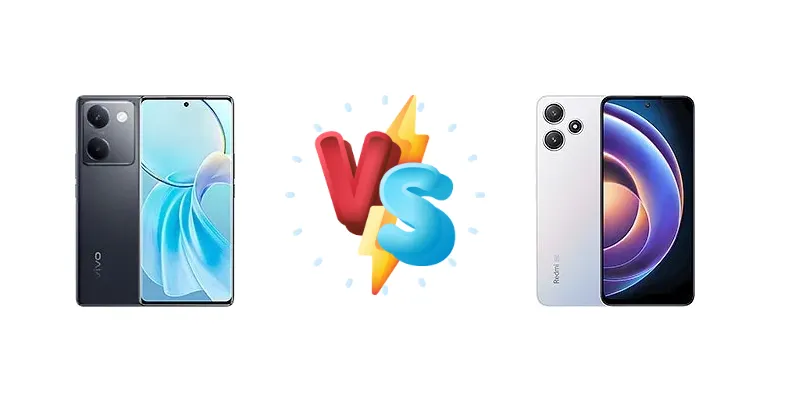
The sub-$200 smartphone market is fiercely competitive. The vivo Y300 Plus and Xiaomi Redmi Note 12R both aim for the sweet spot of affordability and functionality, but they take different approaches. The Y300 Plus leverages the Snapdragon 695 5G for connectivity, while the Redmi Note 12R opts for the newer, more efficient Snapdragon 4 Gen 2. This comparison dissects these choices and determines which phone delivers the best value.
🏆 Quick Verdict
For users prioritizing 5G connectivity and faster charging, the vivo Y300 Plus is the better choice. However, the Xiaomi Redmi Note 12R’s more modern 4nm process offers improved efficiency and potentially better sustained performance for everyday tasks, making it a strong contender for those less concerned with 5G.
| Network |
|---|
| 2G bands | GSM 850 / 900 / 1800 / 1900 | GSM 850 / 900 / 1800 / 1900 |
| 3G bands | HSDPA 850 / 900 / 2100 | HSDPA 850 / 900 / 2100 |
| 4G bands | 1, 3, 5, 8, 28, 38, 40, 41 | 1, 3, 5, 8, 34, 38, 39, 40, 41 |
| 5G bands | 1, 3, 5, 8, 28, 77, 78 SA/NSA | 1, 5, 8, 28, 41, 78 SA/NSA |
| Speed | HSPA, LTE, 5G | HSPA, LTE, 5G |
| Technology | GSM / HSPA / LTE / 5G | GSM / CDMA / HSPA / EVDO / LTE / 5G |
| Launch |
|---|
| Announced | 2024, October 16 | 2023, June 28 |
| Status | Available. Released 2024, October 16 | Available. Released 2023, June 28 |
| Body |
|---|
| Build | Glass front, plastic back or glass back, plastic frame | Glass front, plastic frame, glass back |
| Dimensions | 164.4 x 74.9 x 7.5 mm (6.47 x 2.95 x 0.30 in) | 168.6 x 76.3 x 8.2 mm (6.64 x 3.00 x 0.32 in) |
| SIM | Nano-SIM + Nano-SIM | Nano-SIM + Nano-SIM |
| Weight | 172 g or 183 g (6.07 oz) | 199 g (7.02 oz) |
| Display |
|---|
| Resolution | 1080 x 2400 pixels, 20:9 ratio (~388 ppi density) | 1080 x 2460 pixels (~396 ppi density) |
| Size | 6.78 inches, 111.0 cm2 (~90.1% screen-to-body ratio) | 6.79 inches, 109.5 cm2 (~85.1% screen-to-body ratio) |
| Type | AMOLED, 120Hz, 1300 nits (peak) | IPS LCD, 90Hz, 550 nits |
| Platform |
|---|
| CPU | Octa-core (2x2.2 GHz Kryo 660 Gold & 6x1.8 GHz Kryo 660 Silver) | Octa-core (2x2.2 GHz Cortex-A78 & 6x1.95 GHz Cortex-A55) |
| Chipset | Qualcomm SM6375 Snapdragon 695 5G (6 nm) | Qualcomm SM4450 Snapdragon 4 Gen 2 (4 nm) |
| GPU | Adreno 619 | Adreno 613 |
| OS | Android 14, Funtouch 14 | Android 13, MIUI 14 |
| Memory |
|---|
| Card slot | No | microSDXC (uses shared SIM slot) |
| Internal | 128GB 8GB RAM | 128GB 4GB RAM, 128GB 6GB RAM, 128GB 8GB RAM, 256GB 8GB RAM |
| Main Camera |
|---|
| Dual | 50 MP, f/1.8, (wide), PDAF
Auxiliary lens | 50 MP, f/1.8, (wide), PDAF
2 MP (macro) |
| Features | LED flash, HDR, panorama | LED flash, HDR |
| Video | 1080p@30fps | 1080p@30fps |
| Selfie camera |
|---|
| Features | - | HDR |
| Single | 32 MP, f/2.5, (wide) | 5 MP, f/2.2, (wide), 1/5.0", 1.12µm |
| Video | 1080p@30fps | 1080p@30fps |
| Sound |
|---|
| 35mm jack | No | Yes |
| Loudspeaker | Yes | Yes |
| Comms |
|---|
| Bluetooth | 5.1, A2DP, LE | 5.3, A2DP, LE |
| Infrared port | - | Yes |
| NFC | No | Yes (market/region dependent) |
| Positioning | GPS, GLONASS, GALILEO, BDS, QZSS, NavIC | GPS, GLONASS, GALILEO, BDS |
| Radio | Unspecified | No |
| USB | USB Type-C, OTG | USB Type-C |
| WLAN | Wi-Fi 802.11 a/b/g/n/ac, dual-band | Wi-Fi 802.11 a/b/g/n/ac, dual-band |
| Features |
|---|
| Sensors | Fingerprint (under display, optical), accelerometer, gyro, proximity, compass | Fingerprint (side-mounted), accelerometer, compass |
| Battery |
|---|
| Charging | 44W wired
Reverse wired | 18W wired, PD |
| Type | 5000 mAh | Li-Po 5000 mAh |
| Misc |
|---|
| Colors | Silk black, Silk green | Black, Blue, Silver |
| Models | V2422 | 23076RA4BC |
| Price | About 260 EUR | About 150 EUR |
| SAR | 0.95 W/kg (head) 0.91 W/kg (body) | - |
vivo Y300 Plus
- Faster 44W charging for quick top-ups
- 5G connectivity for faster data speeds
- Potentially better performance in short bursts due to higher peak power
- Less power-efficient 6nm process
- May experience more thermal throttling under sustained load
- 5G connectivity drains battery faster
Xiaomi Redmi Note 12R
- More power-efficient 4nm process for longer battery life
- Potentially better sustained performance due to improved thermal management
- PD support for wider charger compatibility
- Slower 18W charging
- Lacks 5G connectivity
- GPU is slightly less powerful (Adreno 613 vs 619)
Display Comparison
Neither device boasts a standout display. Given the context data focuses on chipsets, we can infer both likely utilize LCD panels common in this price bracket. The absence of details like refresh rate or resolution suggests a focus on cost-effectiveness. Bezels are likely comparable, and color accuracy will be standard for the segment. The real difference will come down to panel quality control, which is difficult to assess without direct testing.
Camera Comparison
Without detailed camera specs, it’s difficult to make a definitive judgment. Both phones likely feature a multi-camera setup with a primary sensor, but the quality will depend on sensor size, aperture, and image processing algorithms. Given the price point, we can expect both to struggle in low-light conditions. The absence of OIS on either device suggests reliance on software stabilization. The Redmi Note 12R’s image processing might lean towards more saturated colors, typical of Xiaomi’s style, while vivo often aims for more natural tones.
Performance
The core difference lies in the chipsets. The vivo Y300 Plus’s Snapdragon 695 (6nm) features a Kryo 660-based octa-core CPU with a peak clock speed of 2.2 GHz. This is paired with an Adreno 619 GPU. The Redmi Note 12R, however, uses the Snapdragon 4 Gen 2 (4nm) with a Cortex-A78 based octa-core CPU, also peaking at 2.2 GHz, and an Adreno 613 GPU. While peak CPU speeds are similar, the Snapdragon 4 Gen 2’s 4nm process offers a significant advantage in power efficiency. This translates to less heat generation and potentially more sustained performance under load. The 6nm Snapdragon 695 prioritizes 5G connectivity, which inherently consumes more power. The Redmi Note 12R’s CPU architecture (Cortex-A78) is also generally more efficient than the Kryo 660 Gold cores found in the Y300 Plus.
Battery Life
The battery capacity isn’t specified, but the charging wattage is a key differentiator. The vivo Y300 Plus’s 44W wired charging is significantly faster than the Redmi Note 12R’s 18W wired charging with PD. This means the Y300 Plus can replenish its battery much quicker, even if the battery capacity is slightly smaller. The Redmi Note 12R’s 4nm chipset should contribute to better battery life during typical usage, but the Y300 Plus’s faster charging could offset this advantage for users who frequently need to top up their phones.
Buying Guide
Buy the vivo Y300 Plus if you need 5G connectivity for faster data speeds and rely on quick top-ups with its 44W charging. This phone suits users who frequently stream, download, or travel in areas with 5G coverage. Buy the Xiaomi Redmi Note 12R if you prioritize battery life and sustained performance for everyday tasks like social media, browsing, and light gaming, and are content with 4G connectivity. It’s ideal for users who want a reliable, efficient device without the premium of 5G.
Frequently Asked Questions
❓ Will the Snapdragon 695 in the vivo Y300 Plus overheat during extended gaming sessions?
The Snapdragon 695, while capable, is known to throttle under sustained load due to its 6nm process. Expect performance dips after 30-45 minutes of demanding games. The Redmi Note 12R’s 4nm Snapdragon 4 Gen 2 is likely to maintain more consistent performance over longer periods.
❓ How much faster is the 44W charging on the vivo Y300 Plus compared to the 18W charging on the Redmi Note 12R?
The 44W charging on the Y300 Plus can potentially charge the phone from 0-100% in around 60-75 minutes, depending on battery capacity. The Redmi Note 12R’s 18W charging will likely take 120-150 minutes for a full charge. This difference is significant for users who need a quick power boost.
❓ Does the lack of 5G on the Redmi Note 12R significantly impact the user experience?
For most users, the lack of 5G isn't a dealbreaker. 4G LTE remains widely available and provides sufficient speeds for most tasks. 5G is most beneficial in areas with strong 5G coverage and for users who frequently download large files or stream high-resolution video.