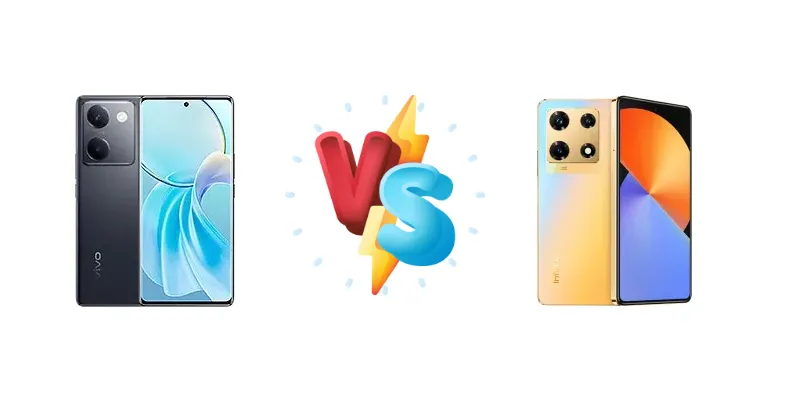
The sub-$250 smartphone market is fiercely competitive, and the vivo Y300 Plus and Infinix Note 30 Pro are two contenders vying for your attention. The Y300 Plus leverages Qualcomm's 5G connectivity with the Snapdragon 695, while the Note 30 Pro opts for MediaTek's Helio G99, prioritizing raw processing power. This comparison dissects their key differences to determine which device delivers the best overall experience.
🏆 Quick Verdict
For the average user prioritizing fast charging and a slightly more versatile feature set, the Infinix Note 30 Pro emerges as the winner. Its 68W charging, coupled with wireless charging capabilities, significantly reduces downtime. However, the vivo Y300 Plus remains a strong contender for those specifically needing 5G connectivity from Qualcomm.
| Network |
|---|
| 2G bands | GSM 850 / 900 / 1800 / 1900 | GSM 850 / 900 / 1800 / 1900 |
| 3G bands | HSDPA 850 / 900 / 2100 | HSDPA 850 / 900 / 1700(AWS) / 1900 / 2100 |
| 4G bands | 1, 3, 5, 8, 28, 38, 40, 41 | 1, 2, 3, 4, 5, 7, 8, 12, 17, 20, 28, 38, 40, 41, 66 |
| 5G bands | 1, 3, 5, 8, 28, 77, 78 SA/NSA | - |
| Speed | HSPA, LTE, 5G | HSPA, LTE |
| Technology | GSM / HSPA / LTE / 5G | GSM / HSPA / LTE |
| Launch |
|---|
| Announced | 2024, October 16 | 2023, May 22 |
| Status | Available. Released 2024, October 16 | Available. Released 2023, May 22 |
| Body |
|---|
| Build | Glass front, plastic back or glass back, plastic frame | Glass front, plastic frame, glass back |
| Dimensions | 164.4 x 74.9 x 7.5 mm (6.47 x 2.95 x 0.30 in) | 162.7 x 76 x 8.2 mm (6.41 x 2.99 x 0.32 in) |
| SIM | Nano-SIM + Nano-SIM | Nano-SIM + Nano-SIM |
| Weight | 172 g or 183 g (6.07 oz) | 203 g (7.16 oz) |
| | - | IP53 |
| Display |
|---|
| Resolution | 1080 x 2400 pixels, 20:9 ratio (~388 ppi density) | 1080 x 2400 pixels, 20:9 ratio (~395 ppi density) |
| Size | 6.78 inches, 111.0 cm2 (~90.1% screen-to-body ratio) | 6.67 inches, 107.4 cm2 (~86.9% screen-to-body ratio) |
| Type | AMOLED, 120Hz, 1300 nits (peak) | AMOLED, 1B colors, 120Hz, 900 nits (peak) |
| | - | * the display diagonal size and resolution is unconfirmed |
| Platform |
|---|
| CPU | Octa-core (2x2.2 GHz Kryo 660 Gold & 6x1.8 GHz Kryo 660 Silver) | Octa-core (2x2.2 GHz Cortex-A76 & 6x2.0 GHz Cortex-A55) |
| Chipset | Qualcomm SM6375 Snapdragon 695 5G (6 nm) | Mediatek Helio G99 (6 nm) |
| GPU | Adreno 619 | Mali-G57 MC2 |
| OS | Android 14, Funtouch 14 | Android 13, XOS 13 |
| Memory |
|---|
| Card slot | No | microSDXC (dedicated slot) |
| Internal | 128GB 8GB RAM | 256GB 8GB RAM |
| Main Camera |
|---|
| Dual | 50 MP, f/1.8, (wide), PDAF
Auxiliary lens | - |
| Features | LED flash, HDR, panorama | Quad-LED flash, HDR, panorama |
| Triple | - | 108 MP, (wide), 1/1.67", PDAF
2 MP (macro)
Auxiliary lens |
| Video | 1080p@30fps | 1440p@30fps, 1080p@30fps |
| Selfie camera |
|---|
| Features | - | LED flash, HDR |
| Single | 32 MP, f/2.5, (wide) | 32 MP, f/2.0, (wide), 1/2.8" |
| Video | 1080p@30fps | 1080p@30fps |
| Sound |
|---|
| 3.5mm jack | - | Yes |
| 35mm jack | No | Yes |
| Loudspeaker | Yes | Yes, with dual speakers |
| | - | Sound by JBL
24-bit/192kHz audio |
| Comms |
|---|
| Bluetooth | 5.1, A2DP, LE | Yes |
| NFC | No | Yes (market/region dependent) |
| Positioning | GPS, GLONASS, GALILEO, BDS, QZSS, NavIC | GPS |
| Radio | Unspecified | FM radio |
| USB | USB Type-C, OTG | USB Type-C 2.0, OTG |
| WLAN | Wi-Fi 802.11 a/b/g/n/ac, dual-band | Wi-Fi 802.11 a/b/g/n/ac, dual-band, Wi-Fi Direct |
| Features |
|---|
| Sensors | Fingerprint (under display, optical), accelerometer, gyro, proximity, compass | Fingerprint (side-mounted), accelerometer, gyro, proximity, compass |
| Battery |
|---|
| Charging | 44W wired
Reverse wired | 68W wired, PD3.0, 80% in 30 min
15W wireless
Reverse wireless |
| Type | 5000 mAh | 5000 mAh |
| Misc |
|---|
| Colors | Silk black, Silk green | Magic Black, Variable Gold |
| Models | V2422 | X678B |
| Price | About 260 EUR | - |
| SAR | 0.95 W/kg (head) 0.91 W/kg (body) | - |
vivo Y300 Plus
- Qualcomm 5G modem for reliable connectivity
- Potentially cleaner software experience (typical of vivo)
- Efficient Snapdragon 695 chipset
- Slower charging speed (44W)
- No wireless charging support
- Potentially less powerful CPU compared to Helio G99
Infinix Note 30 Pro
- Faster 68W wired charging with PD3.0
- 15W wireless charging and reverse wireless charging
- More powerful CPU (Helio G99 Cortex-A76 cores)
- Relies on MediaTek's 5G implementation (potentially less robust)
- Software experience may include more bloatware (typical of Infinix)
- Potential for more aggressive thermal throttling under sustained load
Display Comparison
Neither device boasts a flagship-level display, but both utilize 6nm chipsets which suggests a focus on efficiency. Specific display specs (resolution, panel type, refresh rate) are missing, but given the price point, we can assume both are FHD+ LCD panels. The key differentiator will likely be color accuracy and peak brightness. The Note 30 Pro's potential for higher peak brightness, common in MediaTek-powered devices, could offer better outdoor visibility. Bezels are expected to be similar, reflecting the budget nature of both phones.
Camera Comparison
Detailed camera specs are unavailable, but both phones likely feature a multi-camera setup with a primary sensor, ultrawide, and potentially a macro lens. The image processing style will likely differ – vivo typically leans towards vibrant, saturated colors, while Infinix often aims for a more natural look. Sensor size is crucial; a larger sensor on either device will capture more light, resulting in better low-light performance. The presence (or absence) of Optical Image Stabilization (OIS) on the main sensor will also be a key differentiator, favoring the device that includes it.
Performance
The core difference lies in the chipsets. The Qualcomm Snapdragon 695 (6nm) in the Y300 Plus features a Kryo 660 CPU with a 2x2.2 GHz Gold and 6x1.8 GHz Silver configuration. The Infinix Note 30 Pro utilizes the MediaTek Helio G99 (6nm) with a 2x2.2 GHz Cortex-A76 and 6x2.0 GHz Cortex-A55 setup. While clock speeds are similar, the Cortex-A76 cores in the Helio G99 generally offer a performance edge over the Kryo 660 Gold cores in CPU-intensive tasks. However, the Snapdragon 695 benefits from Qualcomm's integrated 5G modem, a significant advantage for users in 5G-covered areas. Both devices likely pair their chipsets with similar amounts of RAM, but LPDDR5x support would be a significant advantage for the Note 30 Pro, improving memory bandwidth.
Battery Life
The Infinix Note 30 Pro takes a clear lead in charging speed with its 68W wired charging, capable of reaching 80% charge in just 30 minutes. It also adds 15W wireless charging and reverse wireless charging, features absent on the vivo Y300 Plus, which is limited to 44W wired and reverse wired charging. While battery capacity isn't specified, the faster charging and wireless options on the Note 30 Pro offer a more convenient user experience, mitigating the impact of a potentially smaller battery size.
Buying Guide
Buy the vivo Y300 Plus if you need reliable 5G connectivity from Qualcomm's Snapdragon platform and prioritize a clean, streamlined software experience. Buy the Infinix Note 30 Pro if you prefer faster charging speeds, the convenience of wireless charging, and a more feature-rich package, even if it means foregoing Qualcomm's 5G modem.
Frequently Asked Questions
❓ Does the MediaTek Helio G99 in the Infinix Note 30 Pro tend to overheat during prolonged gaming sessions?
The Helio G99 is known to be a capable processor, but it can be prone to thermal throttling under sustained heavy load. Infinix likely implements thermal management solutions, but users should expect some performance reduction during extended gaming. The Snapdragon 695 in the Y300 Plus is generally more thermally efficient, potentially offering more consistent performance over longer periods.
❓ Is the 44W charging on the vivo Y300 Plus sufficient for daily use, or is the 68W on the Note 30 Pro a significant upgrade?
While 44W charging is adequate, the 68W charging on the Infinix Note 30 Pro is a substantial improvement. The Note 30 Pro can reach 80% charge in 30 minutes, significantly reducing downtime. For users who frequently need to top up their battery quickly, the 68W charging is a major benefit.
❓ How does the 5G performance of the Snapdragon 695 compare to the 5G implementation in the Helio G99?
Qualcomm's Snapdragon modems are generally regarded as having more mature and reliable 5G connectivity compared to MediaTek's. The Snapdragon 695 offers broader 5G band support and potentially more stable connections, especially in areas with less-developed 5G infrastructure. If consistent 5G performance is a priority, the Y300 Plus has an edge.
❓ Does either phone support expandable storage via microSD card?
This information is not provided in the context data. However, given the budget nature of both devices, it's highly probable that both the vivo Y300 Plus and the Infinix Note 30 Pro support microSD card expansion for increased storage capacity. Checking official specifications is recommended.