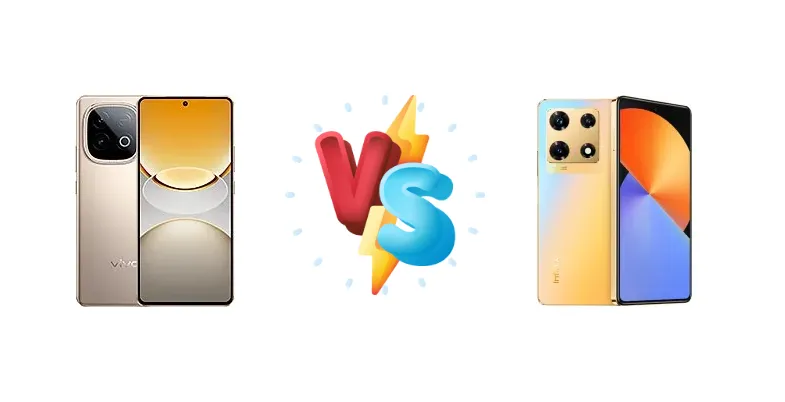
The mid-range smartphone market is fiercely competitive, and the vivo Y300 GT and Infinix Note 30 Pro represent compelling options for users seeking a balance of performance and affordability. However, they take drastically different approaches: the Y300 GT prioritizes raw processing power with the Dimensity 8400, while the Note 30 Pro focuses on efficiency and versatile charging with the Helio G99. This comparison will dissect these choices to determine which device best suits your needs.
🏆 Quick Verdict
For users prioritizing demanding tasks like gaming and video editing, the vivo Y300 GT is the clear winner thanks to its significantly more powerful Dimensity 8400 chipset. However, the Infinix Note 30 Pro offers a more well-rounded package with wireless charging, reverse wireless charging, and a more efficient processor for everyday use.
| Network |
|---|
| 2G bands | GSM 850 / 900 / 1800 / 1900 | GSM 850 / 900 / 1800 / 1900 |
| 3G bands | HSDPA 800 / 850 / 900 / 2100 | HSDPA 850 / 900 / 1700(AWS) / 1900 / 2100 |
| 4G bands | 1, 3, 5, 8, 19, 28, 34, 38, 39, 40, 41, 42, 48 | 1, 2, 3, 4, 5, 7, 8, 12, 17, 20, 28, 38, 40, 41, 66 |
| 5G bands | 1, 3, 5, 8, 28, 34, 38, 39, 40, 41, 48, 77, 78 SA/NSA | - |
| Speed | HSPA, LTE, 5G | HSPA, LTE |
| Technology | GSM / HSPA / LTE / 5G | GSM / HSPA / LTE |
| Launch |
|---|
| Announced | 2025, May 09 | 2023, May 22 |
| Status | Available. Released 2025, May 09 | Available. Released 2023, May 22 |
| Body |
|---|
| Build | Glass front, plastic back, plastic frame | Glass front, plastic frame, glass back |
| Dimensions | 163.7 x 75.9 x 8.1 mm (6.44 x 2.99 x 0.32 in) | 162.7 x 76 x 8.2 mm (6.41 x 2.99 x 0.32 in) |
| SIM | Nano-SIM + Nano-SIM | Nano-SIM + Nano-SIM |
| Weight | 212 g (7.48 oz) | 203 g (7.16 oz) |
| | - | IP53 |
| Display |
|---|
| Resolution | 1260 x 2800 pixels, 20:9 ratio (~453 ppi density) | 1080 x 2400 pixels, 20:9 ratio (~395 ppi density) |
| Size | 6.78 inches, 111.0 cm2 (~89.3% screen-to-body ratio) | 6.67 inches, 107.4 cm2 (~86.9% screen-to-body ratio) |
| Type | AMOLED, 1B colors, 144Hz, HDR, 5500 nits (peak) | AMOLED, 1B colors, 120Hz, 900 nits (peak) |
| | - | * the display diagonal size and resolution is unconfirmed |
| Platform |
|---|
| CPU | Octa-core (1x3.25 GHz Cortex-A725 & 3x3.0 GHz Cortex-A725 & 4x2.1 GHz Cortex-A725) | Octa-core (2x2.2 GHz Cortex-A76 & 6x2.0 GHz Cortex-A55) |
| Chipset | Mediatek Dimensity 8400 (4 nm) | Mediatek Helio G99 (6 nm) |
| GPU | G720 MC7 | Mali-G57 MC2 |
| OS | Android 15, OriginOS 5 | Android 13, XOS 13 |
| Memory |
|---|
| Card slot | No | microSDXC (dedicated slot) |
| Internal | 256GB 8GB RAM, 256GB 12GB RAM, 512GB 12GB RAM | 256GB 8GB RAM |
| Main Camera |
|---|
| Dual | 50 MP, f/1.8, (wide), 1/1.95", 0.8µm, PDAF, OIS
Auxiliary lens | - |
| Features | Color spectrum sensor, LED flash, HDR, panorama | Quad-LED flash, HDR, panorama |
| Triple | - | 108 MP, (wide), 1/1.67", PDAF
2 MP (macro)
Auxiliary lens |
| Video | 4K, 1080p, gyro-EIS, OIS | 1440p@30fps, 1080p@30fps |
| Selfie camera |
|---|
| Features | - | LED flash, HDR |
| Single | 16 MP, f/2.5, (wide), 1/3.0", 1.0µm | 32 MP, f/2.0, (wide), 1/2.8" |
| Video | 1080p@30fps, gyro-EIS | 1080p@30fps |
| Sound |
|---|
| 3.5mm jack | - | Yes |
| 35mm jack | No | Yes |
| Loudspeaker | Yes, with stereo speakers | Yes, with dual speakers |
| | - | Sound by JBL
24-bit/192kHz audio |
| Comms |
|---|
| Bluetooth | 5.4, A2DP, LE, aptX HD | Yes |
| Infrared port | Yes | - |
| NFC | Yes | Yes (market/region dependent) |
| Positioning | GPS (L1+L5), BDS (B1I+B1C+B2a), GALILEO (E1+E5a), QZSS (L1+L5), NavIC (L5), GLONASS | GPS |
| Radio | No | FM radio |
| USB | USB Type-C 2.0, OTG | USB Type-C 2.0, OTG |
| WLAN | Wi-Fi 802.11 a/b/g/n/ac/6, dual-band | Wi-Fi 802.11 a/b/g/n/ac, dual-band, Wi-Fi Direct |
| Features |
|---|
| Sensors | Fingerprint (under display, optical), accelerometer, gyro, proximity, compass | Fingerprint (side-mounted), accelerometer, gyro, proximity, compass |
| Battery |
|---|
| Charging | 90W wired, 100% in 55 min
Reverse wired | 68W wired, PD3.0, 80% in 30 min
15W wireless
Reverse wireless |
| Type | Si/C Li-Ion 7620 mAh | 5000 mAh |
| Misc |
|---|
| Colors | Black, Gold | Magic Black, Variable Gold |
| Models | V2452GA | X678B |
| Price | About 250 EUR | - |
vivo Y300 GT
- Significantly faster processor (Dimensity 8400)
- Faster wired charging (90W)
- Potentially better gaming performance
- Likely shorter battery life due to power-hungry chipset
- No wireless or reverse wireless charging
Infinix Note 30 Pro
- Wireless and reverse wireless charging
- More power-efficient processor (Helio G99)
- Potentially longer battery life
- Significantly slower processor
- Slower wired charging (68W)
Display Comparison
Neither device's display specifications are provided, so a direct comparison is limited. However, given the Y300 GT's focus on performance, it's reasonable to expect a higher refresh rate panel geared towards gaming. The Note 30 Pro, with its emphasis on efficiency, might prioritize power-saving display technology. Bezels and color accuracy will likely be comparable within this price bracket, but the Y300 GT may have a slightly brighter panel to complement its gaming focus.
Camera Comparison
Without detailed camera specifications, a precise comparison is difficult. However, the chipset difference suggests the Y300 GT will have a more powerful ISP (Image Signal Processor) capable of faster image processing and potentially better low-light performance. The Note 30 Pro’s Helio G99 will still be capable of taking decent photos, but it won’t match the Y300 GT’s potential for detail and dynamic range. We can assume both phones will include standard features like portrait mode and night mode, but the Y300 GT is likely to offer more advanced computational photography features.
Performance
The performance gap between these two devices is substantial. The vivo Y300 GT’s Mediatek Dimensity 8400 (4nm) boasts a Cortex-A725-heavy core configuration, offering significantly higher CPU and GPU performance than the Infinix Note 30 Pro’s Helio G99 (6nm). The Dimensity 8400’s 3.25 GHz peak clock speed and advanced architecture will translate to faster app loading times, smoother multitasking, and a far superior gaming experience. While the Helio G99’s 6nm process is more efficient, it simply cannot compete with the raw power of the Dimensity 8400. The Y300 GT is likely paired with faster LPDDR5x RAM, further widening the performance advantage.
Battery Life
The Infinix Note 30 Pro’s 68W wired charging, achieving 80% charge in 30 minutes, is respectable, but the vivo Y300 GT’s 90W wired charging, reaching 100% in 55 minutes, is significantly faster. The Note 30 Pro’s inclusion of 15W wireless charging and reverse wireless charging provides added convenience, features absent on the Y300 GT. While battery capacity isn't specified, the Helio G99’s efficiency should result in comparable or even slightly better battery life despite potentially having a smaller battery than the Y300 GT, which will consume more power due to its more powerful processor.
Buying Guide
Buy the vivo Y300 GT if you need uncompromising performance for gaming, content creation, or multitasking. Its Dimensity 8400 will handle anything you throw at it. Buy the Infinix Note 30 Pro if you prioritize battery life, versatile charging options (including wireless and reverse wireless), and a smoother experience for everyday tasks like browsing and social media. It's the better choice for users who don't need the absolute fastest processor.
Frequently Asked Questions
❓ Will the Dimensity 8400 in the vivo Y300 GT overheat during extended gaming sessions?
While the Dimensity 8400 is a powerful chip, its 4nm process helps mitigate heat generation. However, sustained high loads will inevitably produce heat. The Y300 GT's thermal management system will be crucial; look for reviews that specifically test gaming thermals to determine if throttling occurs.
❓ Is the 15W wireless charging on the Infinix Note 30 Pro fast enough for daily use?
15W wireless charging is relatively slow compared to wired charging, but it's convenient for overnight top-ups. It's best suited for users who don't need extremely fast charging and prefer the convenience of simply placing their phone on a charging pad.
❓ Does the Helio G99 in the Infinix Note 30 Pro support high frame rates in demanding games like PUBG?
The Helio G99 can run PUBG Mobile, but you'll likely need to lower the graphics settings to achieve consistently smooth frame rates. Don't expect to max out the settings and maintain 60fps; it's geared towards medium settings for a playable experience.
❓ Can the Infinix Note 30 Pro charge other devices using its reverse wireless charging feature?
Yes, the Infinix Note 30 Pro supports reverse wireless charging, allowing you to wirelessly charge compatible devices like earbuds or smartwatches. However, the charging speed is limited to 15W, so it's best for smaller devices and emergency top-ups.