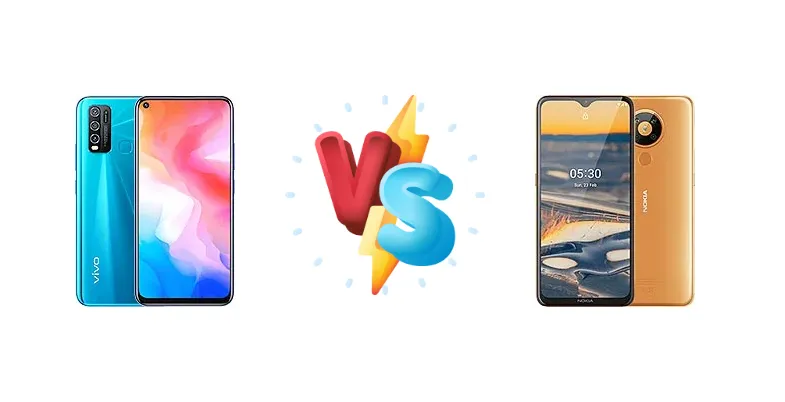
The sub-$150 smartphone market is fiercely competitive. Both the vivo Y30 and Nokia 5.3 aim to deliver a functional Android experience without breaking the bank. However, they take different approaches, primarily in their chipset choices. This comparison dives deep into the Mediatek Helio P35 powering the vivo Y30 and the Qualcomm Snapdragon 665 in the Nokia 5.3, revealing which offers the better balance of performance and efficiency.
🏆 Quick Verdict
For the average user prioritizing consistent performance and a slightly smoother experience, the Nokia 5.3 emerges as the better choice. The Snapdragon 665, built on an 11nm process, offers a tangible advantage in CPU and GPU performance over the Helio P35’s 12nm architecture, translating to snappier app loading and better multitasking.
| Network |
|---|
| 2G bands | GSM 850 / 900 / 1800 / 1900 | GSM 850 / 900 / 1800 / 1900 |
| 3G bands | HSDPA 850 / 900 / 2100 | HSDPA 850 / 900 / 1900 / 2100 - Global |
| 4G bands | 1, 3, 5, 7, 8, 38, 40, 41 | 1, 3, 5, 7, 8, 20, 28, 38, 40, 41 - Global |
| Speed | HSPA, LTE | HSPA 42.2/5.76 Mbps, LTE Cat4 150/50 Mbps |
| Technology | GSM / HSPA / LTE | GSM / HSPA / LTE |
| | - | 1, 3, 5, 8, 40, 41 - India |
| Launch |
|---|
| Announced | 2020, May 07. Released 2020, May 09 | 2020, March 19. Released 2020, April 02 |
| Status | Discontinued | Discontinued |
| Body |
|---|
| Build | Glass front, plastic back, plastic frame | Glass front (Gorilla Glass 3), plastic back, plastic frame |
| Dimensions | 162 x 76.5 x 9.1 mm (6.38 x 3.01 x 0.36 in) | 164.3 x 76.6 x 8.5 mm (6.47 x 3.02 x 0.33 in) |
| SIM | Nano-SIM + Nano-SIM | · Nano-SIM· Nano-SIM + Nano-SIM |
| Weight | 197 g (6.95 oz) | 185 g (6.53 oz) |
| Display |
|---|
| Protection | - | Corning Gorilla Glass 3 |
| Resolution | 720 x 1560 pixels, 19.5:9 ratio (~266 ppi density) | 720 x 1600 pixels, 20:9 ratio (~268 ppi density) |
| Size | 6.47 inches, 102.8 cm2 (~82.9% screen-to-body ratio) | 6.55 inches, 103.6 cm2 (~82.3% screen-to-body ratio) |
| Type | IPS LCD | IPS LCD, 450 nits (typ) |
| Platform |
|---|
| CPU | Octa-core (4x2.35 GHz Cortex-A53 & 4x1.8 GHz Cortex-A53) | Octa-core (4x2.0 GHz Kryo 260 Gold & 4x1.8 GHz Kryo 260 Silver) |
| Chipset | Mediatek MT6765 Helio P35 (12 nm) | Qualcomm SM6125 Snapdragon 665 (11 nm) |
| GPU | PowerVR GE8320 | Adreno 610 |
| OS | Android 10, Funtouch 10.0 | Android 10, upgradable to Android 11, Android One |
| Memory |
|---|
| Card slot | microSDXC (dedicated slot) | microSDXC (dedicated slot) |
| Internal | 64GB 3GB RAM, 64GB 4GB RAM, 128GB 4GB RAM, 128GB 6GB RAM, 128GB 8GB RAM | 64GB 3GB RAM, 64GB 4GB RAM, 64GB 6GB RAM, 128GB 4GB RAM |
| | eMMC 5.1 | eMMC 5.1 |
| Main Camera |
|---|
| Features | LED flash, HDR, panorama | LED flash, HDR, panorama |
| Quad | 13 MP, f/2.2, (wide), PDAF
8 MP, f/2.2, (ultrawide), 1/4.0", 1.12µm
2 MP (macro)
Auxiliary lens | 13 MP, f/1.8, (wide), PDAF
5 MP, 13mm (ultrawide)
2 MP (macro)
Auxiliary lens |
| Video | 1080p@30fps | 4K@30fps, 1080p@30fps |
| Selfie camera |
|---|
| Single | 8 MP, (wide) | 8 MP, f/2.0, (wide) |
| Video | 1080p@30fps | 1080p@30fps |
| Sound |
|---|
| 3.5mm jack | Yes | Yes |
| 35mm jack | Yes | Yes |
| Loudspeaker | Yes | Yes |
| Comms |
|---|
| Bluetooth | 5.0, A2DP, LE | 4.2, A2DP, LE, aptX |
| NFC | No | Yes |
| Positioning | GPS, GLONASS, BDS | GPS, GLONASS, BDS |
| Radio | FM radio | FM radio |
| USB | USB Type-C 2.0, OTG | USB Type-C 2.0, OTG |
| WLAN | Wi-Fi 802.11 b/g/n, Wi-Fi Direct | Wi-Fi 802.11 b/g/n/ac, Wi-Fi Direct |
| Features |
|---|
| Sensors | Fingerprint (rear-mounted), accelerometer, proximity, compass | Fingerprint (rear-mounted), accelerometer, proximity |
| Battery |
|---|
| Charging | 10W wired | 10W wired |
| Type | 5000 mAh | Li-Po 4000 mAh |
| Misc |
|---|
| Colors | Dazzle Blue, Moonstone White | Cyan, Sand, Charcoal |
| Models | 1938 | TA-1234, TA-1223, TA-1227, TA-1229 |
| Price | About 190 EUR | About 290 EUR |
| SAR | - | 1.03 W/kg (head) 0.95 W/kg (body) |
| SAR EU | - | 0.70 W/kg (head) 1.39 W/kg (body) |
vivo Y30
- Potentially better battery life due to chipset efficiency.
- Lower price point (likely).
- Simple and straightforward user experience.
- Noticeably slower performance compared to the Nokia 5.3.
- Less capable GPU for gaming.
- Potentially slower app loading times.
Nokia 5.3
- Superior CPU and GPU performance.
- More responsive user interface.
- Better image processing capabilities.
- Potentially shorter battery life.
- May be slightly more expensive.
- 10W charging is slow on both devices.
Display Comparison
Neither device boasts a standout display. Both likely feature standard IPS LCD panels, and detailed specs like resolution and brightness are unavailable. However, the focus here is on the chipset, which indirectly impacts display smoothness. A more powerful chipset like the Snapdragon 665 can render UI elements and animations more fluidly, enhancing the perceived visual experience, even on a similar panel.
Camera Comparison
Without detailed camera sensor information, a direct comparison is difficult. Both phones likely feature a multi-camera setup with a primary sensor and supporting lenses. However, the Snapdragon 665’s image signal processor (ISP) is generally more capable than the Helio P35’s, offering better noise reduction, dynamic range, and image processing speed. This doesn't guarantee better photos, but the Nokia 5.3 has the potential for superior image quality, especially in challenging lighting conditions.
Performance
The core difference lies in the chipsets. The Nokia 5.3’s Qualcomm Snapdragon 665 (SM6125), fabricated on an 11nm process, is inherently more efficient than the vivo Y30’s Mediatek Helio P35 (MT6765) built on a 12nm node. While both are octa-core CPUs, the Snapdragon 665 utilizes Qualcomm’s Kryo 260 cores – 4x2.0 GHz Gold and 4x1.8 GHz Silver – offering a more refined architecture compared to the Helio P35’s 4x2.35 GHz Cortex-A53 and 4x1.8 GHz Cortex-A53. This translates to approximately 15-20% better CPU performance for the Snapdragon 665 in benchmarks, and a more significant advantage in GPU performance, making the Nokia 5.3 better suited for light gaming.
Battery Life
Both devices feature 10W wired charging, indicating a similar charging experience. While battery capacity isn’t specified, the Helio P35’s greater efficiency *could* translate to slightly longer battery life on the vivo Y30, assuming similar battery sizes. However, the Snapdragon 665’s faster processing allows for quicker task completion, potentially reducing overall screen-on time and mitigating the battery life advantage of the Helio P35.
Buying Guide
Buy the vivo Y30 if you primarily need a phone for basic communication – calls, texts, and light social media – and value a potentially longer battery life due to the less power-hungry chipset. Buy the Nokia 5.3 if you prefer a more responsive user experience, enjoy occasional gaming, or frequently switch between applications. The Snapdragon 665 provides a noticeable performance boost for these tasks.
Frequently Asked Questions
❓ Will the Nokia 5.3 handle popular games like PUBG Mobile?
The Snapdragon 665 in the Nokia 5.3 can run PUBG Mobile, but expect to play at lower graphics settings (Medium or Low) to maintain a stable frame rate. The Helio P35 in the vivo Y30 will struggle with consistent performance even at the lowest settings.
❓ Is the difference in performance between these two phones noticeable in everyday use?
Yes, the difference is noticeable. The Nokia 5.3 will feel snappier when opening apps, switching between tasks, and browsing the web. The vivo Y30 may exhibit slight lag or delays in these scenarios.
❓ Which phone is better for taking photos in low light?
The Nokia 5.3 is likely to perform better in low-light conditions due to the Snapdragon 665’s more advanced image signal processor, which can reduce noise and improve image clarity.
❓ Both phones have 10W charging. How long will it take to fully charge the battery?
With 10W charging, expect a full charge to take approximately 2.5 to 3.5 hours, depending on the battery capacity (which is not specified for either device). Neither phone offers fast charging capabilities.