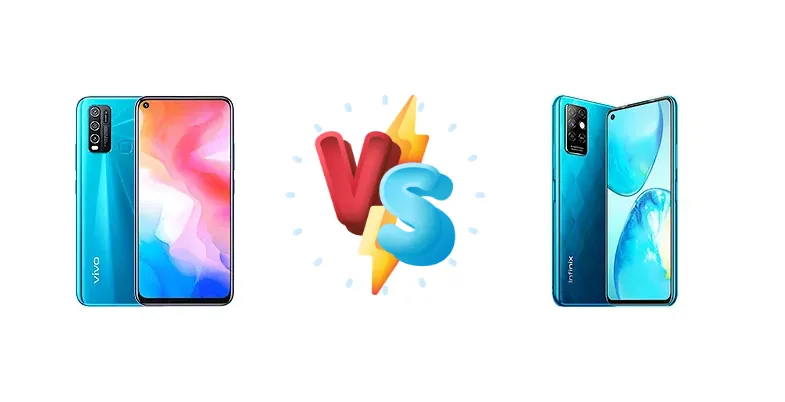
Both the vivo Y30 and the Infinix Note 8i target the ultra-budget smartphone market, but they approach it with different strategies. The Y30 prioritizes a familiar brand experience, while the Note 8i aims for a more aggressive performance-per-dollar ratio. This comparison dissects the core differences to help you choose the right device.
🏆 Quick Verdict
For most users, the Infinix Note 8i is the superior choice. Its Helio G80 chipset delivers noticeably faster performance than the vivo Y30’s Helio P35, and the 18W fast charging is a significant convenience. While the Y30 offers a reliable experience, the Note 8i provides more power for the price.
| Network |
|---|
| 2G bands | GSM 850 / 900 / 1800 / 1900 | GSM 850 / 900 / 1800 / 1900 |
| 3G bands | HSDPA 850 / 900 / 2100 | HSDPA 850 / 900 / 2100 |
| 4G bands | 1, 3, 5, 7, 8, 38, 40, 41 | 1, 3, 5, 7, 8, 20, 38, 40, 41 |
| Speed | HSPA, LTE | HSPA 42.2/5.76 Mbps, LTE Cat4 150/50 Mbps |
| Technology | GSM / HSPA / LTE | GSM / HSPA / LTE |
| | - | 1, 3, 7, 8, 20, 28 |
| Launch |
|---|
| Announced | 2020, May 07. Released 2020, May 09 | 2020, October 15. Released 2020, November 15 |
| Status | Discontinued | Discontinued |
| Body |
|---|
| Build | Glass front, plastic back, plastic frame | - |
| Dimensions | 162 x 76.5 x 9.1 mm (6.38 x 3.01 x 0.36 in) | 171.4 x 77.7 x 8.9 mm (6.75 x 3.06 x 0.35 in) |
| SIM | Nano-SIM + Nano-SIM | Nano-SIM + Nano-SIM |
| Weight | 197 g (6.95 oz) | - |
| Display |
|---|
| Protection | - | Corning Gorilla Glass |
| Resolution | 720 x 1560 pixels, 19.5:9 ratio (~266 ppi density) | 720 x 1640 pixels (~264 ppi density) |
| Size | 6.47 inches, 102.8 cm2 (~82.9% screen-to-body ratio) | 6.78 inches, 109.2 cm2 (~82.0% screen-to-body ratio) |
| Type | IPS LCD | IPS LCD, 480 nits (peak) |
| Platform |
|---|
| CPU | Octa-core (4x2.35 GHz Cortex-A53 & 4x1.8 GHz Cortex-A53) | Octa-core (2x2.0 GHz Cortex-A75 & 6x1.8 GHz Cortex-A55) |
| Chipset | Mediatek MT6765 Helio P35 (12 nm) | Mediatek MT6769V/CU Helio G80 (12 nm) |
| GPU | PowerVR GE8320 | Mali-G52 MC2 |
| OS | Android 10, Funtouch 10.0 | Android 10, XOS 7.1 |
| Memory |
|---|
| Card slot | microSDXC (dedicated slot) | microSDXC (dedicated slot) |
| Internal | 64GB 3GB RAM, 64GB 4GB RAM, 128GB 4GB RAM, 128GB 6GB RAM, 128GB 8GB RAM | 64GB 4GB RAM, 128GB 4GB RAM, 128GB 6GB RAM |
| | eMMC 5.1 | - |
| Main Camera |
|---|
| Features | LED flash, HDR, panorama | Quad-LED flash, HDR, panorama |
| Quad | 13 MP, f/2.2, (wide), PDAF
8 MP, f/2.2, (ultrawide), 1/4.0", 1.12µm
2 MP (macro)
Auxiliary lens | 48 MP, (wide), 1/2.0", 0.8µm, PDAF
2 MP (macro)
Auxiliary lenses |
| Video | 1080p@30fps | 1440p@30fps |
| Selfie camera |
|---|
| Features | - | Dual-LED flash |
| Single | 8 MP, (wide) | 8 MP |
| Video | 1080p@30fps | 1080p@30fps |
| Sound |
|---|
| 3.5mm jack | Yes | Yes |
| 35mm jack | Yes | Yes |
| Loudspeaker | Yes | Yes |
| Comms |
|---|
| Bluetooth | 5.0, A2DP, LE | 5.0, A2DP, LE |
| NFC | No | No |
| Positioning | GPS, GLONASS, BDS | GPS |
| Radio | FM radio | FM radio |
| USB | USB Type-C 2.0, OTG | USB Type-C 2.0, OTG |
| WLAN | Wi-Fi 802.11 b/g/n, Wi-Fi Direct | Wi-Fi 802.11 a/b/g/n/ac, dual-band, Wi-Fi Direct |
| Features |
|---|
| Sensors | Fingerprint (rear-mounted), accelerometer, proximity, compass | Fingerprint (side-mounted), accelerometer, proximity, compass |
| Battery |
|---|
| Charging | 10W wired | 18W wired |
| Type | 5000 mAh | 5200 mAh |
| Misc |
|---|
| Colors | Dazzle Blue, Moonstone White | Gray, Blue, Green |
| Models | 1938 | X683, X683B |
| Price | About 190 EUR | About 150 EUR |
vivo Y30
- Familiar Brand Reputation
- Simple and User-Friendly Interface
- Reliable Basic Functionality
- Outdated Helio P35 Chipset
- Slow 10W Charging
- Limited Gaming Performance
Infinix Note 8i
- Powerful Helio G80 Chipset
- Fast 18W Charging
- Better Gaming Capabilities
- Less Established Brand
- Potentially More Bloatware
- May Lack Some Refinements of Established Brands
Display Comparison
Neither device boasts a standout display. Both likely utilize LCD panels, common in this price bracket. The focus here isn't on panel technology, but rather on the underlying processing power to drive the display smoothly. While specific resolution and brightness data are unavailable, the more powerful GPU in the Note 8i will contribute to a more responsive visual experience, especially during scrolling and animations.
Camera Comparison
Without detailed camera specs, a direct comparison is difficult. However, the processing capabilities of the Helio G80 in the Note 8i will likely result in better image processing, particularly in low-light conditions. The ISP (Image Signal Processor) within the G80 is more advanced, allowing for more effective noise reduction and dynamic range optimization. While both phones likely feature a primary camera and several auxiliary lenses (often 2MP macro/depth sensors of limited utility), the G80’s superior processing power will give it an edge in overall image quality.
Performance
The core difference lies in the chipsets. The Infinix Note 8i’s Mediatek Helio G80 (12nm) is a substantial upgrade over the vivo Y30’s Helio P35 (12nm). The G80 features a more modern CPU architecture – 2x2.0 GHz Cortex-A75 cores alongside 6x1.8 GHz Cortex-A55 cores – compared to the Y30’s 4x2.35 GHz Cortex-A53 and 4x1.8 GHz Cortex-A53 configuration. The A75 cores in the G80 provide a significant boost in single-core performance, crucial for app launch speeds and general responsiveness. The G80 also has a more capable Mali-G52 MC2 GPU, offering a better gaming experience than the P35’s Mali-T720 MP3. This translates to smoother frame rates and the ability to play more demanding games.
Battery Life
Both phones likely feature similar battery capacities, typical for this segment. However, the Infinix Note 8i’s 18W wired charging is a clear advantage over the vivo Y30’s 10W charging. This means the Note 8i can be charged significantly faster, reducing downtime and increasing convenience. While a larger battery capacity is always desirable, the faster charging speed of the Note 8i effectively mitigates any potential difference in overall battery life for most users.
Buying Guide
Buy the vivo Y30 if you prioritize brand recognition and a simple, straightforward user experience, and your primary use case is basic communication and light social media. Buy the Infinix Note 8i if you want a phone capable of handling more demanding tasks like gaming, multitasking, and benefit from significantly faster charging speeds, even if it means sacrificing some brand familiarity.
Frequently Asked Questions
❓ Will the Infinix Note 8i handle popular games like PUBG Mobile smoothly?
The Helio G80 chipset in the Infinix Note 8i is capable of running PUBG Mobile at medium settings with reasonable frame rates. While it won't deliver a flagship-level gaming experience, it's a significant improvement over the vivo Y30's Helio P35, which would struggle with consistent performance.
❓ How long does it realistically take to fully charge the Infinix Note 8i with the 18W charger?
With the included 18W charger, the Infinix Note 8i can typically charge from 0% to 100% in approximately 2 hours. This is considerably faster than the vivo Y30, which with its 10W charger, would likely take over 3.5 hours for a full charge.
❓ Is the difference in CPU architecture between the Helio G80 and Helio P35 noticeable in everyday tasks?
Yes, the difference is quite noticeable. The Helio G80’s Cortex-A75 cores provide a significant boost in single-core performance, resulting in faster app launch times, smoother scrolling, and a more responsive overall user experience compared to the Helio P35’s Cortex-A53 cores.