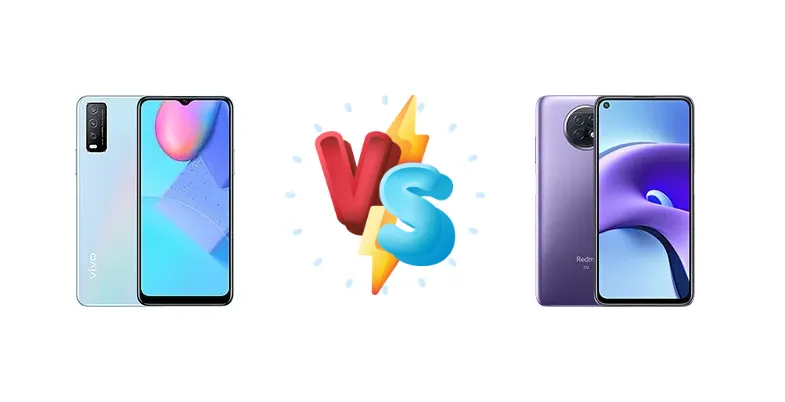
The Xiaomi Redmi Note 9T and vivo Y30 Standard represent distinct approaches to the budget smartphone market. The Redmi Note 9T aims for a balance of 5G connectivity and performance, while the Y30 Standard focuses on maximizing battery life and offering a basic, reliable experience. This comparison dissects their key differences to help you choose the right device.
🏆 Quick Verdict
For most users, the Xiaomi Redmi Note 9T is the superior choice. Its Mediatek Dimensity 800U chipset provides a substantial performance uplift over the vivo Y30 Standard’s Helio P35, alongside faster 18W charging. While the Y30 Standard boasts a slightly longer endurance rating, the Note 9T’s overall capabilities justify the price difference.
| Network |
|---|
| 2G bands | GSM 850 / 900 / 1800 / 1900 | GSM 850 / 900 / 1800 / 1900 |
| 3G bands | HSDPA 850 / 900 / 2100 | HSDPA 850 / 900 / 1700(AWS) / 1900 / 2100 |
| 4G bands | 1, 3, 5, 8, 34, 38, 39, 40, 41 | 1, 2, 3, 4, 5, 7, 8, 12, 17, 18, 19, 20, 26, 28, 32, 38, 40, 41, 42 |
| 5G bands | - | 1, 3, 5, 7, 8, 20, 28, 38, 41, 77, 78, 79 SA/NSA/Sub6 |
| Speed | HSPA, LTE | HSPA, LTE, 5G |
| Technology | GSM / CDMA / HSPA / LTE | GSM / HSPA / LTE / 5G |
| | CDMA 800 & TD-SCDMA | - |
| Launch |
|---|
| Announced | 2020, December 16. Released 2020, December 16 | 2021, January 08 |
| Status | Discontinued | Available. Released 2021, January 18 |
| Body |
|---|
| Build | Glass front, plastic back, plastic frame | Glass front (Gorilla Glass 5), plastic back, plastic frame |
| Dimensions | 164.4 x 76.3 x 8.4 mm (6.47 x 3.00 x 0.33 in) | 161.2 x 77.3 x 9.1 mm (6.35 x 3.04 x 0.36 in) |
| SIM | Nano-SIM + Nano-SIM | Nano-SIM + Nano-SIM |
| Weight | 191.4 g (6.77 oz) | 199 g (7.02 oz) |
| | - | Water-repellent coating |
| Display |
|---|
| Protection | Shatter proof glass | Corning Gorilla Glass 5 |
| Resolution | 720 x 1600 pixels, 20:9 ratio (~270 ppi density) | 1080 x 2340 pixels, 19.5:9 ratio (~395 ppi density) |
| Size | 6.51 inches, 102.3 cm2 (~81.6% screen-to-body ratio) | 6.53 inches, 104.7 cm2 (~84.0% screen-to-body ratio) |
| Type | IPS LCD | IPS LCD, 450 nits (typ) |
| Platform |
|---|
| CPU | Octa-core (4x2.35 GHz Cortex-A53 & 4x1.8 GHz Cortex-A53) | Octa-core (2x2.4 GHz Cortex-A76 & 6x2.0 GHz Cortex-A55) |
| Chipset | Mediatek MT6765 Helio P35 (12 nm) | Mediatek Dimensity 800U (7 nm) |
| GPU | PowerVR GE8320 | Mali-G57 MC3 |
| OS | Android 10, Funtouch 10.5 | Android 10, MIUI 12 |
| Memory |
|---|
| Card slot | No | microSDXC (dedicated slot) |
| Internal | 64GB 4GB RAM, 128GB 4GB RAM, 128GB 6GB RAM, 128GB 8GB RAM | 64GB 4GB RAM, 128GB 4GB RAM, 128GB 6GB RAM |
| | - | UFS 2.1 - 64GB
UFS 2.2 - 128GB |
| Main Camera |
|---|
| Dual | 13 MP, f/2.2, (wide), PDAF
Auxiliary lens | - |
| Features | LED flash, panorama | LED flash, HDR, panorama |
| Single | 13.1 MP, f/2.4, AF | - |
| Triple | - | 48 MP, f/1.8, 26mm (wide), 1/2.0", 0.8µm, PDAF
2 MP (macro)
Auxiliary lens |
| Video | 1080p@30fps | 4K@30fps, 1080p@30/60fps |
| Selfie camera |
|---|
| Single | 8 MP, f/1.8 | 13 MP, f/2.3, 29mm (standard), 1/3.1", 1.12µm |
| Video | 1080p@30fps | 1080p@30fps |
| Sound |
|---|
| 3.5mm jack | Yes | Yes |
| 35mm jack | Yes | Yes |
| Loudspeaker | Yes | Yes, with stereo speakers |
| | - | 24-bit/192kHz audio |
| Comms |
|---|
| Bluetooth | 5.0, A2DP, LE, aptX HD | 5.1, A2DP, LE |
| Infrared port | - | Yes |
| NFC | No | Yes |
| Positioning | GPS, GLONASS, BDS | GPS, GLONASS, GALILEO, BDS |
| Radio | FM radio | FM radio, recording |
| USB | microUSB 2.0, OTG | USB Type-C 2.0 |
| WLAN | Wi-Fi 802.11 a/b/g/n/ac, dual-band, Wi-Fi Direct | Wi-Fi 802.11 a/b/g/n/ac, dual-band, Wi-Fi Direct |
| Features |
|---|
| Sensors | Fingerprint (side-mounted), accelerometer, proximity, compass | Fingerprint (side-mounted), accelerometer, gyro, proximity, compass |
| Battery |
|---|
| Charging | 10W wired
5W reverse wired | 18W wired, 33% in 30 min |
| Music play | Up to 40 h | - |
| Stand-by | Up to 550 h (2G) / Up to 530 h (3G) | - |
| Talk time | Up to 11 h (2G) / Up to 14 h (3G) | - |
| Type | 5000 mAh | Li-Po 5000 mAh |
| Misc |
|---|
| Colors | Aurora, Glacier Blue | Nightfall Black, Daybreak Purple |
| Models | V2036A | M2007J22G, J22 |
| Price | About 180 EUR | About 130 EUR |
| SAR | 1.05 W/kg (head) 0.56 W/kg (body) | 1.07 W/kg (head) 1.05 W/kg (body) |
| SAR EU | 0.48 W/kg (head) | 0.59 W/kg (head) 0.94 W/kg (body) |
| Tests |
|---|
| Audio quality |
Noise -81.9dB / Crosstalk -81.3dB | - |
| Battery life |
Endurance rating 48h
| Endurance rating 118h |
| Camera |
Photo / Video |
Photo / Video |
| Display |
Contrast ratio: 705:1 (nominal) / 2.462:1 (sunlight) |
Contrast ratio: 1226:1 (nominal) |
| Loudspeaker |
Voice 60dB / Noise 58dB / Ring 61dB
|
-26.3 LUFS (Good) |
| Performance | - |
AnTuTu: 288732 (v8)
GeekBench: 1775 (v5.1) |
vivo Y30 Standard
- Exceptional battery endurance (48h rating)
- Lower price point (likely)
- Simple and reliable user experience
- Weak processor performance (Helio P35)
- Slow 10W charging
- Lower display quality
Xiaomi Redmi Note 9T
- Powerful processor (Dimensity 800U)
- Fast 18W charging (33% in 30 min)
- 5G connectivity
- Better display brightness and contrast
- Shorter battery endurance rating (118h)
- Potentially higher price
Display Comparison
The Redmi Note 9T features a contrast ratio of 1226:1 and a measured peak brightness of 471 nits, offering a more vibrant and visible display experience, particularly outdoors. The Y30 Standard’s contrast ratio of 705:1 (nominal) and 2.462:1 (sunlight) suggests a less punchy image and potentially more difficulty viewing in bright conditions. While both are adequate for everyday use, the Note 9T’s higher brightness and contrast provide a noticeable improvement in visual quality.
Camera Comparison
Both phones offer photo and video capabilities, but the specifics are lacking in the provided data. However, given the market positioning, it’s reasonable to assume the Redmi Note 9T benefits from more sophisticated image processing and potentially a larger main sensor. The Y30 Standard likely relies on basic computational photography. Without detailed sensor information, it’s difficult to make a definitive statement, but the Note 9T’s overall hardware advantage suggests superior image quality.
Performance
The performance gap between these devices is significant. The Redmi Note 9T’s Mediatek Dimensity 800U (7nm) utilizes Cortex-A76 cores, offering a substantial performance advantage over the Y30 Standard’s Helio P35 (12nm) and its Cortex-A53 cores. The Dimensity 800U’s more advanced architecture and smaller manufacturing process translate to faster app loading times, smoother multitasking, and improved gaming performance. The Note 9T is demonstrably better suited for demanding applications and future software updates.
Battery Life
The vivo Y30 Standard boasts an endurance rating of 48 hours, while the Redmi Note 9T achieves 118 hours. However, this doesn’t tell the whole story. The Note 9T compensates for its potentially smaller battery capacity with significantly faster 18W wired charging, capable of adding 33% charge in just 30 minutes. The Y30 Standard is limited to 10W charging, resulting in a much slower recharge time. The Note 9T’s faster charging mitigates the endurance difference, making it more convenient for users who frequently need to top up their battery.
Buying Guide
Buy the vivo Y30 Standard if you prioritize absolute battery life above all else and require a phone for very basic tasks like calls, texts, and light social media. You’ll benefit from its extended endurance rating. Buy the Xiaomi Redmi Note 9T if you want a phone capable of handling more demanding apps, enjoy faster charging, and desire 5G connectivity for future-proofing. It’s the better option for gamers and multimedia consumers.
Frequently Asked Questions
❓ Is the Redmi Note 9T’s Dimensity 800U chipset capable of handling demanding games like PUBG or Call of Duty?
Yes, the Dimensity 800U is a capable chipset for gaming. It offers a significant performance boost over the Helio P35 in the Y30 Standard, allowing for smoother frame rates and better graphics settings in popular titles like PUBG and Call of Duty. While it won't match flagship-level performance, it provides a very enjoyable gaming experience for the price.
❓ How much slower is the 10W charging on the vivo Y30 Standard compared to the 18W charging on the Redmi Note 9T?
The difference is substantial. The Redmi Note 9T can gain 33% charge in 30 minutes with its 18W charging. The Y30 Standard’s 10W charging will take significantly longer – likely over 2 hours to reach a similar charge level. This makes the Note 9T much more convenient for users who need a quick power boost.
❓ Does the Redmi Note 9T support carrier aggregation for improved 5G speeds?
Yes, the Mediatek Dimensity 800U supports carrier aggregation, which allows the phone to combine multiple 5G channels for faster and more stable download and upload speeds. This is a key advantage for users in areas with strong 5G coverage.
❓ Is the difference in contrast ratio between the two phones noticeable in everyday use?
Yes, the Redmi Note 9T’s 1226:1 contrast ratio will result in a more vibrant and punchy image compared to the Y30 Standard’s 705:1. Colors will appear richer and blacks will be deeper on the Note 9T, leading to a more immersive viewing experience, especially when watching videos or browsing photos.