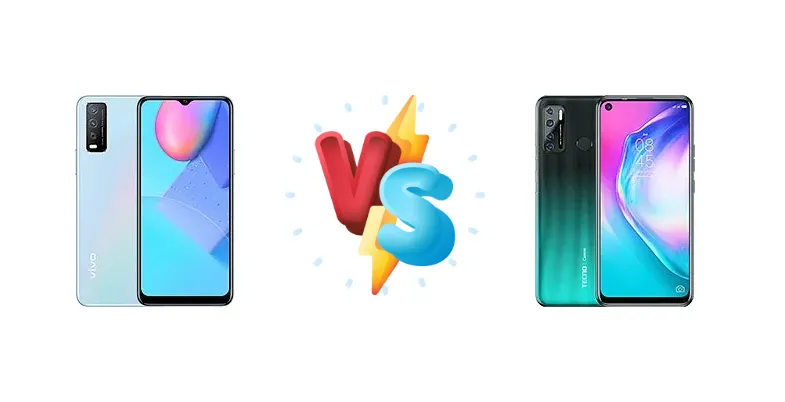
The sub-$150 smartphone market is fiercely competitive. Both the vivo Y30 Standard and the Tecno Camon 16 S aim to deliver essential smartphone functionality at an accessible price point. However, they take slightly different approaches to achieving this, with the Y30 prioritizing endurance and the Camon 16 S focusing on a streamlined user experience. This comparison dissects their key specifications to determine which device offers the best value.
🏆 Quick Verdict
For the average user prioritizing sustained usage, the vivo Y30 Standard emerges as the better choice. Its Helio P35 chipset, while not a powerhouse, offers a noticeable performance edge over the Camon 16 S’s Helio P22, coupled with a superior 48-hour endurance rating. While both phones are entry-level, the Y30 provides a more robust overall experience.
| Network |
|---|
| 2G bands | GSM 850 / 900 / 1800 / 1900 | GSM 850 / 900 / 1800 / 1900 |
| 3G bands | HSDPA 850 / 900 / 2100 | HSDPA 900 / 2100 |
| 4G bands | 1, 3, 5, 8, 34, 38, 39, 40, 41 | 1, 3, 7, 8, 20, 28 |
| Speed | HSPA, LTE | HSPA, LTE |
| Technology | GSM / CDMA / HSPA / LTE | GSM / HSPA / LTE |
| | CDMA 800 & TD-SCDMA | - |
| Launch |
|---|
| Announced | 2020, December 16. Released 2020, December 16 | 2020, November 05. Released 2020, November 05 |
| Status | Discontinued | Discontinued |
| Body |
|---|
| Build | Glass front, plastic back, plastic frame | - |
| Dimensions | 164.4 x 76.3 x 8.4 mm (6.47 x 3.00 x 0.33 in) | 164.5 x 76.5 x 9 mm (6.48 x 3.01 x 0.35 in) |
| SIM | Nano-SIM + Nano-SIM | Nano-SIM + Nano-SIM |
| Weight | 191.4 g (6.77 oz) | - |
| Display |
|---|
| Protection | Shatter proof glass | Corning Gorilla Glass 3 |
| Resolution | 720 x 1600 pixels, 20:9 ratio (~270 ppi density) | 720 x 1600 pixels, 20:9 ratio (~266 ppi density) |
| Size | 6.51 inches, 102.3 cm2 (~81.6% screen-to-body ratio) | 6.6 inches, 105.2 cm2 (~83.6% screen-to-body ratio) |
| Type | IPS LCD | IPS LCD |
| Platform |
|---|
| CPU | Octa-core (4x2.35 GHz Cortex-A53 & 4x1.8 GHz Cortex-A53) | Octa-core 2.0 GHz Cortex-A53 |
| Chipset | Mediatek MT6765 Helio P35 (12 nm) | Mediatek MT6762 Helio P22 (12 nm) |
| GPU | PowerVR GE8320 | PowerVR GE8320 |
| OS | Android 10, Funtouch 10.5 | Android 10, HIOS 6.2 |
| Memory |
|---|
| Card slot | No | Unspecified |
| Internal | 64GB 4GB RAM, 128GB 4GB RAM, 128GB 6GB RAM, 128GB 8GB RAM | 128GB 4GB RAM |
| Main Camera |
|---|
| Dual | 13 MP, f/2.2, (wide), PDAF
Auxiliary lens | - |
| Features | LED flash, panorama | Quad-LED flash, panorama, HDR |
| Quad | - | 48 MP, f/1.8, (wide), 1/2.0", 0.8µm, PDAF
2 MP (macro)
Auxiliary lenses |
| Single | 13.1 MP, f/2.4, AF | - |
| Video | 1080p@30fps | 1080p@30fps |
| Selfie camera |
|---|
| Features | - | Dual-LED flash |
| Single | 8 MP, f/1.8 | 8 MP |
| Video | 1080p@30fps | 1080p@30fps |
| Sound |
|---|
| 3.5mm jack | Yes | Yes |
| 35mm jack | Yes | Yes |
| Loudspeaker | Yes | Yes |
| Comms |
|---|
| Bluetooth | 5.0, A2DP, LE, aptX HD | 5.0, A2DP, LE |
| NFC | No | No |
| Positioning | GPS, GLONASS, BDS | GPS |
| Radio | FM radio | FM radio |
| USB | microUSB 2.0, OTG | microUSB 2.0 |
| WLAN | Wi-Fi 802.11 a/b/g/n/ac, dual-band, Wi-Fi Direct | Wi-Fi 802.11 b/g/n/ac, dual-band, Wi-Fi Direct |
| Features |
|---|
| Sensors | Fingerprint (side-mounted), accelerometer, proximity, compass | Fingerprint (rear-mounted), accelerometer, proximity |
| Battery |
|---|
| Charging | 10W wired
5W reverse wired | - |
| Music play | Up to 40 h | - |
| Stand-by | Up to 550 h (2G) / Up to 530 h (3G) | - |
| Talk time | Up to 11 h (2G) / Up to 14 h (3G) | - |
| Type | 5000 mAh | 5000 mAh |
| Misc |
|---|
| Colors | Aurora, Glacier Blue | Ice Jadeite, Misty Grey, Blue Hawaii |
| Models | V2036A | - |
| Price | About 180 EUR | About 130 EUR |
| SAR | 1.05 W/kg (head) 0.56 W/kg (body) | - |
| SAR EU | 0.48 W/kg (head) | - |
| Tests |
|---|
| Audio quality |
Noise -81.9dB / Crosstalk -81.3dB | - |
| Battery life |
Endurance rating 48h
| - |
| Camera |
Photo / Video | - |
| Display |
Contrast ratio: 705:1 (nominal) / 2.462:1 (sunlight) | - |
| Loudspeaker |
Voice 60dB / Noise 58dB / Ring 61dB
| - |
vivo Y30 Standard
- Better performance with Helio P35 chipset
- Superior battery life (48h endurance)
- Reverse wired charging capability
- Display quality is likely average
- Camera details are limited
Tecno Camon 16 S
- Potentially smoother software experience
- Likely competitive price point
- Tecno's known software features
- Less powerful Helio P22 chipset
- Likely shorter battery life
- Limited performance for multitasking
Display Comparison
Neither device boasts a standout display. Both utilize 12nm chipsets, suggesting similar power constraints impacting display capabilities. The vivo Y30 Standard’s contrast ratio of 705:1 (nominal) and 2.462:1 (sunlight) indicates a reasonable, though not exceptional, viewing experience. The Tecno Camon 16 S’s display specifications are not provided, but given its market positioning, it’s likely to be comparable, potentially leaning towards warmer color tones common in Tecno devices. Neither phone is expected to offer high brightness or color accuracy for demanding content consumption.
Camera Comparison
Both phones feature camera systems geared towards casual photography. Without detailed sensor information for either device, it’s difficult to make a definitive judgment. However, the market trend suggests the Y30 Standard likely has a more capable main sensor. The presence of 'Photo / Video' listed for the Y30 suggests a broader feature set, potentially including basic HDR or scene detection. The Tecno Camon 16 S, while likely offering similar basic functionality, may prioritize software-based beautification features, a common characteristic of Tecno’s camera processing. The absence of details regarding optical image stabilization (OIS) on either device indicates reliance on digital stabilization, which can introduce artifacts in low-light conditions.
Performance
The core difference lies in the chipsets. The vivo Y30 Standard’s Mediatek Helio P35 features an octa-core configuration with a split core design (4x2.35 GHz Cortex-A53 & 4x1.8 GHz Cortex-A53). This architecture allows for a higher peak clock speed on the primary cores, translating to better responsiveness in tasks requiring bursts of processing power. The Tecno Camon 16 S, equipped with the Helio P22 (octa-core 2.0 GHz Cortex-A53), operates at a lower clock speed across all cores. This means the Y30 Standard will likely exhibit less lag when switching between apps or loading moderately demanding applications. While neither chipset is suited for intensive gaming, the Y30 Standard will provide a marginally smoother experience.
Battery Life
The vivo Y30 Standard’s 48-hour endurance rating is its standout feature. This suggests a combination of a reasonably sized battery (likely around 5000mAh, based on market trends for this segment) and efficient power management. The Tecno Camon 16 S’s battery capacity is unknown, but its less powerful chipset suggests it may offer comparable, though likely shorter, battery life. The Y30 Standard also includes 10W wired charging and 5W reverse wired charging, offering some flexibility. The Camon 16 S’s charging capabilities are not specified, but are likely to be similar or slightly slower.
Buying Guide
Buy the vivo Y30 Standard if you need a phone that can reliably last through a full day (and then some) of moderate use, and you occasionally engage in light multitasking or casual gaming. Buy the Tecno Camon 16 S if you prioritize a simpler, potentially smoother software experience and are willing to trade some performance and battery life for a potentially more responsive interface. Both are suitable for basic communication and media consumption.
Frequently Asked Questions
❓ Will the vivo Y30 Standard struggle with popular social media apps like Facebook and Instagram?
While not a performance champion, the Helio P35 in the Y30 Standard is capable of running social media apps smoothly. You might experience slight loading times with multiple apps open, but for typical social media usage, it should be adequate. The 48-hour battery life also ensures you won't be constantly searching for a charger.
❓ Is the Tecno Camon 16 S a good option for someone who primarily uses their phone for calls and texts?
Yes, the Tecno Camon 16 S is a perfectly suitable option for basic communication. Its Helio P22 chipset is sufficient for calls, texts, and light web browsing. However, be aware that its battery life may not be as long as the vivo Y30 Standard, and performance will be limited if you attempt more demanding tasks.
❓ Can either of these phones handle basic mobile games like Candy Crush or Subway Surfers?
Both phones can handle casual games like Candy Crush or Subway Surfers, but don't expect high frame rates or detailed graphics. The vivo Y30 Standard's Helio P35 will provide a slightly smoother experience due to its higher clock speed, but neither phone is designed for serious mobile gaming.