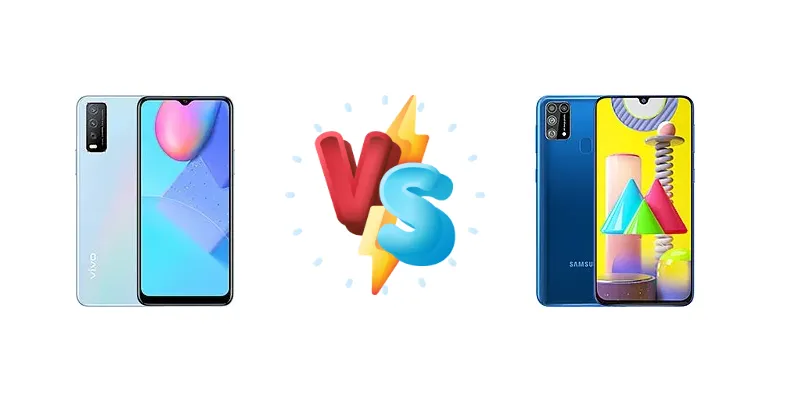
Looking for a reliable budget smartphone? The vivo Y30 Standard and Samsung Galaxy M31 Prime are popular contenders. Both offer compelling features at an affordable price, but which one reigns supreme? This comprehensive comparison will help you decide.
🏆 Quick Verdict
The Samsung Galaxy M31 Prime edges out the vivo Y30 Standard thanks to its superior chipset, faster charging, and generally better performance. While the Y30 boasts impressive battery life, the M31 Prime's overall package makes it the slightly better choice for most users.
| Network |
|---|
| 2G bands | GSM 850 / 900 / 1800 / 1900 | GSM 850 / 900 / 1800 / 1900 |
| 3G bands | HSDPA 850 / 900 / 2100 | HSDPA 850 / 900 / 1700(AWS) / 1900 / 2100 |
| 4G bands | 1, 3, 5, 8, 34, 38, 39, 40, 41 | 1, 2, 3, 4, 5, 7, 8, 12, 13, 17, 20, 26, 28, 38, 40, 41, 66 |
| EDGE | - | Yes |
| GPRS | - | Class 10 |
| Speed | HSPA, LTE | HSPA, LTE |
| Technology | GSM / CDMA / HSPA / LTE | GSM / HSPA / LTE |
| | CDMA 800 & TD-SCDMA | - |
| Launch |
|---|
| Announced | 2020, December 16. Released 2020, December 16 | 2020, October 14. Released 2020, October 17 |
| Status | Discontinued | Discontinued |
| Body |
|---|
| Build | Glass front, plastic back, plastic frame | Glass front (Gorilla Glass 3), plastic back, plastic frame |
| Dimensions | 164.4 x 76.3 x 8.4 mm (6.47 x 3.00 x 0.33 in) | 159.2 x 75.1 x 8.9 mm (6.27 x 2.96 x 0.35 in) |
| SIM | Nano-SIM + Nano-SIM | Nano-SIM + Nano-SIM |
| Weight | 191.4 g (6.77 oz) | 191 g (6.74 oz) |
| Display |
|---|
| Protection | Shatter proof glass | Corning Gorilla Glass 3 |
| Resolution | 720 x 1600 pixels, 20:9 ratio (~270 ppi density) | 1080 x 2340 pixels, 19.5:9 ratio (~403 ppi density) |
| Size | 6.51 inches, 102.3 cm2 (~81.6% screen-to-body ratio) | 6.4 inches, 100.5 cm2 (~84.1% screen-to-body ratio) |
| Type | IPS LCD | Super AMOLED, 420 nits (peak) |
| Platform |
|---|
| CPU | Octa-core (4x2.35 GHz Cortex-A53 & 4x1.8 GHz Cortex-A53) | Octa-core (4x2.3 GHz Cortex-A73 & 4x1.7 GHz Cortex-A53) |
| Chipset | Mediatek MT6765 Helio P35 (12 nm) | Exynos 9611 (10 nm) |
| GPU | PowerVR GE8320 | Mali-G72 MP3 |
| OS | Android 10, Funtouch 10.5 | Android 10, One UI 2.0 |
| Memory |
|---|
| Call records | - | Yes |
| Card slot | No | microSDXC (dedicated slot) |
| Internal | 64GB 4GB RAM, 128GB 4GB RAM, 128GB 6GB RAM, 128GB 8GB RAM | 64GB 6GB RAM, 128GB 6GB RAM |
| Phonebook | - | Yes |
| | - | UFS 2.1 |
| Main Camera |
|---|
| Dual | 13 MP, f/2.2, (wide), PDAF
Auxiliary lens | - |
| Features | LED flash, panorama | LED flash, panorama, HDR |
| Quad | - | 64 MP, f/1.8, 26mm (wide), 1/1.72", 0.8µm, PDAF
8 MP, f/2.2, 123˚ (ultrawide), 1/4.0", 1.12µm
5 MP (macro)
Auxiliary lens |
| Single | 13.1 MP, f/2.4, AF | 3.15 MP |
| Video | 1080p@30fps | 4K@30fps, 1080p@30fps, gyro-EIS |
| Selfie camera |
|---|
| Features | - | HDR |
| Single | 8 MP, f/1.8 | 32 MP, f/2.0, 26mm (wide), 1/2.8", 0.8µm |
| Video | 1080p@30fps | 4K@30fps, 1080p@30fps |
| Sound |
|---|
| 3.5mm jack | Yes | Yes |
| 35mm jack | Yes | Yes |
| Loudspeaker | Yes | Yes |
| Comms |
|---|
| Bluetooth | 5.0, A2DP, LE, aptX HD | 5.0, A2DP, LE |
| NFC | No | No |
| Positioning | GPS, GLONASS, BDS | GPS, GLONASS, GALILEO, BDS |
| Radio | FM radio | FM radio, RDS, recording |
| USB | microUSB 2.0, OTG | USB Type-C 2.0 |
| WLAN | Wi-Fi 802.11 a/b/g/n/ac, dual-band, Wi-Fi Direct | Wi-Fi 802.11 a/b/g/n/ac, dual-band, Wi-Fi Direct |
| Features |
|---|
| Games | - | Downloadable |
| Java | - | Yes |
| Messaging | - | SMS, MMS, Email, Push Email, IM |
| Sensors | Fingerprint (side-mounted), accelerometer, proximity, compass | Fingerprint (rear-mounted), accelerometer, gyro, compass |
| | - | Virtual proximity sensing |
| Battery |
|---|
| Charging | 10W wired
5W reverse wired | 15W wired |
| Music play | Up to 40 h | - |
| Stand-by | Up to 550 h (2G) / Up to 530 h (3G) | Up to 150 h |
| Talk time | Up to 11 h (2G) / Up to 14 h (3G) | Up to 1 h 30 min |
| Type | 5000 mAh | Li-Po 6000 mAh |
| Misc |
|---|
| Colors | Aurora, Glacier Blue | Ocean Blue, Space Black, Iceberg Blue |
| Models | V2036A | SM-M315F/DS |
| Price | About 180 EUR | About 190 EUR |
| SAR | 1.05 W/kg (head) 0.56 W/kg (body) | 0.38 W/kg (head) |
| SAR EU | 0.48 W/kg (head) | - |
| Tests |
|---|
| Audio quality |
Noise -81.9dB / Crosstalk -81.3dB | - |
| Battery life |
Endurance rating 48h
| - |
| Camera |
Photo / Video | - |
| Display |
Contrast ratio: 705:1 (nominal) / 2.462:1 (sunlight) | - |
| Loudspeaker |
Voice 60dB / Noise 58dB / Ring 61dB
| - |
vivo Y30 Standard
- Exceptional battery life (48h endurance)
- Reverse wired charging
- Simple and user-friendly interface
- Decent outdoor display visibility
- Less powerful chipset
- Slower charging speed
- IPS LCD display (inferior to AMOLED)
- Lower overall performance
Samsung Galaxy M31 Prime
- More powerful Exynos 9611 chipset
- Faster 15W charging
- Vibrant Super AMOLED display
- Generally better camera performance
- Battery life slightly shorter than Y30
- Design may be less appealing to some
- Software updates can be inconsistent
Display Comparison
Both phones feature a 6.43-inch Super AMOLED (M31 Prime) vs IPS LCD (Y30) display with a 720 x 1600 resolution. The M31 Prime's Super AMOLED panel offers significantly better color accuracy, contrast, and viewing angles. The Y30's contrast ratio figures (705:1 nominal, 2.462:1 sunlight) suggest decent outdoor visibility, but it won't match the vibrancy of the AMOLED.
Camera Comparison
Camera specs are similar, both offering multiple rear lenses. However, Samsung's image processing is generally considered superior. The M31 Prime likely delivers better dynamic range, color reproduction, and low-light performance. The Y30's camera is decent for casual photography, but the M31 Prime offers a more refined experience.
Performance
The Samsung Galaxy M31 Prime's Exynos 9611 chipset (10nm) is noticeably more powerful than the vivo Y30's Mediatek Helio P35 (12nm). The Cortex-A73 cores in the Exynos provide a significant boost in CPU performance, resulting in smoother multitasking, faster app loading, and better gaming performance. The Y30 is adequate for basic tasks but will struggle with demanding applications.
Battery Life
The vivo Y30 Standard shines in battery life, boasting an endurance rating of 48 hours. While the M31 Prime's battery capacity is comparable, the Y30's efficient chipset contributes to its exceptional longevity. The M31 Prime's 15W charging is faster than the Y30's 10W, but the Y30's reverse charging is a unique feature.
Buying Guide
The vivo Y30 Standard is ideal for users prioritizing long battery life and a simple, user-friendly experience. The Samsung Galaxy M31 Prime is a better fit for those who value performance, faster charging, and a more premium feel, even within a budget.
Frequently Asked Questions
❓ Which phone is better for gaming?
The Samsung Galaxy M31 Prime is significantly better for gaming due to its more powerful chipset.
❓ Does the vivo Y30 have 5G?
No, neither the vivo Y30 Standard nor the Samsung Galaxy M31 Prime support 5G connectivity.
❓ Which phone has better software support?
Samsung generally offers better and more consistent software updates compared to vivo, although both brands have improved in recent years.