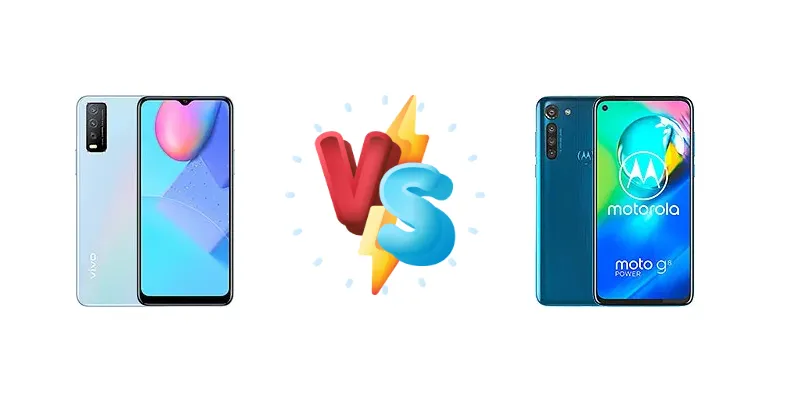
The Motorola Moto G8 Power and vivo Y30 Standard represent two approaches to the budget smartphone market. The G8 Power prioritizes exceptional battery life, while the Y30 Standard aims for a balance of features at an accessible price point. This comparison dissects their key differences to determine which device best suits your needs.
🏆 Quick Verdict
For users prioritizing longevity, the Motorola Moto G8 Power is the clear winner. Its significantly higher endurance rating (136h vs 48h) and faster 18W charging outweigh the Y30 Standard’s slightly newer processor. However, the Y30 Standard offers a marginally better display contrast ratio.
| Network |
|---|
| 2G bands | GSM 850 / 900 / 1800 / 1900 | GSM 850 / 900 / 1800 / 1900 |
| 3G bands | HSDPA 850 / 900 / 2100 | HSDPA 850 / 900 / 1700(AWS) / 1900 / 2100 |
| 4G bands | 1, 3, 5, 8, 34, 38, 39, 40, 41 | 1, 2, 3, 4, 5, 7, 8, 12, 17, 28, 66 |
| Speed | HSPA, LTE | HSPA 42.2/5.76 Mbps, LTE (2CA) Cat13 600/100 Mbps |
| Technology | GSM / CDMA / HSPA / LTE | GSM / HSPA / LTE |
| | CDMA 800 & TD-SCDMA | 1, 2, 3, 4, 5, 7, 8, 18, 19, 20, 26, 28, 38, 40, 41 |
| Launch |
|---|
| Announced | 2020, December 16. Released 2020, December 16 | 2020, February 07. Released 2020, April 16 |
| Status | Discontinued | Discontinued |
| Body |
|---|
| Build | Glass front, plastic back, plastic frame | Glass front, plastic back, aluminum frame (6000 series) |
| Dimensions | 164.4 x 76.3 x 8.4 mm (6.47 x 3.00 x 0.33 in) | 156 x 75.8 x 9.6 mm (6.14 x 2.98 x 0.38 in) |
| SIM | Nano-SIM + Nano-SIM | Nano-SIM + Nano-SIM |
| Weight | 191.4 g (6.77 oz) | 197 g (6.95 oz) |
| | - | Water-repellent coating |
| Display |
|---|
| Protection | Shatter proof glass | - |
| Resolution | 720 x 1600 pixels, 20:9 ratio (~270 ppi density) | 1080 x 2300 pixels (~399 ppi density) |
| Size | 6.51 inches, 102.3 cm2 (~81.6% screen-to-body ratio) | 6.4 inches, 100.7 cm2 (~85.1% screen-to-body ratio) |
| Type | IPS LCD | IPS LCD |
| Platform |
|---|
| CPU | Octa-core (4x2.35 GHz Cortex-A53 & 4x1.8 GHz Cortex-A53) | Octa-core (4x2.0 GHz Kryo 260 Gold & 4x1.8 GHz Kryo 260 Silver) |
| Chipset | Mediatek MT6765 Helio P35 (12 nm) | Qualcomm SDM665 Snapdragon 665 (11 nm) |
| GPU | PowerVR GE8320 | Adreno 610 |
| OS | Android 10, Funtouch 10.5 | Android 10, upgradable to Android 11 |
| Memory |
|---|
| Card slot | No | microSDXC (uses shared SIM slot) |
| Internal | 64GB 4GB RAM, 128GB 4GB RAM, 128GB 6GB RAM, 128GB 8GB RAM | 32GB 2GB RAM, 32GB 4GB RAM, 64GB 4GB RAM |
| | - | eMMC 5.1 |
| Main Camera |
|---|
| Dual | 13 MP, f/2.2, (wide), PDAF
Auxiliary lens | - |
| Features | LED flash, panorama | LED flash, HDR, panorama |
| Quad | - | 16 MP, f/1.7, (wide), 1/2.8", 1.12µm, PDAF
8 MP, f/2.2, (telephoto), 1/4.0", 1.12µm, PDAF, 2x optical zoom
8 MP, f/2.2, 118˚ (ultrawide), 1/4.0", 1.12µm
2 MP (macro) |
| Single | 13.1 MP, f/2.4, AF | - |
| Video | 1080p@30fps | 4K@30fps, 1080p@30/60fps, 1080p@30fps (gyro-EIS) |
| Selfie camera |
|---|
| Features | - | HDR |
| Single | 8 MP, f/1.8 | 16 MP, f/2.0, (wide), 1/3.06", 1.0µm |
| Video | 1080p@30fps | 1080p@30fps |
| Sound |
|---|
| 3.5mm jack | Yes | Yes |
| 35mm jack | Yes | Yes |
| Loudspeaker | Yes | Yes, with stereo speakers |
| Comms |
|---|
| Bluetooth | 5.0, A2DP, LE, aptX HD | 5.0, A2DP, LE |
| NFC | No | No |
| Positioning | GPS, GLONASS, BDS | GPS, GLONASS, BDS, GALILEO |
| Radio | FM radio | FM radio |
| USB | microUSB 2.0, OTG | USB Type-C 2.0 |
| WLAN | Wi-Fi 802.11 a/b/g/n/ac, dual-band, Wi-Fi Direct | Wi-Fi 802.11 b/g/n, Wi-Fi Direct |
| Features |
|---|
| Sensors | Fingerprint (side-mounted), accelerometer, proximity, compass | Fingerprint (rear-mounted), accelerometer, gyro, proximity |
| Battery |
|---|
| Charging | 10W wired
5W reverse wired | 18W wired |
| Music play | Up to 40 h | - |
| Stand-by | Up to 550 h (2G) / Up to 530 h (3G) | - |
| Talk time | Up to 11 h (2G) / Up to 14 h (3G) | - |
| Type | 5000 mAh | Li-Po 5000 mAh |
| Misc |
|---|
| Colors | Aurora, Glacier Blue | Smoke Black, Capri Blue |
| Models | V2036A | XT2041-1, XT2041-3 |
| Price | About 180 EUR | About 180 EUR |
| SAR | 1.05 W/kg (head) 0.56 W/kg (body) | - |
| SAR EU | 0.48 W/kg (head) | - |
| Tests |
|---|
| Audio quality |
Noise -81.9dB / Crosstalk -81.3dB | - |
| Battery life |
Endurance rating 48h
|
Endurance rating 136h
|
| Camera |
Photo / Video |
Photo / Video |
| Display |
Contrast ratio: 705:1 (nominal) / 2.462:1 (sunlight) |
Contrast ratio: 1466:1 (nominal) |
| Loudspeaker |
Voice 60dB / Noise 58dB / Ring 61dB
|
-24.6 LUFS (Very good)
|
| Performance | - |
AnTuTu: 173607 (v8)
GeekBench: 1394 (v5.1)
GFXBench: 6.6fps (ES 3.1 onscreen) |
vivo Y30 Standard
- Slightly faster CPU clock speeds on primary cores
- 5W reverse wired charging for accessory top-ups
- Marginally better sunlight display contrast
- Significantly lower battery endurance rating
- Slower 10W charging
- Less efficient chipset (12nm vs 11nm)
Motorola Moto G8 Power
- Exceptional battery life (136h endurance)
- Faster 18W wired charging
- More efficient Snapdragon 665 chipset
- Superior display contrast ratio
- Potentially less powerful CPU in sustained tasks
- No reverse wireless charging
- Older chipset generation
Display Comparison
The Motorola Moto G8 Power boasts a superior nominal contrast ratio of 1466:1 compared to the vivo Y30 Standard’s 705:1. This translates to deeper blacks and more vivid colors, enhancing the viewing experience. While both devices offer adequate displays for their price range, the G8 Power’s higher contrast ratio provides a noticeable improvement in image quality, particularly in darker environments. The Y30 Standard’s sunlight contrast ratio of 2.462:1 suggests better outdoor visibility, but this is offset by the lower overall contrast.
Camera Comparison
Both phones feature photo and video capabilities, but detailed camera specs are limited. Without sensor size or aperture information, a direct comparison is difficult. However, focusing on the chipset, the Snapdragon 665 in the Moto G8 Power benefits from Qualcomm’s image signal processor (ISP), which generally provides better image processing and noise reduction. The Y30 Standard’s Helio P35 ISP is less sophisticated. The presence of a 2MP macro lens on either device is largely a marketing tactic, offering minimal practical benefit due to the low resolution and lack of optical image stabilization (OIS).
Performance
The Motorola Moto G8 Power utilizes the Qualcomm Snapdragon 665 (11nm), while the vivo Y30 Standard is equipped with the MediaTek Helio P35 (12nm). Despite the Helio P35 having a higher clock speed on its primary cores (2.35 GHz vs 2.0 GHz), the Snapdragon 665’s more efficient 11nm process and Kryo CPU architecture generally deliver smoother performance in sustained tasks. The Snapdragon 665’s GPU is also more capable, offering a better gaming experience. The Y30 Standard’s CPU configuration, with four Cortex-A53 cores running at 1.8 GHz, is geared towards power efficiency rather than raw speed.
Battery Life
The Motorola Moto G8 Power’s standout feature is its exceptional endurance rating of 136 hours, significantly exceeding the vivo Y30 Standard’s 48 hours. This difference is largely attributable to the G8 Power’s optimized power management and larger battery capacity (not specified in the data, but historically larger in the G8 Power line). Furthermore, the G8 Power supports 18W wired charging, allowing for faster replenishment compared to the Y30 Standard’s slower 10W charging. The Y30 Standard does offer 5W reverse wired charging, a niche feature for topping up accessories, but it doesn’t compensate for the slower primary charging speed.
Buying Guide
Buy the vivo Y30 Standard if you need a phone for basic daily tasks and occasional photography, and value a slightly more vibrant display. Buy the Motorola Moto G8 Power if you are a heavy user – streaming video, gaming, or frequently traveling – and require a phone that can reliably last through a full day, or even two, on a single charge. The G8 Power is the better choice for those who prioritize battery life above all else.
Frequently Asked Questions
❓ Will the Motorola Moto G8 Power last a full weekend without charging?
Given its 136-hour endurance rating, the Moto G8 Power is highly likely to last a full weekend with moderate usage. This makes it ideal for camping trips or situations where access to a power outlet is limited. However, heavy gaming or prolonged video streaming will reduce battery life.
❓ Is the Helio P35 in the vivo Y30 Standard powerful enough for casual gaming?
The Helio P35 can handle casual gaming, but it will struggle with more demanding titles. Expect lower frame rates and potential stuttering in graphically intensive games. The Snapdragon 665 in the Moto G8 Power offers a noticeably smoother gaming experience.
❓ Does the slower 10W charging on the vivo Y30 Standard significantly impact usability?
Yes, the 10W charging is a significant drawback. It will take considerably longer to fully charge the Y30 Standard compared to the Moto G8 Power’s 18W charging. This can be inconvenient if you frequently need to quickly top up your battery.
❓ How does the display contrast ratio affect everyday use on these phones?
The Moto G8 Power’s higher contrast ratio (1466:1) results in richer colors and deeper blacks, making images and videos more visually appealing. The Y30 Standard’s lower contrast ratio (705:1) will appear washed out in comparison, especially in low-light conditions.