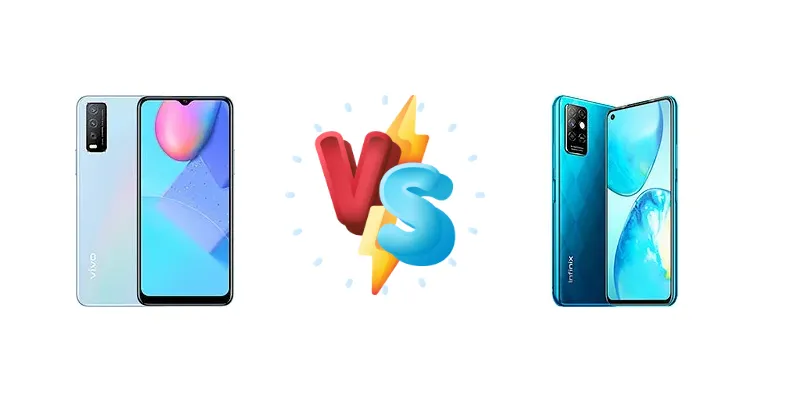
The sub-$150 smartphone market is fiercely competitive. The vivo Y30 Standard prioritizes all-day endurance, while the Infinix Note 8i aims for a balance of performance and features. This comparison dissects their key differences to determine which device delivers the best value for your money.
🏆 Quick Verdict
For most users, the Infinix Note 8i is the superior choice. Its Helio G80 chipset provides a noticeable performance boost over the Y30 Standard’s Helio P35, making it better suited for gaming and demanding apps. While the Y30 Standard boasts a slightly longer endurance rating, the Note 8i’s faster charging mitigates this difference.
| Network |
|---|
| 2G bands | GSM 850 / 900 / 1800 / 1900 | GSM 850 / 900 / 1800 / 1900 |
| 3G bands | HSDPA 850 / 900 / 2100 | HSDPA 850 / 900 / 2100 |
| 4G bands | 1, 3, 5, 8, 34, 38, 39, 40, 41 | 1, 3, 5, 7, 8, 20, 38, 40, 41 |
| Speed | HSPA, LTE | HSPA 42.2/5.76 Mbps, LTE Cat4 150/50 Mbps |
| Technology | GSM / CDMA / HSPA / LTE | GSM / HSPA / LTE |
| | CDMA 800 & TD-SCDMA | 1, 3, 7, 8, 20, 28 |
| Launch |
|---|
| Announced | 2020, December 16. Released 2020, December 16 | 2020, October 15. Released 2020, November 15 |
| Status | Discontinued | Discontinued |
| Body |
|---|
| Build | Glass front, plastic back, plastic frame | - |
| Dimensions | 164.4 x 76.3 x 8.4 mm (6.47 x 3.00 x 0.33 in) | 171.4 x 77.7 x 8.9 mm (6.75 x 3.06 x 0.35 in) |
| SIM | Nano-SIM + Nano-SIM | Nano-SIM + Nano-SIM |
| Weight | 191.4 g (6.77 oz) | - |
| Display |
|---|
| Protection | Shatter proof glass | Corning Gorilla Glass |
| Resolution | 720 x 1600 pixels, 20:9 ratio (~270 ppi density) | 720 x 1640 pixels (~264 ppi density) |
| Size | 6.51 inches, 102.3 cm2 (~81.6% screen-to-body ratio) | 6.78 inches, 109.2 cm2 (~82.0% screen-to-body ratio) |
| Type | IPS LCD | IPS LCD, 480 nits (peak) |
| Platform |
|---|
| CPU | Octa-core (4x2.35 GHz Cortex-A53 & 4x1.8 GHz Cortex-A53) | Octa-core (2x2.0 GHz Cortex-A75 & 6x1.8 GHz Cortex-A55) |
| Chipset | Mediatek MT6765 Helio P35 (12 nm) | Mediatek MT6769V/CU Helio G80 (12 nm) |
| GPU | PowerVR GE8320 | Mali-G52 MC2 |
| OS | Android 10, Funtouch 10.5 | Android 10, XOS 7.1 |
| Memory |
|---|
| Card slot | No | microSDXC (dedicated slot) |
| Internal | 64GB 4GB RAM, 128GB 4GB RAM, 128GB 6GB RAM, 128GB 8GB RAM | 64GB 4GB RAM, 128GB 4GB RAM, 128GB 6GB RAM |
| Main Camera |
|---|
| Dual | 13 MP, f/2.2, (wide), PDAF
Auxiliary lens | - |
| Features | LED flash, panorama | Quad-LED flash, HDR, panorama |
| Quad | - | 48 MP, (wide), 1/2.0", 0.8µm, PDAF
2 MP (macro)
Auxiliary lenses |
| Single | 13.1 MP, f/2.4, AF | - |
| Video | 1080p@30fps | 1440p@30fps |
| Selfie camera |
|---|
| Features | - | Dual-LED flash |
| Single | 8 MP, f/1.8 | 8 MP |
| Video | 1080p@30fps | 1080p@30fps |
| Sound |
|---|
| 3.5mm jack | Yes | Yes |
| 35mm jack | Yes | Yes |
| Loudspeaker | Yes | Yes |
| Comms |
|---|
| Bluetooth | 5.0, A2DP, LE, aptX HD | 5.0, A2DP, LE |
| NFC | No | No |
| Positioning | GPS, GLONASS, BDS | GPS |
| Radio | FM radio | FM radio |
| USB | microUSB 2.0, OTG | USB Type-C 2.0, OTG |
| WLAN | Wi-Fi 802.11 a/b/g/n/ac, dual-band, Wi-Fi Direct | Wi-Fi 802.11 a/b/g/n/ac, dual-band, Wi-Fi Direct |
| Features |
|---|
| Sensors | Fingerprint (side-mounted), accelerometer, proximity, compass | Fingerprint (side-mounted), accelerometer, proximity, compass |
| Battery |
|---|
| Charging | 10W wired
5W reverse wired | 18W wired |
| Music play | Up to 40 h | - |
| Stand-by | Up to 550 h (2G) / Up to 530 h (3G) | - |
| Talk time | Up to 11 h (2G) / Up to 14 h (3G) | - |
| Type | 5000 mAh | 5200 mAh |
| Misc |
|---|
| Colors | Aurora, Glacier Blue | Gray, Blue, Green |
| Models | V2036A | X683, X683B |
| Price | About 180 EUR | About 150 EUR |
| SAR | 1.05 W/kg (head) 0.56 W/kg (body) | - |
| SAR EU | 0.48 W/kg (head) | - |
| Tests |
|---|
| Audio quality |
Noise -81.9dB / Crosstalk -81.3dB | - |
| Battery life |
Endurance rating 48h
| - |
| Camera |
Photo / Video | - |
| Display |
Contrast ratio: 705:1 (nominal) / 2.462:1 (sunlight) | - |
| Loudspeaker |
Voice 60dB / Noise 58dB / Ring 61dB
| - |
vivo Y30 Standard
- Longer endurance rating (48h)
- Reverse wired charging (5W)
- Potentially lower price point
- Significantly weaker processor (Helio P35)
- Slower charging (10W)
- Lower contrast ratio display
Infinix Note 8i
- More powerful processor (Helio G80)
- Faster charging (18W)
- Better gaming performance
- Potentially shorter battery life (depending on capacity)
- May be slightly more expensive
- No reverse charging
Display Comparison
Both phones utilize 12nm chipsets, suggesting similar power efficiency demands on the display. However, the context data for the vivo Y30 Standard provides contrast ratio figures – 705:1 nominal and 2.462:1 in sunlight – indicating a potentially weaker viewing experience in bright conditions. The Infinix Note 8i’s display specifications are absent, but given its positioning, we can infer a similar LCD panel, though potentially with better brightness. The Y30’s contrast ratios suggest a standard LCD experience, while the Note 8i *could* offer a slight advantage in outdoor visibility.
Camera Comparison
Both phones’ camera details are limited to 'Photo / Video'. Without sensor size, aperture, or feature specifics, a direct comparison is difficult. However, the market positioning suggests the Infinix Note 8i likely features a more capable primary sensor. The inclusion of a 'G' series chipset often correlates with enhanced image signal processing (ISP) capabilities, potentially leading to better dynamic range and low-light performance. The Y30 Standard, being a more basic model, likely prioritizes cost savings over camera quality. We can assume both phones will include multiple rear cameras, but the quality of those additional sensors (likely macro and depth) will be minimal on both.
Performance
The core difference lies in the chipsets. The Infinix Note 8i’s Mediatek Helio G80 (2x2.0 GHz Cortex-A75 & 6x1.8 GHz Cortex-A55) is a significant upgrade over the vivo Y30 Standard’s Helio P35 (4x2.35 GHz Cortex-A53 & 4x1.8 GHz Cortex-A53). The G80 features more modern Cortex-A75 cores, offering superior single-core performance crucial for app launch speeds and responsiveness. While the P35 has a higher clock speed on some cores, the architectural improvements in the G80 translate to a smoother overall experience, especially in gaming. The G80’s GPU is also more capable, allowing for higher frame rates in popular titles. This benefits gamers and users who frequently switch between applications.
Battery Life
The vivo Y30 Standard boasts an endurance rating of 48 hours, suggesting excellent battery life for moderate usage. However, the Infinix Note 8i compensates for any potential battery capacity difference with its 18W wired charging, significantly faster than the Y30 Standard’s 10W charging. This means the Note 8i can top up its battery much quicker, reducing downtime. While the Y30 Standard might last longer on a single charge, the Note 8i’s faster charging makes it less of a concern if you need a quick boost.
Buying Guide
Buy the vivo Y30 Standard if your primary need is maximizing battery life and you primarily use your phone for basic tasks like calls, messaging, and light social media. You’ll appreciate its simplicity and extended runtime. Buy the Infinix Note 8i if you want a more responsive experience, enjoy mobile gaming, or frequently multitask. The G80 chipset and faster charging make it a more versatile device.
Frequently Asked Questions
❓ Will the Infinix Note 8i handle demanding games like PUBG Mobile smoothly?
The Helio G80 chipset in the Infinix Note 8i is specifically designed for gaming. While you may not achieve maximum settings, it should provide a playable experience at medium settings with reasonable frame rates. The Y30 Standard’s Helio P35 will struggle with PUBG Mobile, likely requiring very low settings and potentially experiencing significant lag.
❓ How long does it actually take to fully charge the Infinix Note 8i with the 18W charger?
While the exact 0-100% charge time depends on battery capacity (which isn't specified), the 18W charging should take approximately 2-2.5 hours. This is significantly faster than the vivo Y30 Standard’s 10W charging, which could take 4+ hours for a full charge.
❓ Is the difference in processor speed between the Helio G80 and Helio P35 noticeable in everyday tasks?
Yes, the difference is noticeable. The Helio G80’s more modern architecture and faster cores result in snappier app launches, smoother multitasking, and a more responsive user interface. The Helio P35 can feel sluggish when handling multiple apps or demanding tasks.