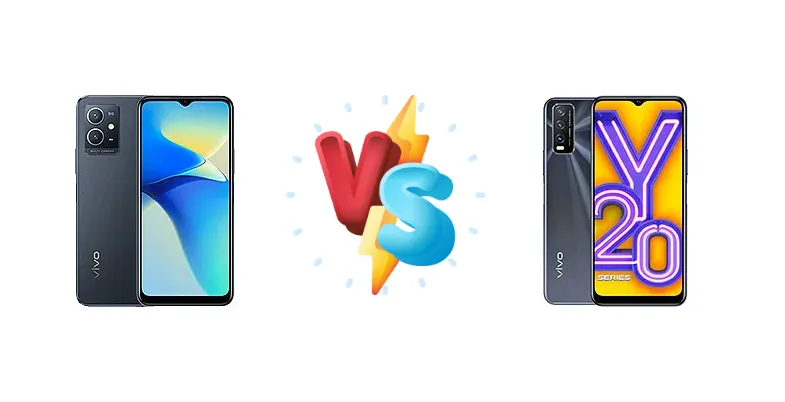
The vivo Y series consistently delivers affordable smartphones packed with features. But with so many options, choosing the right one can be tricky. We're pitting the vivo Y30 5G against the vivo Y20 to help you determine which phone best suits your needs and budget.
🏆 Quick Verdict
The vivo Y30 5G takes the lead thanks to its 5G connectivity and significantly more powerful Dimensity 700 chipset. However, the Y20 offers faster charging and a potentially more attractive price point, making it a solid choice for budget-conscious users who don't need 5G.
| Network |
|---|
| 2G bands | GSM 850 / 900 / 1800 / 1900 | GSM 850 / 900 / 1800 / 1900 |
| 3G bands | HSDPA 850 / 900 / 1700(AWS) / 1900 / 2100 | HSDPA 850 / 900 / 2100 |
| 4G bands | 1, 2, 3, 4, 5, 7, 8, 20, 28, 38, 40, 41 | 1, 3, 5, 8, 38, 40, 41 |
| 5G bands | 1, 3, 28, 40, 41, 78 SA/NSA | - |
| Speed | HSPA, LTE, 5G | HSPA, LTE |
| Technology | GSM / HSPA / LTE / 5G | GSM / HSPA / LTE |
| | - | 1, 3, 5, 7, 8, 18, 19, 20, 26, 28, 38, 39, 40, 41 |
| Launch |
|---|
| Announced | 2022, July 25 | 2020, August 26. Released 2020, August 28 |
| Status | Available. Released 2022, July 25 | Discontinued |
| Body |
|---|
| Build | Glass front, plastic frame, plastic back | Glass front, plastic back, plastic frame |
| Dimensions | 164 x 75.9 x 8.3 mm (6.46 x 2.99 x 0.33 in) | 164.4 x 76.3 x 8.4 mm (6.47 x 3.00 x 0.33 in) |
| SIM | Nano-SIM + Nano-SIM | Nano-SIM + Nano-SIM |
| Weight | 193 g (6.81 oz) | 192.3 g (6.77 oz) |
| Display |
|---|
| Resolution | 720 x 1600 pixels, 20:9 ratio (~270 ppi density) | 720 x 1600 pixels, 20:9 ratio (~270 ppi density) |
| Size | 6.51 inches, 102.3 cm2 (~82.2% screen-to-body ratio) | 6.51 inches, 102.3 cm2 (~81.6% screen-to-body ratio) |
| Type | IPS LCD | IPS LCD |
| Platform |
|---|
| CPU | Octa-core (2x2.2 GHz Cortex-A76 & 6x2.0 GHz Cortex-A55) | Octa-core (4x1.8 GHz Kryo 240 & 4x1.6 GHz Kryo 240) |
| Chipset | Mediatek Dimensity 700 (7 nm) | Qualcomm SM4250 Snapdragon 460 (11 nm) |
| GPU | Mali-G57 MC2 | Adreno 610 |
| OS | Android 12 | Android 10, Funtouch 10.5 |
| Memory |
|---|
| Card slot | microSDXC (uses shared SIM slot) | microSDXC (dedicated slot) |
| Internal | 128GB 6GB RAM | 64GB 3GB RAM, 64GB 4GB RAM, 64GB 6GB RAM |
| | - | eMMC 5.1 |
| Main Camera |
|---|
| Dual | 50 MP, f/1.8, 26mm (wide), PDAF
Auxiliary lens | - |
| Features | LED flash, HDR, panorama | LED flash, HDR |
| Single | 8 MP, f/2.0, (wide) | - |
| Triple | - | 13 MP, f/2.2, (wide), PDAF
2 MP (macro)
Auxiliary lens |
| Video | 1080p@30fps | 1080p@30fps |
| Selfie camera |
|---|
| Single | 8 MP, f/2.0, (wide) | 8 MP, f/1.8, (wide) |
| Video | 1080p@30fps | 1080p@30fps |
| Sound |
|---|
| 3.5mm jack | Yes | Yes |
| 35mm jack | Yes | Yes |
| Loudspeaker | Yes | Yes |
| Comms |
|---|
| Bluetooth | 5.1, A2DP, LE | 5.0, A2DP, LE |
| NFC | No | No |
| Positioning | GPS, GLONASS, GALILEO, BDS, QZSS | GPS, GLONASS, BDS, GALILEO |
| Radio | FM radio | FM radio |
| USB | USB Type-C, OTG | microUSB 2.0, OTG |
| WLAN | Wi-Fi 802.11 a/b/g/n/ac, dual-band, Wi-Fi Direct | Wi-Fi 802.11 a/b/g/n/ac, dual-band, Wi-Fi Direct |
| Features |
|---|
| Sensors | Fingerprint (side-mounted), accelerometer, proximity, compass | Fingerprint (side-mounted), accelerometer, proximity, compass |
| Battery |
|---|
| Charging | 10W wired | 18W wired |
| Type | 5000 mAh | 5000 mAh |
| Misc |
|---|
| Colors | Black, Blue | Obsidian Black, Dawn White, Purist Blue |
| Models | V2160 | V2029, V2029_PK |
| Price | About 230 EUR | About 150 EUR |
| SAR | - | 1.19 W/kg (head) 0.58 W/kg (body) |
| Pricing |
|---|
| 64GB 3GB RAM | - | Rp 2,099,000 |
| 64GB 4GB RAM | - | ₹ 13,990 |
vivo Y30 5G
- 5G Connectivity
- Faster Processor (Dimensity 700)
- Potentially Better Camera
- More RAM options (likely)
- Larger Display (likely)
- Slower Charging (10W)
- Potentially Higher Price
vivo Y20
- Faster Charging (18W)
- More Affordable
- Decent Battery Life
- Available in multiple RAM/Storage configurations
- Slower Processor (Snapdragon 460)
- No 5G
- Potentially Lower Camera Quality
- Less RAM (3GB/4GB)
Display Comparison
Both phones feature similar display technology (likely IPS LCD) with comparable resolutions. The Y30 5G likely has a slightly larger screen size (around 6.51 inches) compared to the Y20 (around 6.5 inches). Expect similar color accuracy and viewing angles, suitable for everyday use.
Camera Comparison
The Y30 5G likely boasts a more versatile camera system, potentially including a higher resolution main sensor and additional lenses (ultrawide, macro). While both phones offer decent camera performance in good lighting, the Y30 5G should deliver better low-light photos and more detailed images. Expect both to offer standard features like portrait mode and HDR.
Performance
This is where the Y30 5G shines. The Mediatek Dimensity 700 chipset is a substantial upgrade over the Snapdragon 460 in the Y20. Expect significantly faster app loading times, smoother multitasking, and better gaming performance on the Y30 5G. The Y20 will handle basic tasks adequately, but will struggle with demanding applications.
Battery Life
The Y20 has a clear advantage here with its 18W fast charging support. The Y30 5G's 10W charging is considerably slower. Both phones likely have similar battery capacities (around 5000mAh), so the Y20 will likely charge much faster, which is a significant convenience.
Buying Guide
The vivo Y30 5G is ideal for users who want 5G connectivity, smoother performance for gaming and multitasking, and are willing to spend a bit more. The vivo Y20 is a great option for those on a tight budget who prioritize faster charging and don't require 5G capabilities.
Frequently Asked Questions
❓ Is the vivo Y30 5G worth the extra cost?
If 5G connectivity and smoother performance are important to you, then yes. The Dimensity 700 chipset offers a significant upgrade. However, if you're on a strict budget and don't need 5G, the Y20 is a more economical choice.
❓ Which phone has better battery life?
While both have similar battery capacities, the Y20's faster charging means you'll spend less time plugged in, making it feel like it has better overall battery management.