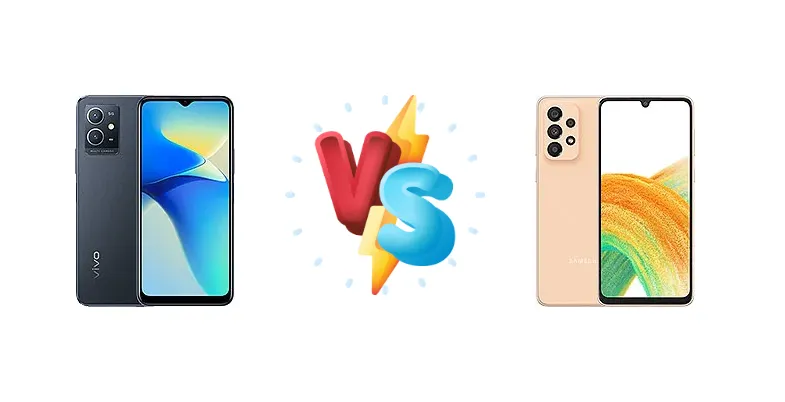
The sub-$300 5G smartphone market is fiercely competitive. The vivo Y30 5G and Samsung Galaxy A33 5G both aim to deliver next-gen connectivity at an accessible price point, but they take different approaches. This comparison dissects their key specifications to determine which device offers the best overall experience.
🏆 Quick Verdict
For most users, the Samsung Galaxy A33 5G emerges as the stronger contender. Its Exynos 1280 chipset provides a noticeable performance uplift over the Dimensity 700 in the vivo Y30 5G, and the brighter display enhances usability. While charging is slower, the overall package justifies the potential price difference.
| Network |
|---|
| 2G bands | GSM 850 / 900 / 1800 / 1900 | GSM 850 / 900 / 1800 / 1900 |
| 3G bands | HSDPA 850 / 900 / 1700(AWS) / 1900 / 2100 | HSDPA 850 / 900 / 1700(AWS) / 1900 / 2100 |
| 4G bands | 1, 2, 3, 4, 5, 7, 8, 20, 28, 38, 40, 41 | 1, 2, 3, 4, 5, 7, 8, 12, 17, 20, 26, 28, 32, 38, 40, 41, 66 |
| 5G bands | 1, 3, 28, 40, 41, 78 SA/NSA | 1, 3, 5, 7, 8, 20, 28, 38, 40, 41, 66, 78 SA/NSA/Sub6 |
| Speed | HSPA, LTE, 5G | HSPA, LTE, 5G |
| Technology | GSM / HSPA / LTE / 5G | GSM / HSPA / LTE / 5G |
| Launch |
|---|
| Announced | 2022, July 25 | 2022, March 17 |
| Status | Available. Released 2022, July 25 | Available. Released 2022, April 20 |
| Body |
|---|
| Build | Glass front, plastic frame, plastic back | Glass front (Gorilla Glass 5), plastic frame, plastic back |
| Dimensions | 164 x 75.9 x 8.3 mm (6.46 x 2.99 x 0.33 in) | 159.7 x 74 x 8.1 mm (6.29 x 2.91 x 0.32 in) |
| SIM | Nano-SIM + Nano-SIM | · Nano-SIM· Nano-SIM + Nano-SIM |
| Weight | 193 g (6.81 oz) | 186 g (6.56 oz) |
| | - | IP67 dust/water resistant (up to 1m for 30 min) |
| Display |
|---|
| Protection | - | Corning Gorilla Glass 5 |
| Resolution | 720 x 1600 pixels, 20:9 ratio (~270 ppi density) | 1080 x 2400 pixels, 20:9 ratio (~411 ppi density) |
| Size | 6.51 inches, 102.3 cm2 (~82.2% screen-to-body ratio) | 6.4 inches, 98.9 cm2 (~83.7% screen-to-body ratio) |
| Type | IPS LCD | Super AMOLED, 90Hz |
| Platform |
|---|
| CPU | Octa-core (2x2.2 GHz Cortex-A76 & 6x2.0 GHz Cortex-A55) | Octa-core (2x2.4 GHz Cortex-A78 & 6x2.0 GHz Cortex-A55) |
| Chipset | Mediatek Dimensity 700 (7 nm) | Exynos 1280 (5 nm) |
| GPU | Mali-G57 MC2 | Mali-G68 |
| OS | Android 12 | Android 12, up to 4 major Android upgrades, One UI 8 |
| Memory |
|---|
| Card slot | microSDXC (uses shared SIM slot) | microSDXC (uses shared SIM slot) |
| Internal | 128GB 6GB RAM | 128GB 4GB RAM, 128GB 6GB RAM, 128GB 8GB RAM, 256GB 8GB RAM |
| Main Camera |
|---|
| Dual | 50 MP, f/1.8, 26mm (wide), PDAF
Auxiliary lens | - |
| Features | LED flash, HDR, panorama | LED flash, panorama, HDR |
| Quad | - | 48 MP, f/1.8, 26mm (wide), 1/2.0", 0.8µm, PDAF, OIS
8 MP, f/2.2, 123˚, (ultrawide), 1/4.0", 1.12µm
5 MP (macro)
Auxiliary lens |
| Single | 8 MP, f/2.0, (wide) | 13 MP, f/2.2, (wide), 1/3.1", 1.12µm |
| Video | 1080p@30fps | 4K@30fps, 1080p@30/60fps |
| Selfie camera |
|---|
| Single | 8 MP, f/2.0, (wide) | 13 MP, f/2.2, (wide), 1/3.1", 1.12µm |
| Video | 1080p@30fps | 4K@30fps, 1080p@30fps |
| Sound |
|---|
| 3.5mm jack | Yes | No |
| 35mm jack | Yes | No |
| Loudspeaker | Yes | Yes, with stereo speakers |
| Comms |
|---|
| Bluetooth | 5.1, A2DP, LE | 5.1, A2DP, LE |
| NFC | No | Yes (market/region dependent) |
| Positioning | GPS, GLONASS, GALILEO, BDS, QZSS | GPS, GLONASS, GALILEO, BDS |
| Radio | FM radio | No |
| USB | USB Type-C, OTG | USB Type-C 2.0, OTG |
| WLAN | Wi-Fi 802.11 a/b/g/n/ac, dual-band, Wi-Fi Direct | Wi-Fi 802.11 a/b/g/n/ac, dual-band, Wi-Fi Direct |
| Features |
|---|
| Sensors | Fingerprint (side-mounted), accelerometer, proximity, compass | Fingerprint (under display, optical), accelerometer, gyro, compass |
| | - | Virtual proximity sensing |
| Battery |
|---|
| Charging | 10W wired | 25W wired |
| Type | 5000 mAh | Li-Po 5000 mAh |
| Misc |
|---|
| Colors | Black, Blue | Black, White, Blue, Peach |
| Models | V2160 | SM-A336E, SM-A336B, SM-A336B/DS, SM-A336B/DSN, SM-A336E/DS, SM-A336M, SM-A3360 |
| Price | About 230 EUR | £ 174.99 / € 187.50 / ₹ 21,999 |
| SAR | - | 0.35 W/kg (head) |
| SAR EU | - | 0.57 W/kg (head) 1.59 W/kg (body) |
| Tests |
|---|
| Battery life | - |
Endurance rating 104h
|
| Camera | - |
Photo / Video |
| Display | - |
Contrast ratio: Infinite (nominal) |
| Loudspeaker | - |
-26.5 LUFS (Good)
|
| Performance | - |
AnTuTu: 354420 (v8), 394918 (v9)
GeekBench: 1900 (v5.1)
GFXBench: 20fps (ES 3.1 onscreen) |
vivo Y30 5G
- More affordable price point
- 5G connectivity
- Decent battery endurance
- Slower processor
- Slow 10W charging
- Likely lower display brightness
Samsung Galaxy A33 5G
- Faster and more efficient Exynos 1280 chipset
- Brighter display with potentially higher refresh rate
- Faster 25W charging
- Higher price
- May not offer significantly better battery life in real-world use
- Software bloat (typical for Samsung)
Display Comparison
The Samsung Galaxy A33 5G boasts a significantly brighter display, reaching a measured 728 nits, compared to an unspecified brightness for the vivo Y30 5G. This translates to better outdoor visibility. While both likely utilize AMOLED panels (based on Samsung's typical A-series implementation and market trends for vivo), the A33’s 'Infinite' contrast ratio suggests deeper blacks and more vivid colors. The lack of high refresh rate information for the Y30 5G suggests it's likely capped at 60Hz, while the A33 5G is expected to have a 90Hz panel, resulting in smoother scrolling and animations.
Camera Comparison
Both devices offer photo and video capabilities, but details are limited. The Samsung Galaxy A33 5G likely benefits from Samsung’s established image processing algorithms and potentially a larger main sensor (typical for the A33 series). The vivo Y30 5G, while capable, likely relies on software optimization to compensate for potentially less advanced hardware. The presence of a 2MP macro camera on the Y30 5G is a common, but often underwhelming, feature in this price segment, offering limited practical benefit compared to a well-tuned primary sensor. Without specific sensor size or aperture information, the A33 5G is expected to deliver superior image quality, particularly in low-light conditions.
Performance
The Exynos 1280 (5nm) in the Galaxy A33 5G represents a clear architectural advantage over the Dimensity 700 (7nm) in the vivo Y30 5G. The A33’s CPU features two Cortex-A78 cores clocked at 2.4 GHz, offering superior single-core performance compared to the Y30’s Cortex-A76 cores at 2.2 GHz. This difference is particularly noticeable in demanding applications and games. The 5nm fabrication process of the Exynos 1280 also contributes to better power efficiency and potentially less thermal throttling during sustained workloads. While both phones feature 6x Cortex-A55 efficiency cores at 2.0 GHz, the A33’s overall system-on-chip is more capable.
Battery Life
Both the vivo Y30 5G and Samsung Galaxy A33 5G achieve an endurance rating of 104 hours, suggesting comparable overall battery life despite unspecified mAh capacities. However, the Galaxy A33 5G’s 25W wired charging is a significant advantage over the Y30 5G’s slow 10W charging. This means the A33 5G can replenish its battery much faster, minimizing downtime. While the endurance rating suggests similar longevity, the convenience of faster charging makes the A33 5G more practical for users who frequently need to top up their battery.
Buying Guide
Buy the vivo Y30 5G if your primary need is basic 5G connectivity and you're on a very tight budget. It's a solid choice for essential tasks like calling, texting, and light social media. Buy the Samsung Galaxy A33 5G if you prioritize smoother performance for gaming and multitasking, a brighter and more vibrant display, and a more refined camera experience, even if it means spending a bit more.
Frequently Asked Questions
❓ Does the Exynos 1280 in the Galaxy A33 5G overheat during prolonged gaming sessions?
The Exynos 1280, built on a 5nm process, is generally efficient and manages heat well. While some throttling is possible during extended, graphically intensive gaming, it's unlikely to cause significant performance drops or discomfort. The A33 5G's thermal design should be adequate for most gaming scenarios.
❓ Is the 2MP macro camera on the vivo Y30 5G actually useful for taking detailed close-up photos?
Typically, 2MP macro cameras on budget phones offer limited detail and image quality. The small sensor size and fixed focus often result in soft, noisy images. While it can be used for experimentation, don't expect professional-level macro photography from the Y30 5G.
❓ Can the Samsung Galaxy A33 5G reliably maintain 60fps in popular games like PUBG Mobile?
The Exynos 1280 in the A33 5G is capable of running PUBG Mobile at 60fps with medium to high graphics settings. However, achieving consistently smooth performance may depend on the specific game optimization and background processes. Expect some frame rate fluctuations during intense combat scenarios.
❓ How long does it realistically take to fully charge the vivo Y30 5G with its 10W charger?
With a 10W charger, fully charging the vivo Y30 5G will likely take over 3 hours, potentially closer to 4 hours depending on the battery capacity. This is significantly slower than the Samsung Galaxy A33 5G's 25W charging.