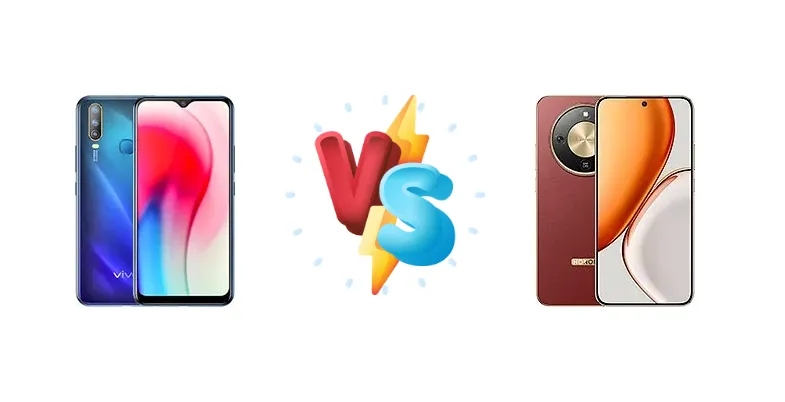
The vivo Y3 and Honor X9d represent two distinct approaches to the budget smartphone market. The Y3 aims for affordability, while the X9d attempts to deliver a more modern experience with a newer chipset and faster charging. This comparison dissects their specifications to determine which device offers the best value.
🏆 Quick Verdict
For most users, the Honor X9d is the superior choice. Its Snapdragon 6 Gen 4 chipset provides a substantial performance boost over the vivo Y3’s Helio P35, and the 66W charging is a game-changer. While the Y3 is cheaper, the X9d’s improvements justify the price difference.
| Network |
|---|
| 2G bands | GSM 850 / 900 / 1800 / 1900 | GSM 850 / 900 / 1800 / 1900 |
| 3G bands | HSDPA 850 / 900 / 2100 | HSDPA 850 / 900 / 1700(AWS) / 1900 / 2100 |
| 4G bands | 1, 3, 5, 8, 34, 38, 39, 40, 41 | LTE |
| 5G bands | - | SA/NSA |
| Speed | HSPA 42.2/5.76 Mbps, LTE (2CA) Cat6 400/50 Mbps | HSPA, LTE, 5G |
| Technology | GSM / CDMA / HSPA / EVDO / LTE | GSM / HSPA / LTE / 5G |
| | CDMA2000 1xEV-DO | - |
| Launch |
|---|
| Announced | 2019, May. Released 2019, May | 2025, September 24 |
| Status | Discontinued | Available. Released 2025, October 09 |
| Body |
|---|
| Dimensions | 159.4 x 76.7 x 8.9 mm (6.28 x 3.02 x 0.35 in) | 161.9 x 76.1 x 7.8 mm (6.37 x 3.00 x 0.31 in) |
| SIM | Nano-SIM + Nano-SIM | Nano-SIM + Nano-SIM |
| Weight | 190.5 g (6.70 oz) | 193 g (6.81 oz) |
| Display |
|---|
| Protection | - | Aluminosilicate glass |
| Resolution | 720 x 1544 pixels, 19.3:9 ratio (~268 ppi density) | 1200 x 2640 pixels (~427 ppi density) |
| Size | 6.35 inches, 99.6 cm2 (~81.5% screen-to-body ratio) | 6.79 inches, 112.1 cm2 (~90.9% screen-to-body ratio) |
| Type | IPS LCD | AMOLED, 1B colors, 120Hz, 3840Hz PWM, HDR, 800 nits (typ), 1800 nits (HBM), 6000 nits (peak) |
| Platform |
|---|
| CPU | Octa-core (4x2.3 GHz Cortex-A53 & 4x1.8 GHz Cortex-A53) | Octa-core (1x2.3 GHz Cortex-A720s & 3x2.2 GHz Cortex-A720s & 4x1.8 GHz Cortex-A520s) |
| Chipset | Mediatek MT6765 Helio P35 (12 nm) | Qualcomm Snapdragon 6 Gen 4 (4 nm) |
| GPU | PowerVR GE8320 | Adreno 810 |
| OS | Android 9.0 (Pie), Funtouch 9.0 | Android 15, Magic OS 9 |
| Memory |
|---|
| Card slot | microSDXC (dedicated slot) | No |
| Internal | 128GB 4GB RAM, 128GB 6GB RAM | 256GB 8GB RAM, 256GB 12GB RAM, 512GB 12GB RAM |
| | eMMC 5.1 | - |
| Main Camera |
|---|
| Dual | - | 108 MP, f/1.8, (wide), PDAF, OIS
5 MP, f/2.2, (ultrawide) |
| Features | LED flash, HDR, panorama | LED flash, panorama, HDR |
| Triple | 13 MP, f/2.2, (wide), PDAF
8 MP, f/2.2, 13mm (ultrawide)
Auxiliary lens | - |
| Video | 1080p@30fps | 4K@30fps, 1080p@30fps, gyro-EIS |
| Selfie camera |
|---|
| Single | 16 MP, f/2.0, 26mm (wide), 1/3.06", 1.0µm | 16 MP, f/2.5, (wide) |
| Video | 1080p@30fps | 1080p@30fps |
| Sound |
|---|
| 3.5mm jack | Yes | - |
| 35mm jack | Yes | No |
| Loudspeaker | Yes | Yes, with stereo speakers |
| Comms |
|---|
| Bluetooth | 5.0, A2DP, LE | 5.2, A2DP, LE, aptX HD, aptX Adaptive |
| NFC | No | Yes |
| Positioning | GPS, BDS | GPS, GALILEO, GLONASS, BDS |
| Radio | FM radio | No |
| USB | microUSB 2.0, OTG | USB Type-C 2.0, OTG |
| WLAN | Wi-Fi 802.11 a/b/g/n/ac, dual-band, Wi-Fi Direct | Wi-Fi 802.11 a/b/g/n/ac/6, dual-band, Wi-Fi Direct |
| Features |
|---|
| Sensors | Fingerprint (rear-mounted), accelerometer, proximity, compass | Fingerprint (under display, optical), accelerometer, compass, gyro, proximity |
| Battery |
|---|
| Charging | 18W wired | 66W wired
7.5W reverse wired |
| Type | 5000 mAh, non-removable | Si/C Li-Ion 8300 mAh |
| Misc |
|---|
| Colors | Peacock blue, Peach powder (pink), Ink blue | Reddish Brown, Midnight Black, Sunrise Gold, Forest Green |
| Models | - | MTN-NX1 |
| Price | About 190 EUR | About 300 EUR |
vivo Y3
- Lower price point makes it accessible to budget-conscious buyers.
- Simple and easy-to-use interface.
- Potentially longer battery life due to less demanding chipset (depending on battery capacity).
- Significantly slower performance compared to the Honor X9d.
- Slow 18W charging.
- Older chipset may limit software update support.
Honor X9d
- Much faster Snapdragon 6 Gen 4 chipset for smoother performance.
- 66W fast charging significantly reduces charging times.
- 7.5W reverse wired charging for topping up other devices.
- Higher price compared to the vivo Y3.
- Potentially shorter battery life due to more powerful chipset (depending on battery capacity).
- May include bloatware (typical for Honor devices).
Display Comparison
Neither device's display specifications are provided, so a direct comparison is limited. However, given the Y3's positioning, it likely features a standard 60Hz LCD panel. The X9d, benefiting from a more recent launch, may incorporate a higher refresh rate display, potentially 90Hz or 120Hz, for smoother scrolling. The X9d's likely higher price point suggests a better panel in terms of color accuracy and peak brightness, though this remains speculative without further data.
Camera Comparison
Without detailed camera specifications, a precise comparison is difficult. However, the X9d’s more modern chipset likely includes a more advanced image signal processor (ISP), leading to better image processing and potentially improved low-light performance. The Y3’s Helio P35 is likely paired with a simpler camera system. While both phones may feature multiple lenses, the X9d is more likely to offer features like improved dynamic range and noise reduction. We can assume the X9d will have a more capable main sensor.
Performance
The core difference lies in the chipsets. The vivo Y3’s MediaTek Helio P35 (12nm) utilizes older Cortex-A53 cores, resulting in noticeably slower performance compared to the Honor X9d’s Qualcomm Snapdragon 6 Gen 4 (4nm). The Snapdragon 6 Gen 4’s newer Cortex-A720s cores offer a significant architectural improvement, translating to faster app loading times, smoother multitasking, and better gaming performance. The 4nm process node of the Snapdragon 6 Gen 4 also contributes to improved thermal efficiency, reducing the likelihood of throttling during sustained workloads. This benefits gamers and users who frequently use demanding applications.
Battery Life
While battery capacities aren't specified, the Honor X9d’s 66W wired charging is a massive advantage over the vivo Y3’s 18W charging. This means the X9d can replenish its battery much faster, minimizing downtime. The X9d also features 7.5W reverse wired charging, allowing it to top up other devices, a feature absent on the Y3. Even if the Y3 has a slightly larger battery capacity, the X9d’s faster charging will likely result in a more convenient user experience.
Buying Guide
Buy the vivo Y3 if your primary need is a basic smartphone for essential tasks like calls, texts, and light social media, and you're operating on an extremely tight budget. Buy the Honor X9d if you prioritize smoother performance for apps and multitasking, faster charging speeds, and a more future-proofed experience, even if it means spending a bit more.
Frequently Asked Questions
❓ Will the Snapdragon 6 Gen 4 in the Honor X9d handle demanding games like PUBG Mobile?
The Snapdragon 6 Gen 4 is a significant step up from the Helio P35. While it's not a flagship gaming chip, it should be capable of running PUBG Mobile at medium settings with reasonable frame rates. The improved GPU and thermal efficiency will provide a more consistent gaming experience compared to the Y3.
❓ How much faster is the 66W charging on the Honor X9d compared to the 18W charging on the vivo Y3?
The 66W charging on the X9d is substantially faster. While exact times depend on battery capacity, you can expect the X9d to charge from 0-100% in around 45-60 minutes, whereas the Y3 could take over 2 hours with its 18W charger. This difference is particularly noticeable for users who frequently need to quickly top up their phone.
❓ Does the Honor X9d support software updates for a longer period than the vivo Y3?
Generally, devices with newer chipsets receive longer software support. The Snapdragon 6 Gen 4 in the X9d is more likely to receive Android version updates and security patches for a longer duration compared to the older Helio P35 in the Y3. This is a key consideration for long-term usability.