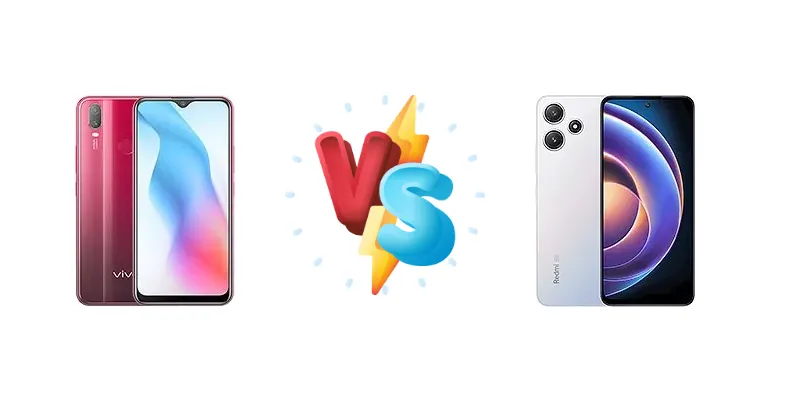
The entry-level smartphone market is fiercely competitive. The vivo Y3 Standard, powered by the older Snapdragon 439, represents a cost-optimized approach. The Xiaomi Redmi Note 12R, featuring the newer Snapdragon 4 Gen 2, aims to deliver a more modern experience. This comparison dissects the key differences to help you determine which device offers the best value for your needs.
🏆 Quick Verdict
For most users, the Xiaomi Redmi Note 12R is the superior choice. Its Snapdragon 4 Gen 2 chipset provides a significant performance uplift over the Y3 Standard’s Snapdragon 439, coupled with faster 18W charging. While the Y3 Standard is cheaper, the performance gains and improved efficiency of the Redmi Note 12R justify the price premium.
| Network |
|---|
| 2G bands | GSM 850 / 900 / 1800 / 1900 | GSM 850 / 900 / 1800 / 1900 |
| 3G bands | HSDPA 850 / 900 / 2100 | HSDPA 850 / 900 / 2100 |
| 4G bands | 1, 3, 5, 8, 34, 38, 39, 40, 41 | 1, 3, 5, 8, 34, 38, 39, 40, 41 |
| 5G bands | - | 1, 5, 8, 28, 41, 78 SA/NSA |
| Speed | HSPA, LTE | HSPA, LTE, 5G |
| Technology | GSM / CDMA / HSPA / EVDO / LTE | GSM / CDMA / HSPA / EVDO / LTE / 5G |
| | CDMA2000 1xEV-DO | - |
| Launch |
|---|
| Announced | 2019, November. Released 2019, November | 2023, June 28 |
| Status | Discontinued | Available. Released 2023, June 28 |
| Body |
|---|
| Build | - | Glass front, plastic frame, glass back |
| Dimensions | 159.4 x 76.7 x 8.9 mm (6.28 x 3.02 x 0.35 in) | 168.6 x 76.3 x 8.2 mm (6.64 x 3.00 x 0.32 in) |
| SIM | Nano-SIM + Nano-SIM | Nano-SIM + Nano-SIM |
| Weight | 191.5 g (6.77 oz) | 199 g (7.02 oz) |
| Display |
|---|
| Resolution | 720 x 1544 pixels, 19.3:9 ratio (~268 ppi density) | 1080 x 2460 pixels (~396 ppi density) |
| Size | 6.35 inches, 99.6 cm2 (~81.5% screen-to-body ratio) | 6.79 inches, 109.5 cm2 (~85.1% screen-to-body ratio) |
| Type | IPS LCD | IPS LCD, 90Hz, 550 nits |
| Platform |
|---|
| CPU | Octa-core (4x1.95 GHz Cortex-A53 & 4x1.45 GHz Cortex A53) | Octa-core (2x2.2 GHz Cortex-A78 & 6x1.95 GHz Cortex-A55) |
| Chipset | Qualcomm SDM439 Snapdragon 439 (12 nm) | Qualcomm SM4450 Snapdragon 4 Gen 2 (4 nm) |
| GPU | Adreno 505 | Adreno 613 |
| OS | Android 9.0 (Pie), Funtouch 9.1 | Android 13, MIUI 14 |
| Memory |
|---|
| Card slot | microSDXC (dedicated slot) | microSDXC (uses shared SIM slot) |
| Internal | 64GB 3GB RAM | 128GB 4GB RAM, 128GB 6GB RAM, 128GB 8GB RAM, 256GB 8GB RAM |
| | eMMC 5.1 | - |
| Main Camera |
|---|
| Dual | - | 50 MP, f/1.8, (wide), PDAF
2 MP (macro) |
| Features | LED flash, HDR, panorama | LED flash, HDR |
| Triple | 13 MP, f/2.2, (wide), PDAF
Auxiliary lens | - |
| Video | 1080p@30fps | 1080p@30fps |
| Selfie camera |
|---|
| Features | - | HDR |
| Single | 8 MP, f/1.8 | 5 MP, f/2.2, (wide), 1/5.0", 1.12µm |
| Video | 1080p@30fps | 1080p@30fps |
| Sound |
|---|
| 3.5mm jack | Yes | - |
| 35mm jack | Yes | Yes |
| Loudspeaker | Yes | Yes |
| Comms |
|---|
| Bluetooth | 4.2, A2DP, LE | 5.3, A2DP, LE |
| Infrared port | - | Yes |
| NFC | No | Yes (market/region dependent) |
| Positioning | GPS, GLONASS, BDS | GPS, GLONASS, GALILEO, BDS |
| Radio | FM radio | No |
| USB | microUSB 2.0, OTG | USB Type-C |
| WLAN | Wi-Fi 802.11 b/g/n | Wi-Fi 802.11 a/b/g/n/ac, dual-band |
| Features |
|---|
| Sensors | Fingerprint (rear-mounted), accelerometer, proximity, compass | Fingerprint (side-mounted), accelerometer, compass |
| Battery |
|---|
| Charging | 10W wired | 18W wired, PD |
| Type | 5000 mAh, non-removable | Li-Po 5000 mAh |
| Misc |
|---|
| Colors | Ink blue, Jade Red | Black, Blue, Silver |
| Models | V1930A | 23076RA4BC |
| Price | About 130 EUR | About 150 EUR |
vivo Y3 Standard
- Lower price point makes it highly accessible.
- Potentially longer battery life due to less demanding chipset.
- Simple and straightforward user experience.
- Significantly slower performance compared to the Redmi Note 12R.
- Outdated chipset architecture.
- Slow 10W charging.
Xiaomi Redmi Note 12R
- Much faster performance thanks to the Snapdragon 4 Gen 2.
- Faster 18W charging with PD support.
- More efficient chipset for better battery life under load.
- Higher price compared to the vivo Y3 Standard.
- May not offer significantly better battery life in all scenarios.
- Potential for slightly more heat generation during intensive tasks.
Display Comparison
Neither device is expected to boast a high-end display. Given the market segment, both likely utilize LCD panels. However, display specifics are missing. The Redmi Note 12R’s potential for a higher resolution and better color calibration, due to its more modern chipset’s image signal processor, is a likely advantage. Bezels are expected to be similar, prioritizing cost reduction over premium aesthetics.
Camera Comparison
Without detailed camera specs, analysis is limited. However, the Redmi Note 12R benefits from the more advanced image signal processor (ISP) within the Snapdragon 4 Gen 2. This ISP enables better noise reduction, dynamic range, and overall image quality, even with similar sensor sizes. The Y3 Standard’s ISP is older and less capable. Expect the Redmi Note 12R to produce more detailed and vibrant photos, particularly in challenging lighting conditions. The presence of a more modern ISP also suggests better video recording capabilities.
Performance
The core difference lies in the chipsets. The vivo Y3 Standard’s Snapdragon 439 (12nm) uses older Cortex-A53 cores in a big.LITTLE configuration, while the Redmi Note 12R’s Snapdragon 4 Gen 2 (4nm) features more modern Cortex-A78 and A55 cores. This architectural shift, combined with the smaller 4nm process node, translates to a substantial performance improvement for the Redmi Note 12R – roughly 30-40% in CPU benchmarks and a more significant leap in GPU performance. The Redmi Note 12R will handle multitasking and graphically intensive apps with greater ease. The 4nm process also contributes to better thermal efficiency, reducing throttling during sustained workloads.
Battery Life
Battery capacity is not specified for either device. However, the Redmi Note 12R’s 18W charging with Power Delivery (PD) support is a clear advantage over the Y3 Standard’s 10W charging. 18W charging will significantly reduce charging times, offering greater convenience. While a larger battery capacity on the Y3 Standard might partially offset the slower charging, the efficiency gains of the Snapdragon 4 Gen 2 in the Redmi Note 12R could result in comparable real-world battery life despite a potentially smaller battery.
Buying Guide
Buy the vivo Y3 Standard if your primary need is an extremely affordable smartphone for basic tasks like calls, texts, and light social media use, and battery life is paramount. You're willing to accept slower performance and limited charging speed. Buy the Xiaomi Redmi Note 12R if you prioritize a smoother user experience, faster app loading times, and the ability to handle more demanding applications, even if it means spending a bit more upfront.
Frequently Asked Questions
❓ Will the Redmi Note 12R handle popular games like PUBG Mobile or Call of Duty?
The Snapdragon 4 Gen 2 in the Redmi Note 12R is capable of running PUBG Mobile and Call of Duty, but likely at medium graphics settings and frame rates. While not a dedicated gaming phone, it offers a significantly better gaming experience than the Snapdragon 439-powered Y3 Standard, which would struggle with these titles.
❓ Is the difference in charging speed between 10W and 18W really noticeable?
Yes, the difference is substantial. 10W charging can take over 3 hours to fully charge a typical smartphone battery. 18W charging with PD can reduce that time to around 1.5-2 hours, offering a much more convenient charging experience, especially for users who frequently need to top up their battery.
❓ Does the Redmi Note 12R support software updates for longer than the Y3 Standard?
Generally, Xiaomi provides longer software support for its devices compared to vivo's entry-level models. The Redmi Note 12R is likely to receive more Android version updates and security patches over its lifespan, ensuring a more secure and up-to-date user experience.