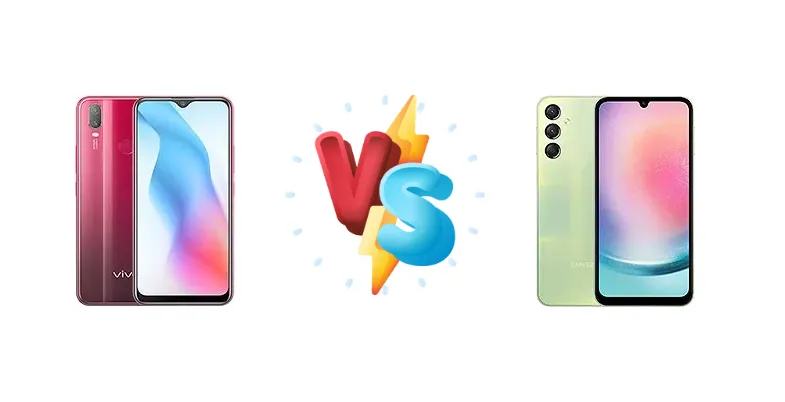
The Samsung Galaxy A24 4G and the vivo Y3 Standard represent two distinct approaches to the budget smartphone market. The A24 aims for a more modern experience with a brighter display and a more powerful chipset, while the Y3 Standard focuses on delivering basic functionality at an extremely competitive price point. This comparison dissects their key differences to help you choose the right phone for your needs.
🏆 Quick Verdict
For most users, the Samsung Galaxy A24 4G is the superior choice. Its Mediatek Helio G99 chipset offers significantly better performance than the Snapdragon 439 in the vivo Y3 Standard, and the brighter 1012 nit display provides a far more enjoyable viewing experience. While the Y3 Standard is cheaper, the A24’s improvements justify the price difference.
| Network |
|---|
| 2G bands | GSM 850 / 900 / 1800 / 1900 | GSM 850 / 900 / 1800 / 1900 |
| 3G bands | HSDPA 850 / 900 / 2100 | HSDPA 850 / 900 / 2100 |
| 4G bands | 1, 3, 5, 8, 34, 38, 39, 40, 41 | 1, 3, 5, 7, 8, 20, 28, 38, 40, 41 |
| Speed | HSPA, LTE | HSPA, LTE |
| Technology | GSM / CDMA / HSPA / EVDO / LTE | GSM / HSPA / LTE |
| | CDMA2000 1xEV-DO | - |
| Launch |
|---|
| Announced | 2019, November. Released 2019, November | 2023, April 19 |
| Status | Discontinued | Available. Released 2023, May 05 |
| Body |
|---|
| Build | - | Glass front, plastic frame, plastic back |
| Dimensions | 159.4 x 76.7 x 8.9 mm (6.28 x 3.02 x 0.35 in) | 162.1 x 77.6 x 8.3 mm (6.38 x 3.06 x 0.33 in) |
| SIM | Nano-SIM + Nano-SIM | · Nano-SIM· Nano-SIM + Nano-SIM |
| Weight | 191.5 g (6.77 oz) | 195 g (6.88 oz) |
| Display |
|---|
| Resolution | 720 x 1544 pixels, 19.3:9 ratio (~268 ppi density) | 1080 x 2340 pixels, 19.5:9 ratio (~396 ppi density) |
| Size | 6.35 inches, 99.6 cm2 (~81.5% screen-to-body ratio) | 6.5 inches, 103.7 cm2 (~82.4% screen-to-body ratio) |
| Type | IPS LCD | Super AMOLED, 90Hz, 1000 nits (peak) |
| Platform |
|---|
| CPU | Octa-core (4x1.95 GHz Cortex-A53 & 4x1.45 GHz Cortex A53) | Octa-core (2x2.2 GHz Cortex-A76 & 6x2.0 GHz Cortex-A55) |
| Chipset | Qualcomm SDM439 Snapdragon 439 (12 nm) | Mediatek Helio G99 (6 nm) |
| GPU | Adreno 505 | Mali-G57 MC2 |
| OS | Android 9.0 (Pie), Funtouch 9.1 | Android 13, up to 4 major Android upgrades, One UI 6 |
| Memory |
|---|
| Card slot | microSDXC (dedicated slot) | microSDXC (dedicated slot) |
| Internal | 64GB 3GB RAM | 128GB 4GB RAM, 128GB 6GB RAM, 128GB 8GB RAM |
| | eMMC 5.1 | - |
| Main Camera |
|---|
| Features | LED flash, HDR, panorama | LED flash, panorama, HDR |
| Triple | 13 MP, f/2.2, (wide), PDAF
Auxiliary lens | 50 MP, f/1.8, 27mm (wide), 1/2.76", 0.64µm, PDAF, OIS
5 MP, f/2.2, 17mm, 123˚ (ultrawide), 1/5.0", 1.12µm
2 MP (macro) |
| Video | 1080p@30fps | 1080p@30fps, gyro-EIS |
| Selfie camera |
|---|
| Single | 8 MP, f/1.8 | 13 MP, f/2.2, 25mm (wide), 1/3.06", 1.12µm |
| Video | 1080p@30fps | 1080p@30fps |
| Sound |
|---|
| 3.5mm jack | Yes | - |
| 35mm jack | Yes | Yes |
| Loudspeaker | Yes | Yes |
| Comms |
|---|
| Bluetooth | 4.2, A2DP, LE | 5.3, A2DP, LE |
| NFC | No | Yes (market/region dependent) |
| Positioning | GPS, GLONASS, BDS | GPS, GLONASS, GALILEO, BDS, QZSS |
| Radio | FM radio | Unspecified |
| USB | microUSB 2.0, OTG | USB Type-C 2.0 |
| WLAN | Wi-Fi 802.11 b/g/n | Wi-Fi 802.11 a/b/g/n/ac, dual-band, Wi-Fi Direct |
| Features |
|---|
| Sensors | Fingerprint (rear-mounted), accelerometer, proximity, compass | Fingerprint (side-mounted), accelerometer, gyro, compass |
| Battery |
|---|
| Charging | 10W wired | 25W wired |
| Type | 5000 mAh, non-removable | Li-Po 5000 mAh |
| Misc |
|---|
| Colors | Ink blue, Jade Red | Black, Lime Green, Blue gradient, Dark red |
| Models | V1930A | SM-A245F, SM-A245F/DS, SM-A245F/DSN, SM-A245M, SM-A245M/DS, SM-A245N |
| Price | About 130 EUR | About 150 EUR |
| SAR EU | - | 0.41 W/kg (head) 1.30 W/kg (body) |
vivo Y3 Standard
- Significantly faster processor (Helio G99)
- Much brighter and more vibrant display (1012 nits)
- Faster 25W charging
- Better camera image processing
- Higher price point
- May not have expandable storage (check specific model)
Samsung Galaxy A24 4G
- Lower price
- Potentially longer battery life under light use
- Simple and easy-to-use interface
- Slow Snapdragon 439 processor
- Dimmer display
- Slow 10W charging
- Limited performance for gaming and demanding apps
Display Comparison
The Samsung Galaxy A24 4G boasts a significantly brighter display, reaching a measured peak brightness of 1012 nits. This is a substantial advantage over the vivo Y3 Standard, which lacks specific brightness data but is expected to be considerably dimmer given its lower price point. The higher brightness of the A24 translates to better visibility outdoors and a more immersive viewing experience. While both likely utilize LCD panels, the A24’s superior brightness and contrast make it the clear winner for media consumption and everyday use.
Camera Comparison
While both phones feature a camera, detailed specifications are limited for the vivo Y3 Standard. The Samsung Galaxy A24 4G’s camera system, though not flagship-level, benefits from a more modern image signal processor (ISP) within the Helio G99 chipset. This allows for improved image processing, potentially resulting in better dynamic range and noise reduction. The A24’s lens aperture and sensor size are likely superior, contributing to better low-light performance. The presence of a dedicated night mode on the A24 further enhances its photographic capabilities, something likely absent on the Y3 Standard.
Performance
The performance gap between these two devices is considerable. The Samsung Galaxy A24 4G is powered by the Mediatek Helio G99, a 6nm chipset featuring two Cortex-A76 cores clocked at 2.2 GHz and six Cortex-A55 cores at 2.0 GHz. This contrasts sharply with the vivo Y3 Standard’s Qualcomm Snapdragon 439, a 12nm chip with four Cortex-A53 cores at 1.95 GHz and four at 1.45 GHz. The Helio G99’s newer architecture and higher clock speeds deliver a noticeable performance boost in both single-core and multi-core tasks, making the A24 far more responsive and capable of handling demanding applications and games. The 6nm process also contributes to better thermal efficiency, reducing the likelihood of throttling during extended use.
Battery Life
The Samsung Galaxy A24 4G has an endurance rating of 141 hours, indicating solid battery life. While the vivo Y3 Standard’s battery capacity is unknown, its less powerful chipset and dimmer display likely result in comparable, if not slightly longer, battery life under light usage. However, the A24’s 25W wired charging is a significant advantage over the Y3 Standard’s slow 10W charging. This means the A24 can be charged much faster, minimizing downtime and providing greater convenience.
Buying Guide
Buy the vivo Y3 Standard if you prioritize absolute affordability and only need a phone for basic tasks like calls, texts, and light social media. It’s a suitable option for first-time smartphone users or those on a very tight budget. Buy the Samsung Galaxy A24 4G if you value performance, a vibrant display, and a more future-proof experience. It’s ideal for users who enjoy mobile gaming, streaming videos, or taking photos regularly.
Frequently Asked Questions
❓ Does the Mediatek Helio G99 in the Samsung Galaxy A24 4G get hot during prolonged gaming sessions?
The Helio G99 is a relatively efficient chipset, and the Samsung Galaxy A24 4G’s thermal design is adequate for moderate gaming. While some heat is expected during extended gameplay, the 6nm process node helps to mitigate throttling compared to older, larger-node chipsets. Expect playable frame rates in most popular titles, but don't anticipate sustained peak performance for hours on end.
❓ Is the camera on the Samsung Galaxy A24 4G good enough for casual photography and social media?
Yes, the Samsung Galaxy A24 4G’s camera is well-suited for casual photography and social media sharing. While it doesn’t compete with flagship-level cameras, the Helio G99’s ISP and likely larger sensor size deliver respectable image quality in good lighting conditions. Features like night mode can improve low-light performance, and the camera app offers various shooting modes for creative expression.
❓ Can the vivo Y3 Standard handle popular games like PUBG Mobile or Call of Duty Mobile?
The Snapdragon 439 in the vivo Y3 Standard is not ideal for demanding games like PUBG Mobile or Call of Duty Mobile. While you might be able to run them at the lowest settings, expect significant frame rate drops and lag, making the experience less enjoyable. The phone is better suited for less graphically intensive games.