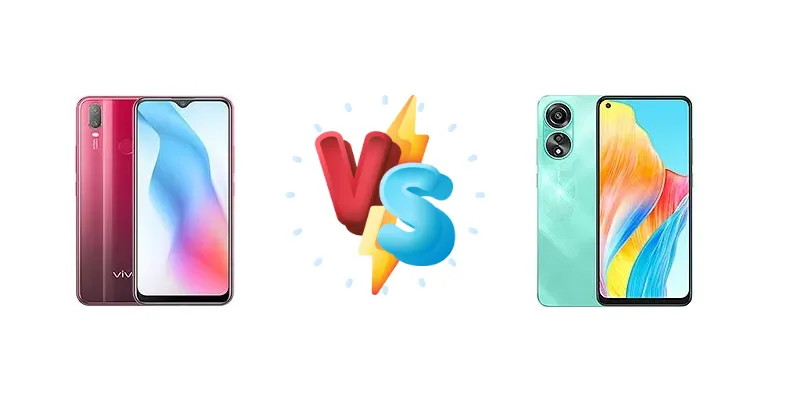
The sub-$200 smartphone market is fiercely competitive. Both the vivo Y3 Standard and the Oppo A78 4G aim to deliver essential smartphone functionality at an accessible price. However, they take distinctly different approaches to achieving this, with the Oppo A78 4G prioritizing fast charging and a newer chipset, while the vivo Y3 Standard focuses on a more basic, cost-optimized experience. This comparison will dissect the key differences to help you choose the right device.
🏆 Quick Verdict
For most users, the Oppo A78 4G is the superior choice. Its Snapdragon 680 chipset, built on a more efficient 6nm process, provides a noticeable performance boost over the vivo Y3 Standard’s Snapdragon 439. Crucially, the 67W charging support dramatically reduces downtime, making it ideal for users who rely heavily on their phones throughout the day.
| Network |
|---|
| 2G bands | GSM 850 / 900 / 1800 / 1900 | GSM 850 / 900 / 1800 / 1900 |
| 3G bands | HSDPA 850 / 900 / 2100 | HSDPA 850 / 900 / 2100 |
| 4G bands | 1, 3, 5, 8, 34, 38, 39, 40, 41 | LTE |
| Speed | HSPA, LTE | HSPA, LTE |
| Technology | GSM / CDMA / HSPA / EVDO / LTE | GSM / HSPA / LTE |
| | CDMA2000 1xEV-DO | - |
| Launch |
|---|
| Announced | 2019, November. Released 2019, November | 2023, July 10 |
| Status | Discontinued | Available. Released 2023, July 10 |
| Body |
|---|
| Dimensions | 159.4 x 76.7 x 8.9 mm (6.28 x 3.02 x 0.35 in) | 160 x 73.2 x 7.9 mm (6.30 x 2.88 x 0.31 in) |
| SIM | Nano-SIM + Nano-SIM | Nano-SIM + Nano-SIM |
| Weight | 191.5 g (6.77 oz) | 180 g (6.35 oz) |
| Display |
|---|
| Protection | - | Corning Gorilla Glass 5 |
| Resolution | 720 x 1544 pixels, 19.3:9 ratio (~268 ppi density) | 1080 x 2400 pixels, 20:9 ratio (~409 ppi density) |
| Size | 6.35 inches, 99.6 cm2 (~81.5% screen-to-body ratio) | 6.43 inches, 99.8 cm2 (~85.2% screen-to-body ratio) |
| Type | IPS LCD | AMOLED, 90Hz, 430 nits |
| Platform |
|---|
| CPU | Octa-core (4x1.95 GHz Cortex-A53 & 4x1.45 GHz Cortex A53) | Octa-core (4x2.4 GHz Kryo 265 Gold & 4x1.9 GHz Kryo 265 Silver) |
| Chipset | Qualcomm SDM439 Snapdragon 439 (12 nm) | Qualcomm SM6225 Snapdragon 680 4G (6 nm) |
| GPU | Adreno 505 | Adreno 610 |
| OS | Android 9.0 (Pie), Funtouch 9.1 | Android 13, ColorOS 13.1 |
| Memory |
|---|
| Card slot | microSDXC (dedicated slot) | microSDXC |
| Internal | 64GB 3GB RAM | 128GB 8GB RAM, 256GB 8GB RAM |
| | eMMC 5.1 | - |
| Main Camera |
|---|
| Dual | - | 50 MP, f/1.8, (wide), PDAF
Auxiliary lens |
| Features | LED flash, HDR, panorama | LED flash, HDR, panorama |
| Triple | 13 MP, f/2.2, (wide), PDAF
Auxiliary lens | - |
| Video | 1080p@30fps | 1080p@30fps |
| Selfie camera |
|---|
| Single | 8 MP, f/1.8 | 8 MP, f/2.0, (wide) |
| Video | 1080p@30fps | 1080p@30fps |
| Sound |
|---|
| 3.5mm jack | Yes | - |
| 35mm jack | Yes | Yes |
| Loudspeaker | Yes | Yes, with stereo speakers |
| Comms |
|---|
| Bluetooth | 4.2, A2DP, LE | 5.0, A2DP, LE |
| NFC | No | Yes (market/region dependent) |
| Positioning | GPS, GLONASS, BDS | GPS, GALILEO, GLONASS, BDS |
| Radio | FM radio | No |
| USB | microUSB 2.0, OTG | USB Type-C 2.0, OTG |
| WLAN | Wi-Fi 802.11 b/g/n | Wi-Fi 802.11 a/b/g/n/ac, dual-band |
| Features |
|---|
| Sensors | Fingerprint (rear-mounted), accelerometer, proximity, compass | Fingerprint (under display, optical), accelerometer, gyro, proximity, compass |
| Battery |
|---|
| Charging | 10W wired | 67W wired, PD, 76% in 30 min |
| Type | 5000 mAh, non-removable | Li-Po 5000 mAh |
| Misc |
|---|
| Colors | Ink blue, Jade Red | Mist Black, Aqua Green |
| Models | V1930A | CPH2565 |
| Price | About 130 EUR | About 200 EUR |
vivo Y3 Standard
- Extremely affordable
- Functional for basic tasks
- Reliable Qualcomm chipset (albeit older)
- Slow 10W charging
- Outdated Snapdragon 439 chipset
- Likely limited software support
Oppo A78 4G
- Fast 67W charging with PD
- More powerful and efficient Snapdragon 680
- Likely better long-term software support
- Improved multitasking performance
- Slightly higher price point
- May not have a significantly better camera
Display Comparison
Neither device boasts a particularly impressive display. Details regarding panel type, resolution, and refresh rate are absent from the provided data, suggesting both likely utilize standard LCD panels. The focus here isn't on visual fidelity. However, the chipset powering the Oppo A78 4G has the headroom to potentially support a higher resolution or refresh rate display in other variants, hinting at future potential. The lack of information suggests both are targeting the lowest possible bill of materials.
Camera Comparison
Without detailed camera specifications, a direct comparison is difficult. However, the market segment suggests both phones will feature basic camera setups. The absence of information regarding sensor size or optical image stabilization (OIS) indicates neither device will excel in low-light photography. Image processing will likely be the differentiating factor, and Oppo generally employs more aggressive image enhancement algorithms, which may appeal to some users. The presence of a 2MP macro camera on either device is largely a marketing gimmick and should not be a deciding factor.
Performance
The core difference lies in the chipsets. The Oppo A78 4G’s Snapdragon 680 (6nm) is a significant upgrade over the vivo Y3 Standard’s Snapdragon 439 (12nm). The 6nm process node translates to improved power efficiency and reduced heat generation, meaning the A78 4G will likely sustain peak performance for longer periods. The CPU configuration also favors the Oppo device: 4x2.4 GHz Kryo 265 Gold cores paired with 4x1.9 GHz Kryo 265 Silver cores versus the Y3 Standard’s 4x1.95 GHz Cortex-A53 and 4x1.45 GHz Cortex-A53. This architectural difference, combined with the higher clock speeds, will result in noticeably faster app loading times and smoother multitasking on the A78 4G.
Battery Life
While battery capacity isn't specified, the charging capabilities are a major differentiator. The Oppo A78 4G’s 67W wired charging, with support for PD and a claimed 76% charge in 30 minutes, is a game-changer in this price bracket. The vivo Y3 Standard’s 10W charging is comparatively slow, requiring significantly longer to reach a full charge. Even if the Y3 Standard has a slightly larger battery capacity, the A78 4G’s faster charging will likely result in less downtime for the average user.
Buying Guide
Buy the vivo Y3 Standard if you prioritize absolute affordability and only need a phone for basic tasks like calls, texts, and light social media. It’s a functional device for those on a very tight budget. Buy the Oppo A78 4G if you value faster performance, significantly quicker charging, and a more modern chipset that will likely receive software updates for a longer period. It’s a worthwhile investment for anyone who wants a smoother, more responsive experience.
Frequently Asked Questions
❓ Will the Snapdragon 680 in the Oppo A78 4G handle popular games like PUBG Mobile smoothly?
The Snapdragon 680 is capable of running PUBG Mobile, but likely at medium settings to maintain a stable frame rate. While it's not a gaming powerhouse, it offers a significantly better gaming experience than the Snapdragon 439 in the vivo Y3 Standard, which may struggle even at lower settings.
❓ How much faster is the 67W charging on the Oppo A78 4G compared to the 10W charging on the vivo Y3 Standard in real-world use?
The difference is substantial. The Oppo A78 4G can gain a significant charge – 76% – in just 30 minutes. The vivo Y3 Standard, with its 10W charging, would likely take over 3 hours to reach a similar charge level, making the Oppo A78 4G far more convenient for users who need to quickly top up their battery.
❓ Does the Oppo A78 4G support Power Delivery (PD) for charging with other chargers?
Yes, the Oppo A78 4G explicitly supports Power Delivery (PD) charging. This means you can use a variety of PD-compatible chargers, including those for laptops and tablets, to charge the phone, offering greater flexibility.