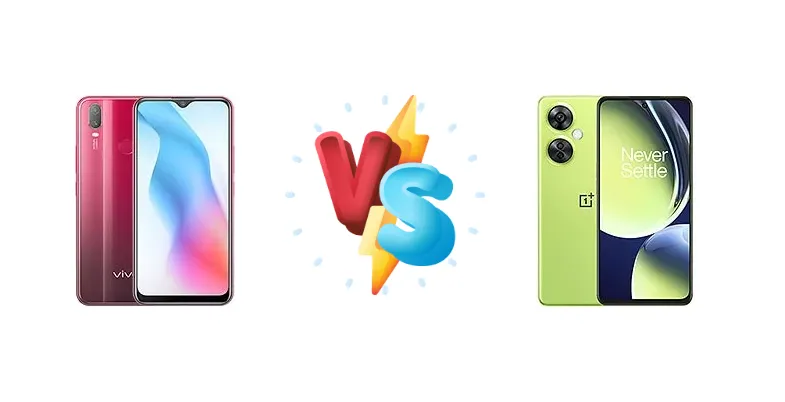
The smartphone market is flooded with options under $300, but performance and features vary wildly. We pit the OnePlus Nord CE 3 Lite, boasting a modern 5G chipset and blazing-fast charging, against the vivo Y3 Standard, a more basic offering focused on affordability. This comparison will dissect the key differences to help you determine which device best suits your needs.
🏆 Quick Verdict
For the average user, the OnePlus Nord CE 3 Lite is the clear winner. Its Snapdragon 695 5G chipset delivers significantly better performance and future-proofing than the Snapdragon 439 in the vivo Y3 Standard. The 67W charging is a game-changer, drastically reducing recharge times compared to the Y3 Standard’s slow 10W charging.
| Network |
|---|
| 2G bands | GSM 850 / 900 / 1800 / 1900 | GSM 850 / 900 / 1800 / 1900 |
| 3G bands | HSDPA 850 / 900 / 2100 | HSDPA 800 / 850 / 900 / 1700(AWS) / 1900 / 2100 - International |
| 4G bands | 1, 3, 5, 8, 34, 38, 39, 40, 41 | 1, 2, 3, 4, 5, 7, 8, 12, 13, 17, 18, 19, 20, 26, 28, 32, 38, 39, 40, 41, 66 - International |
| 5G bands | - | 1, 3, 5, 7, 8, 20, 28, 38, 40, 41, 66, 77, 78 SA/NSA - International |
| Speed | HSPA, LTE | HSPA, LTE, 5G |
| Technology | GSM / CDMA / HSPA / EVDO / LTE | GSM / HSPA / LTE / 5G |
| | CDMA2000 1xEV-DO | 1, 3, 5, 8, 28, 40, 41, 77, 78 SA/NSA - India |
| Launch |
|---|
| Announced | 2019, November. Released 2019, November | 2023, April 04 |
| Status | Discontinued | Available. Released 2023, April 11 |
| Body |
|---|
| Build | - | Glass front, plastic frame, plastic back |
| Dimensions | 159.4 x 76.7 x 8.9 mm (6.28 x 3.02 x 0.35 in) | 165.5 x 76 x 8.3 mm (6.52 x 2.99 x 0.33 in) |
| SIM | Nano-SIM + Nano-SIM | Nano-SIM + Nano-SIM |
| Weight | 191.5 g (6.77 oz) | 195 g (6.88 oz) |
| Display |
|---|
| Protection | - | Corning Gorilla Glass |
| Resolution | 720 x 1544 pixels, 19.3:9 ratio (~268 ppi density) | 1080 x 2400 pixels, 20:9 ratio (~391 ppi density) |
| Size | 6.35 inches, 99.6 cm2 (~81.5% screen-to-body ratio) | 6.72 inches, 109.6 cm2 (~87.1% screen-to-body ratio) |
| Type | IPS LCD | IPS LCD, 120Hz, 550 nits (typ), 680 nits (peak) |
| Platform |
|---|
| CPU | Octa-core (4x1.95 GHz Cortex-A53 & 4x1.45 GHz Cortex A53) | Octa-core (2x2.2 GHz Kryo 660 Gold & 6x1.7 GHz Kryo 660 Silver) |
| Chipset | Qualcomm SDM439 Snapdragon 439 (12 nm) | Qualcomm SM6375 Snapdragon 695 5G (6 nm) |
| GPU | Adreno 505 | Adreno 619 |
| OS | Android 9.0 (Pie), Funtouch 9.1 | Android 13, OxygenOS 13.1 |
| Memory |
|---|
| Card slot | microSDXC (dedicated slot) | microSDXC (uses shared SIM slot) |
| Internal | 64GB 3GB RAM | 128GB 8GB RAM, 256GB 8GB RAM |
| | eMMC 5.1 | UFS 2.2 |
| Main Camera |
|---|
| Features | LED flash, HDR, panorama | LED flash, HDR, panorama |
| Triple | 13 MP, f/2.2, (wide), PDAF
Auxiliary lens | 108 MP, f/1.8, (wide), 1/1.67", 0.64µm, PDAF
2 MP (macro)
Auxiliary lens |
| Video | 1080p@30fps | 1080p@30fps |
| Selfie camera |
|---|
| Features | - | HDR, panorama |
| Single | 8 MP, f/1.8 | 16 MP, f/2.4, (wide), 1.0µm |
| Video | 1080p@30fps | 1080p@30fps |
| Sound |
|---|
| 3.5mm jack | Yes | Yes |
| 35mm jack | Yes | Yes |
| Loudspeaker | Yes | Yes, with stereo speakers |
| Comms |
|---|
| Bluetooth | 4.2, A2DP, LE | 5.1, A2DP, LE, aptX HD |
| NFC | No | Yes (market/region dependent) |
| Positioning | GPS, GLONASS, BDS | GPS, GALILEO, GLONASS, BDS, QZSS |
| Radio | FM radio | No |
| USB | microUSB 2.0, OTG | USB Type-C 2.0, OTG |
| WLAN | Wi-Fi 802.11 b/g/n | Wi-Fi 802.11 a/b/g/n/ac, dual-band |
| Features |
|---|
| Sensors | Fingerprint (rear-mounted), accelerometer, proximity, compass | Fingerprint (side-mounted), accelerometer, gyro, proximity, compass |
| Battery |
|---|
| Charging | 10W wired | 67W wired, 80% in 30 min |
| Type | 5000 mAh, non-removable | Li-Po 5000 mAh |
| Misc |
|---|
| Colors | Ink blue, Jade Red | Pastel Lime, Chromatic Gray |
| Models | V1930A | CPH2467, CPH2465 |
| Price | About 130 EUR | £ 169.98 / € 209.99 |
| SAR | - | 1.17 W/kg (head) 0.70 W/kg (body) |
| Tests |
|---|
| Performance | - |
AnTuTu: 412006 (v9)
GeekBench: 2052 (v5)
GFXBench: 17fps (ES 3.1 onscreen) |
vivo Y3 Standard
- Extremely affordable price point
- Functional for basic smartphone tasks
- Potentially longer battery life due to less demanding chipset
- Slow Snapdragon 439 processor
- Outdated 10W charging
- Likely lower quality display
OnePlus Nord CE 3 Lite
- Significantly faster Snapdragon 695 5G processor
- Ultra-fast 67W SuperVOOC charging
- 5G connectivity for faster data speeds
- Higher price compared to the vivo Y3 Standard
- Potentially shorter battery life due to more powerful processor
- May lack some premium features found in higher-end devices
Display Comparison
Neither device’s display specifications are provided, so we must infer. Given the price point, both likely utilize LCD panels. However, the Nord CE 3 Lite, being a newer device, likely benefits from a higher peak brightness and potentially a more refined color calibration. The Y3 Standard, targeting the lowest price bracket, likely prioritizes cost savings over display quality. Bezels are expected to be larger on the Y3 Standard due to its older design.
Camera Comparison
Without specific camera sensor details, a direct comparison is difficult. However, the Snapdragon 695 typically supports more advanced image signal processors (ISPs) than the Snapdragon 439, leading to better image quality in the Nord CE 3 Lite. The Y3 Standard likely relies on basic computational photography techniques. It’s reasonable to assume the Nord CE 3 Lite will offer superior low-light performance and dynamic range. We can expect the Y3 Standard to include lower resolution sensors and lack features like optical image stabilization (OIS).
Performance
The performance gap between these two devices is substantial. The OnePlus Nord CE 3 Lite’s Snapdragon 695, built on a 6nm process, features a Kryo CPU architecture with 2x2.2 GHz performance cores and 6x1.7 GHz efficiency cores. This contrasts sharply with the vivo Y3 Standard’s Snapdragon 439, a 12nm chip with a less efficient Cortex-A53 based octa-core configuration peaking at 1.95 GHz. The 6nm node of the Snapdragon 695 translates to better thermal efficiency, meaning sustained performance will be higher, especially during demanding tasks. The Nord CE 3 Lite will handle multitasking and gaming far more smoothly.
Battery Life
Battery capacity isn’t specified for either device. However, the charging speed difference is a defining factor. The OnePlus Nord CE 3 Lite’s 67W SuperVOOC charging can replenish 80% of the battery in just 30 minutes, a massive convenience. The vivo Y3 Standard’s 10W charging is significantly slower, requiring several hours for a full charge. While the Y3 Standard might have a slightly larger battery capacity, the Nord CE 3 Lite’s fast charging effectively mitigates any potential disadvantage.
Buying Guide
Buy the vivo Y3 Standard if you prioritize absolute affordability and only need a phone for basic tasks like calls, texts, and light social media. It’s a functional device for those on a very tight budget. Buy the OnePlus Nord CE 3 Lite if you value performance, 5G connectivity, and fast charging. It’s ideal for users who enjoy mobile gaming, streaming video, or simply want a smoother, more responsive experience.
Frequently Asked Questions
❓ Will the Snapdragon 439 in the vivo Y3 Standard struggle with modern apps and multitasking?
Yes, the Snapdragon 439 is a relatively low-end chipset. While it can handle basic tasks, you'll likely experience lag and slowdowns when running multiple apps simultaneously or using demanding applications like social media or mobile games. It's best suited for light usage.
❓ How much faster is the 67W charging on the OnePlus Nord CE 3 Lite compared to the 10W charging on the vivo Y3 Standard in real-world use?
The difference is substantial. The Nord CE 3 Lite can go from 0% to 80% in approximately 30 minutes, while the Y3 Standard will take several hours to reach a full charge. This means you can quickly top up your Nord CE 3 Lite during short breaks, whereas the Y3 Standard requires overnight charging for consistent use.
❓ Does the OnePlus Nord CE 3 Lite support 5G in all regions?
The Snapdragon 695 is a 5G modem, but 5G availability depends on your carrier and region. Check with your mobile provider to confirm 5G compatibility in your area. The vivo Y3 Standard lacks 5G support.
❓ Is the performance difference between these phones noticeable for everyday tasks like browsing and social media?
Yes, even for everyday tasks, the Nord CE 3 Lite will feel noticeably smoother and more responsive. The Snapdragon 695’s faster processor and more efficient architecture result in quicker app loading times and a more fluid user experience.