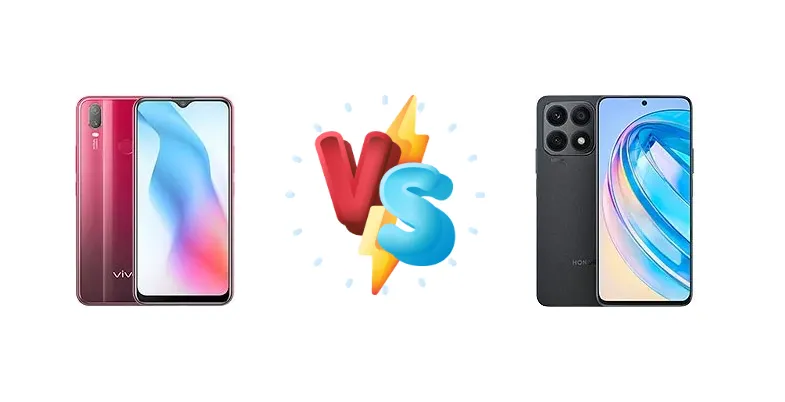
The sub-$150 smartphone market is fiercely competitive. Both the vivo Y3 Standard and the Honor X8a aim to deliver essential smartphone functionality at an accessible price. However, they take different approaches to achieving this, with the vivo relying on Qualcomm’s Snapdragon 439 and the Honor opting for MediaTek’s Helio G88. This comparison dissects the key differences to help you determine which device best suits your needs.
🏆 Quick Verdict
For most users, the Honor X8a emerges as the better choice. Its Helio G88 chipset offers a noticeable performance uplift over the Snapdragon 439 in the vivo Y3 Standard, and the significantly faster 22.5W charging is a game-changer for convenience. While the vivo is still functional, the Honor provides a more responsive and user-friendly experience.
| Network |
|---|
| 2G bands | GSM 850 / 900 / 1800 / 1900 | GSM 850 / 900 / 1800 / 1900 |
| 3G bands | HSDPA 850 / 900 / 2100 | HSDPA 850 / 900 / 2100 |
| 4G bands | 1, 3, 5, 8, 34, 38, 39, 40, 41 | LTE |
| Speed | HSPA, LTE | HSPA, LTE |
| Technology | GSM / CDMA / HSPA / EVDO / LTE | GSM / HSPA / LTE |
| | CDMA2000 1xEV-DO | Virtual proximity sensing |
| Launch |
|---|
| Announced | 2019, November. Released 2019, November | 2023, February 08 |
| Status | Discontinued | Available. Released 2023, February 11 |
| Body |
|---|
| Build | - | Glass front, plastic frame, plastic back |
| Dimensions | 159.4 x 76.7 x 8.9 mm (6.28 x 3.02 x 0.35 in) | 162.9 x 74.5 x 7.5 mm (6.41 x 2.93 x 0.30 in) |
| SIM | Nano-SIM + Nano-SIM | Nano-SIM + Nano-SIM |
| Weight | 191.5 g (6.77 oz) | 179 g (6.31 oz) |
| Display |
|---|
| Resolution | 720 x 1544 pixels, 19.3:9 ratio (~268 ppi density) | 1080 x 2388 pixels (~391 ppi density) |
| Size | 6.35 inches, 99.6 cm2 (~81.5% screen-to-body ratio) | 6.7 inches, 108.7 cm2 (~89.6% screen-to-body ratio) |
| Type | IPS LCD | IPS LCD, 90Hz |
| Platform |
|---|
| CPU | Octa-core (4x1.95 GHz Cortex-A53 & 4x1.45 GHz Cortex A53) | Octa-core (2x2.0 GHz Cortex-A75 & 6x1.8 GHz Cortex-A55) |
| Chipset | Qualcomm SDM439 Snapdragon 439 (12 nm) | Mediatek MT6769H Helio G88 (12 nm) |
| GPU | Adreno 505 | Mali-G52 MC2 |
| OS | Android 9.0 (Pie), Funtouch 9.1 | Android 12, Magic UI 6.1 |
| Memory |
|---|
| Card slot | microSDXC (dedicated slot) | No |
| Internal | 64GB 3GB RAM | 128GB 4GB RAM, 128GB 6GB RAM, 128GB 8GB RAM, 128GB 12GB RAM, 256GB 4GB RAM, 256GB 8GB RAM |
| | eMMC 5.1 | - |
| Main Camera |
|---|
| Features | LED flash, HDR, panorama | LED flash, panorama, HDR |
| Single | - | 16 MP, f/2.5 |
| Triple | 13 MP, f/2.2, (wide), PDAF
Auxiliary lens | 100 MP, f/1.9, (wide), AF
5 MP, f/2.2, (ultrawide)
2 MP (macro) |
| Video | 1080p@30fps | 1080p@30fps |
| Selfie camera |
|---|
| Single | 8 MP, f/1.8 | 16 MP, f/2.5 |
| Video | 1080p@30fps | 1080p@30fps |
| Sound |
|---|
| 3.5mm jack | Yes | No |
| 35mm jack | Yes | No |
| Loudspeaker | Yes | Yes |
| Comms |
|---|
| Bluetooth | 4.2, A2DP, LE | 5.1, A2DP, LE |
| NFC | No | Yes (CRT-LX1 only) |
| Positioning | GPS, GLONASS, BDS | GPS, GLONASS, GALILEO, BDS |
| Radio | FM radio | No |
| USB | microUSB 2.0, OTG | USB Type-C 2.0, OTG |
| WLAN | Wi-Fi 802.11 b/g/n | Wi-Fi 802.11 a/b/g/n/ac, dual-band, Wi-Fi Direct |
| Features |
|---|
| Sensors | Fingerprint (rear-mounted), accelerometer, proximity, compass | Fingerprint (side-mounted), accelerometer, compass |
| Battery |
|---|
| Charging | 10W wired | 22.5W wired, 50% in 30 min |
| Type | 5000 mAh, non-removable | Li-Po 4500 mAh |
| Misc |
|---|
| Colors | Ink blue, Jade Red | Cyan Lake, Titanium Silver, Midnight Black |
| Models | V1930A | CRT-LX1, CRT-LX2, CRT-LX3 |
| Price | About 130 EUR | About 170 EUR |
vivo Y3 Standard
- Potentially slightly better battery life due to lower performance demands.
- Reliable Qualcomm chipset with established software support.
- Simple and straightforward user experience.
- Significantly slower performance compared to the Honor X8a.
- Extremely slow 10W charging.
- Limited multitasking capabilities.
Honor X8a
- Faster and more responsive performance thanks to the Helio G88.
- Significantly faster 22.5W charging.
- Better suited for gaming and demanding apps.
- Potentially slightly shorter battery life due to higher performance.
- MediaTek chipset may have less long-term software support (historically).
- Image processing may be overly aggressive.
Display Comparison
Neither device boasts a standout display. Both are likely utilizing LCD panels, common in this price bracket. Without specific display specs, it's difficult to assess color accuracy or brightness. However, the focus here isn't on visual fidelity; it's on basic usability. Bezels are expected to be relatively thick on both, maximizing screen real estate within a budget. The absence of high refresh rates is also anticipated.
Camera Comparison
Camera performance is likely to be similar, with both devices prioritizing affordability over image quality. Without sensor size or aperture information, it’s safe to assume both rely on basic image processing. The presence of a 2MP macro camera on both is largely a marketing tactic, offering limited practical benefit. Expect acceptable results in well-lit conditions, but struggles in low light. The focus should be on capturing memories, not professional-grade photography.
Performance
The core difference lies in the chipsets. The Honor X8a’s MediaTek Helio G88 features two Cortex-A75 cores clocked at 2.0 GHz, paired with six Cortex-A55 cores at 1.8 GHz. This configuration provides a significant advantage over the vivo Y3 Standard’s Qualcomm Snapdragon 439, which uses eight Cortex-A53 cores split between 1.95 GHz and 1.45 GHz. The Helio G88’s A75 cores offer substantially higher single-core performance, translating to snappier app launches and smoother multitasking. While both are 12nm chips, the architectural improvements in the Helio G88 yield a more responsive user experience. The Honor X8a will likely handle moderately demanding games with more ease.
Battery Life
While battery capacity isn't specified, both devices likely house batteries in the 5000mAh range, typical for this segment. However, the Honor X8a’s 22.5W charging capability is a major advantage. The ability to reach 50% charge in just 30 minutes significantly reduces downtime compared to the vivo Y3 Standard’s slow 10W charging. This difference in charging speed dramatically impacts the user experience, making the Honor X8a far more convenient for users who are frequently on the go.
Buying Guide
Buy the vivo Y3 Standard if your primary need is a basic, reliable smartphone for essential tasks like calls, texts, and light social media, and you prioritize maximizing battery life over performance. Buy the Honor X8a if you want a more responsive device for everyday use, enjoy occasional gaming, and value the convenience of fast charging. The X8a is the better option for users who don't want to wait hours for a full charge.
Frequently Asked Questions
❓ Will the Helio G88 in the Honor X8a overheat during prolonged gaming sessions?
While the Helio G88 isn't a flagship gaming chip, it's generally well-managed in devices like the X8a. Expect some heat during extended gaming, but thermal throttling shouldn't be severe enough to render the phone unusable. The Snapdragon 439 in the Y3 Standard will likely heat up less, but also deliver significantly lower frame rates.
❓ Is the 10W charging on the vivo Y3 Standard realistically usable in 2024?
Frankly, no. 10W charging is extremely slow by modern standards. Expect a full charge to take several hours. This is a significant inconvenience for users accustomed to faster charging technologies. The Honor X8a’s 22.5W charging is a far more practical solution.
❓ Can the Honor X8a handle popular games like PUBG Mobile or Call of Duty Mobile?
The Honor X8a can run PUBG Mobile and Call of Duty Mobile, but you'll likely need to lower the graphics settings to medium or low to achieve a playable frame rate. Don't expect a flagship gaming experience, but it's certainly capable of casual gaming.
❓ Does either phone support software updates beyond the initial Android version?
Software update support is a known weakness in this price segment. While both brands promise updates, the frequency and duration are often limited. Historically, Honor has had a slightly better track record than vivo in providing updates, but expectations should remain modest.