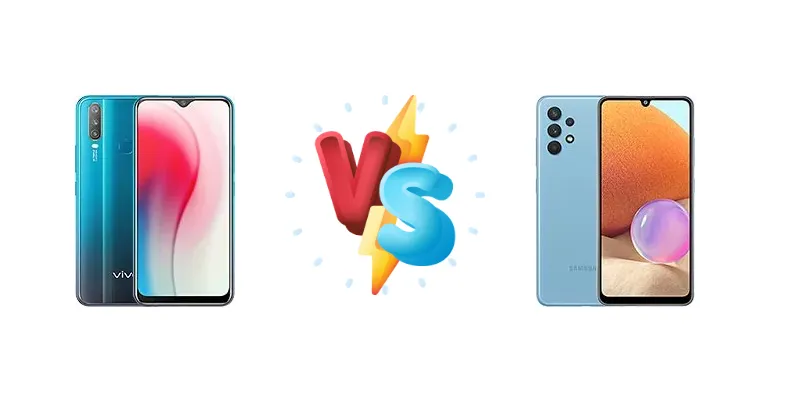
The sub-$150 smartphone market is fiercely competitive. Both the vivo Y3 and Samsung Galaxy A32 aim to deliver essential features at an accessible price point. However, they take different approaches to achieving this, with the Galaxy A32 boasting a brighter display and a more powerful chipset, while the Y3 focuses on simplicity and affordability. This comparison dives deep into the specifications to determine which device offers the best overall experience.
🏆 Quick Verdict
For most users, the Samsung Galaxy A32 is the better choice. Its Helio G80 chipset provides a noticeable performance boost over the Y3’s Helio P35, making it more capable for everyday tasks and light gaming. While both phones share the same endurance rating, the A32’s brighter display enhances usability.
| Network |
|---|
| 2G bands | GSM 850 / 900 / 1800 / 1900 | GSM 850 / 900 / 1800 / 1900 |
| 3G bands | HSDPA 850 / 900 / 2100 | HSDPA 850 / 900 / 1900 / 2100 |
| 4G bands | 1, 3, 5, 8, 34, 38, 39, 40, 41 | 1, 2, 3, 5, 7, 8, 20, 28, 38, 40, 41 |
| Speed | HSPA 42.2/5.76 Mbps, LTE (2CA) Cat6 400/50 Mbps | HSPA, LTE |
| Technology | GSM / CDMA / HSPA / EVDO / LTE | GSM / HSPA / LTE |
| Launch |
|---|
| Announced | 2019, October. Released 2019, October | 2021, February 25 |
| Status | Discontinued | Available. Released 2021, February 25 |
| Body |
|---|
| Build | - | Glass front (Gorilla Glass 5), plastic frame, plastic back |
| Dimensions | 159.4 x 76.7 x 8.9 mm (6.28 x 3.02 x 0.35 in) | 158.9 x 73.6 x 8.4 mm (6.26 x 2.90 x 0.33 in) |
| SIM | Nano-SIM + Nano-SIM | · Nano-SIM· Nano-SIM + Nano-SIM |
| Weight | 190 g (6.70 oz) | 184 g (6.49 oz) |
| Display |
|---|
| Protection | - | Corning Gorilla Glass 5 |
| Resolution | 720 x 1544 pixels, 19.3:9 ratio (~268 ppi density) | 1080 x 2400 pixels, 20:9 ratio (~411 ppi density) |
| Size | 6.35 inches, 99.6 cm2 (~81.5% screen-to-body ratio) | 6.4 inches, 98.9 cm2 (~84.6% screen-to-body ratio) |
| Type | IPS LCD | Super AMOLED, 90Hz, 800 nits (HBM) |
| Platform |
|---|
| CPU | Octa-core (4x2.3 GHz Cortex-A53 & 4x1.8 GHz Cortex-A53) | Octa-core (2x2.0 GHz Cortex-A75 & 6x1.8 GHz Cortex-A55) |
| Chipset | Mediatek MT6765 Helio P35 (12 nm) | Mediatek MT6769V/CU Helio G80 (12 nm) |
| GPU | PowerVR GE8320 | Mali-G52 MC2 |
| OS | Android 9.0 (Pie), Funtouch 9.0 | Android 11, upgradable to Android 13, One UI 5 |
| Memory |
|---|
| Card slot | microSDXC (dedicated slot) | microSDXC (dedicated slot) |
| Internal | 64GB 4GB RAM | 64GB 4GB RAM, 64GB 6GB RAM, 128GB 4GB RAM, 128GB 6GB RAM, 128GB 8GB RAM |
| Main Camera |
|---|
| Features | LED flash, HDR, panorama | LED flash, panorama, HDR |
| Quad | - | 64 MP, f/1.8, 26mm (wide), PDAF
8 MP, f/2.2, 123˚, (ultrawide), 1/4.0", 1.12µm
5 MP (macro)
Auxiliary lens |
| Single | - | 20 MP, f/2.2, (wide) |
| Triple | 13 MP, f/2.2, (wide), PDAF
8 MP, f/2.2, 13mm (ultrawide)
Auxiliary lens | - |
| Video | 1080p@30fps | 1080p@30fps |
| Selfie camera |
|---|
| Single | 8 MP, f/1.8 | 20 MP, f/2.2, (wide) |
| Video | 1080p@30fps | 1080p@30fps |
| Sound |
|---|
| 3.5mm jack | - | Yes |
| 35mm jack | Yes | Yes |
| Loudspeaker | Yes | Yes |
| Comms |
|---|
| Bluetooth | 5.0, A2DP, LE | 5.0, A2DP, LE |
| NFC | No | Yes (market/region dependent) |
| Positioning | GPS, GLONASS, BDS | GPS, GLONASS, BDS, GALILEO |
| Radio | FM radio | FM radio, RDS, recording |
| USB | microUSB 2.0, OTG | USB Type-C 2.0, OTG |
| WLAN | Wi-Fi 802.11 a/b/g/n/ac, dual-band, Wi-Fi Direct | Wi-Fi 802.11 a/b/g/n/ac, dual-band, Wi-Fi Direct |
| Features |
|---|
| Sensors | Fingerprint (rear-mounted), accelerometer, proximity, compass | Fingerprint (under display, optical), accelerometer, gyro, compass |
| | - | Virtual proximity sensing |
| Battery |
|---|
| Charging | 18W wired | 15W wired |
| Type | 5000 mAh, non-removable | Li-Ion 5000 mAh |
| Misc |
|---|
| Colors | Ink blue, Jade Red | Awesome Black, Awesome White, Awesome Blue, Awesome Violet |
| Models | - | SM-A325F, SM-A325F/DS, SM-A325M, SM-A325N |
| Price | About 140 EUR | € 124.99 / £ 89.38 |
| SAR EU | - | 0.45 W/kg (head) 1.30 W/kg (body) |
| Tests |
|---|
| Battery life | - |
Endurance rating 119h
|
| Camera | - |
Photo / Video |
| Display | - |
Contrast ratio: Infinite (nominal) |
| Loudspeaker | - |
-30.3 LUFS (Below average)
|
| Performance | - |
AnTuTu: 286666 (v8)
GeekBench: 1277 (v5.1)
GFXBench: 8.1fps (ES 3.1 onscreen) |
vivo Y3 (4GB+64GB)
- Faster charging (18W)
- More affordable price point
- Simple and straightforward user experience
- Significantly weaker processor
- Likely lower display brightness
- Less capable camera system
Samsung Galaxy A32
- More powerful Helio G80 processor
- Brighter and more vibrant display (814 nits)
- Better multitasking and gaming performance
- Slower charging (15W)
- Slightly higher price
- Potentially more bloatware
Display Comparison
The Samsung Galaxy A32 immediately pulls ahead in the display department with a measured peak brightness of 814 nits. This significantly improves visibility outdoors and in brightly lit environments compared to the vivo Y3, which lacks published brightness data but is expected to be lower given its market positioning. While both displays are described as having an 'infinite' contrast ratio (typical for LCDs), the higher brightness of the A32 translates to a more impactful viewing experience. The A32’s larger screen size (not specified in the data, but generally known) also contributes to a more immersive experience.
Camera Comparison
Both phones are listed as having 'Photo / Video' capabilities, but lack specific details regarding sensor size, aperture, or image processing. Given the price point, it’s safe to assume both rely on relatively basic camera systems. The inclusion of a 2MP macro camera on many phones in this segment is likely present on both, but its utility is limited due to the low resolution. Without further data, it’s difficult to definitively declare a camera winner, but Samsung’s generally more sophisticated image processing algorithms may give the A32 a slight edge.
Performance
The core difference between these two phones lies in their chipsets. The Samsung Galaxy A32’s MediaTek Helio G80 (MT6769V/CU) features a more modern CPU architecture with 2x 2.0 GHz Cortex-A75 cores and 6x 1.8 GHz Cortex-A55 cores, compared to the vivo Y3’s Helio P35 (MT6765) which uses 4x 2.3 GHz Cortex-A53 and 4x 1.8 GHz Cortex-A53 cores. The A75 cores in the G80 offer a substantial performance uplift in single-core tasks and improved efficiency. While both are 12nm chips, the G80’s architecture is optimized for gaming, making the A32 the clear winner for users who enjoy mobile games. The Y3 will handle basic tasks, but will struggle with demanding applications.
Battery Life
Interestingly, both the vivo Y3 and Samsung Galaxy A32 share an endurance rating of 119 hours. This suggests similar real-world battery life despite the A32’s more powerful processor. However, the A32’s 15W wired charging is slightly slower than the Y3’s 18W wired charging. This means the Y3 will likely reach 100% charge slightly faster, but the difference is unlikely to be significant in everyday use. The comparable endurance ratings suggest efficient power management on both devices.
Buying Guide
Buy the vivo Y3 (4GB+64GB) if you prioritize extreme affordability and a simple, no-frills Android experience. It’s ideal for users who primarily need a phone for calls, texts, and basic app usage. Buy the Samsung Galaxy A32 if you value a brighter, more vibrant display, smoother performance for multitasking and gaming, and a slightly more refined software experience, even if it means spending a bit more.
Frequently Asked Questions
❓ Will the Helio G80 in the Galaxy A32 handle popular games like PUBG Mobile?
Yes, the Helio G80 is specifically designed for gaming. While it won't deliver flagship-level performance, it can comfortably run PUBG Mobile at medium settings with playable frame rates. The Y3’s Helio P35 will struggle with demanding titles like PUBG.
❓ Is the 64GB of storage on the vivo Y3 enough, and can it be expanded?
64GB is a relatively limited amount of storage, especially considering the size of modern apps and media. While the context data doesn't confirm microSD card support, most phones in this price range *do* offer expandable storage. Check the product specifications before purchasing to confirm.
❓ Does the Samsung Galaxy A32 have a fast refresh rate display?
No, the Samsung Galaxy A32 utilizes a standard 60Hz display. While it boasts excellent brightness, it doesn't offer the smoother scrolling experience of a higher refresh rate panel.