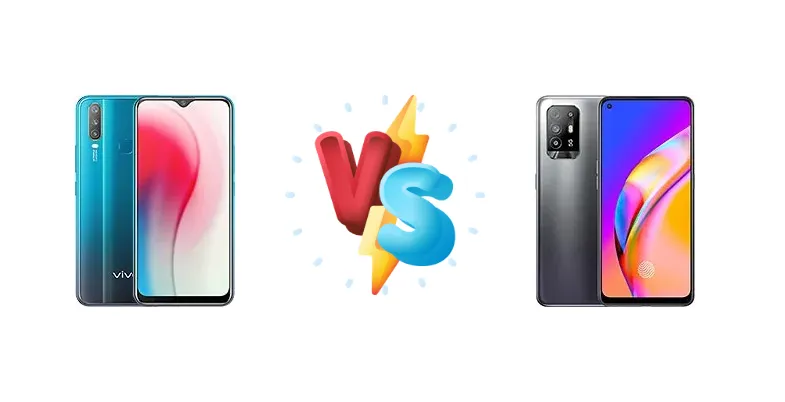
The smartphone market offers a wide spectrum of choices, and the Oppo F19 Pro+ 5G and vivo Y3 represent distinct points within the budget and mid-range segments. While both aim to deliver a functional smartphone experience, they diverge significantly in processing power and charging capabilities. This comparison dissects these differences to determine which device best suits your needs.
🏆 Quick Verdict
For the average user prioritizing responsiveness and future-proofing, the Oppo F19 Pro+ 5G is the clear winner. Its Dimensity 800U chipset offers a substantial performance leap over the vivo Y3’s Helio P35, coupled with significantly faster 50W charging. While the Y3 is more affordable, the F19 Pro+ 5G provides a better long-term user experience.
| Network |
|---|
| 2G bands | GSM 850 / 900 / 1800 / 1900 | GSM 850 / 900 / 1800 / 1900 - SIM 1 & SIM 2 |
| 3G bands | HSDPA 850 / 900 / 2100 | HSDPA 850 / 900 / 2100 |
| 4G bands | 1, 3, 5, 8, 34, 38, 39, 40, 41 | 1, 3, 5, 7, 8, 38, 40, 41 |
| 5G bands | - | 1, 41, 77, 78 SA/NSA |
| Speed | HSPA 42.2/5.76 Mbps, LTE (2CA) Cat6 400/50 Mbps | HSPA, LTE-A, 5G |
| Technology | GSM / CDMA / HSPA / EVDO / LTE | GSM / HSPA / LTE / 5G |
| Launch |
|---|
| Announced | 2019, October. Released 2019, October | 2021, March 08 |
| Status | Discontinued | Available. Released 2021, March 17 |
| Body |
|---|
| Dimensions | 159.4 x 76.7 x 8.9 mm (6.28 x 3.02 x 0.35 in) | 160.1 x 73.4 x 7.8 mm (6.30 x 2.89 x 0.31 in) |
| SIM | Nano-SIM + Nano-SIM | Dual SIM (Nano-SIM, dual stand-by) |
| Weight | 190 g (6.70 oz) | 173 g (6.10 oz) |
| Display |
|---|
| Protection | - | Corning Gorilla Glass 5 |
| Resolution | 720 x 1544 pixels, 19.3:9 ratio (~268 ppi density) | 1080 x 2400 pixels, 20:9 ratio (~409 ppi density) |
| Size | 6.35 inches, 99.6 cm2 (~81.5% screen-to-body ratio) | 6.43 inches, 99.8 cm2 (~84.9% screen-to-body ratio) |
| Type | IPS LCD | Super AMOLED, 430 nits (typ), 800 nits (peak) |
| Platform |
|---|
| CPU | Octa-core (4x2.3 GHz Cortex-A53 & 4x1.8 GHz Cortex-A53) | Octa-core (2x2.4 GHz Cortex-A76 & 6x2.0 GHz Cortex-A55) |
| Chipset | Mediatek MT6765 Helio P35 (12 nm) | Mediatek MT6853 Dimensity 800U (7 nm) |
| GPU | PowerVR GE8320 | Mali-G57 MC3 |
| OS | Android 9.0 (Pie), Funtouch 9.0 | Android 11, upgradable to Android 12, ColorOS 12 |
| Memory |
|---|
| Card slot | microSDXC (dedicated slot) | microSDXC (dedicated slot) |
| Internal | 64GB 4GB RAM | 128GB 8GB RAM |
| | - | UFS 2.1 |
| Main Camera |
|---|
| Features | LED flash, HDR, panorama | LED flash, HDR, panorama |
| Quad | - | 48 MP, f/1.7, 25mm (wide), 1/2.0", 0.8µm, PDAF
8 MP, f/2.2, 16mm, 119˚ (ultrawide), 1/4.0", 1.12µm
2 MP, f/2.4, (macro)
2 MP, f/2.4, (depth) |
| Single | - | 16 MP, f/2.4, 26mm (wide), 1/3.09", 1.0µm |
| Triple | 13 MP, f/2.2, (wide), PDAF
8 MP, f/2.2, 13mm (ultrawide)
Auxiliary lens | - |
| Video | 1080p@30fps | 4K@30fps, 1080p@30/120fps; gyro-EIS, HDR |
| Selfie camera |
|---|
| Features | - | HDR |
| Single | 8 MP, f/1.8 | 16 MP, f/2.4, 26mm (wide), 1/3.09", 1.0µm |
| Video | 1080p@30fps | 1080p@30fps |
| Sound |
|---|
| 3.5mm jack | - | Yes |
| 35mm jack | Yes | - |
| Loudspeaker | Yes | Yes |
| Comms |
|---|
| Bluetooth | 5.0, A2DP, LE | 5.1, A2DP, LE, aptX HD |
| NFC | No | No |
| Positioning | GPS, GLONASS, BDS | GPS, GLONASS, GALILEO, BDS |
| Radio | FM radio | Unspecified |
| USB | microUSB 2.0, OTG | USB Type-C 2.0, OTG |
| WLAN | Wi-Fi 802.11 a/b/g/n/ac, dual-band, Wi-Fi Direct | Wi-Fi 802.11 a/b/g/n/ac, dual-band, Wi-Fi Direct |
| Features |
|---|
| Sensors | Fingerprint (rear-mounted), accelerometer, proximity, compass | Fingerprint (under display, optical), accelerometer, gyro, proximity, compass |
| Battery |
|---|
| Charging | 18W wired | 50W wired, 100% in 48 min (advertised) |
| Type | 5000 mAh, non-removable | Li-Po 4310 mAh, non-removable |
| Misc |
|---|
| Colors | Ink blue, Jade Red | Fluid Black, Space Silver, Cosmo Blue |
| Models | - | CPH2213 |
| Price | About 140 EUR | ₹ 25,990 |
vivo Y3 (4GB+64GB)
- More affordable price point
- Potentially longer battery life (depending on capacity)
- Simple and straightforward user experience
- Significantly slower performance
- Slower charging speeds
- Inferior camera quality
Oppo F19 Pro+ 5G
- Much faster performance with Dimensity 800U
- 50W fast charging (100% in 48 mins)
- Likely superior display quality (AMOLED)
- 5G connectivity
- Higher price tag
- Potentially shorter battery life (depending on capacity)
- More complex software features
Display Comparison
Neither device’s display specifications are provided, so we must infer. Given the Y3’s positioning, it likely features a 720p+ LCD panel. The F19 Pro+ 5G, being a more premium offering, likely boasts a 1080p AMOLED display. This difference in panel technology translates to superior color accuracy, contrast, and viewing angles on the Oppo. While neither is likely to feature high refresh rates, the AMOLED panel on the F19 Pro+ 5G will offer a more visually pleasing experience.
Camera Comparison
Without detailed camera specs, a direct comparison is difficult. However, the F19 Pro+ 5G, positioned as a 'Pro' model, likely features a more capable primary sensor and potentially optical image stabilization (OIS). The Helio P35’s image signal processor (ISP) in the Y3 is less advanced, resulting in lower image quality, particularly in low-light conditions. While both phones likely include multiple rear cameras, the Y3’s secondary sensors are likely lower resolution and offer limited utility. The F19 Pro+ 5G’s ISP will likely offer more sophisticated image processing algorithms, resulting in better dynamic range and detail.
Performance
The core difference lies in the chipsets. The Oppo F19 Pro+ 5G’s Mediatek Dimensity 800U (7nm) is a significant upgrade over the vivo Y3’s Mediatek Helio P35 (12nm). The Dimensity 800U utilizes more efficient 7nm fabrication, resulting in better power efficiency and thermal management. Its CPU configuration – 2x2.4 GHz Cortex-A76 & 6x2.0 GHz Cortex-A55 – is architecturally superior to the Y3’s 4x2.3 GHz Cortex-A53 & 4x1.8 GHz Cortex-A53. The A76 cores provide a substantial boost in single-core performance, crucial for app responsiveness, while the A55 cores offer improved efficiency. This translates to faster app launches, smoother multitasking, and a more enjoyable gaming experience on the Oppo.
Battery Life
The battery capacity isn’t specified for either device. However, the charging speeds are drastically different. The vivo Y3 offers 18W wired charging, while the Oppo F19 Pro+ 5G boasts 50W wired charging, advertised to reach 100% in 48 minutes. This faster charging is a significant advantage for the Oppo, allowing users to quickly top up their battery and minimize downtime. Even if the Y3 has a slightly larger battery capacity, the F19 Pro+ 5G’s faster charging will likely result in a more convenient user experience.
Buying Guide
Buy the vivo Y3 (4GB+64GB) if you need a basic smartphone for essential tasks like calls, messaging, and light social media use, and your budget is extremely limited. Buy the Oppo F19 Pro+ 5G if you prioritize smoother multitasking, faster app loading times, 5G connectivity, and significantly quicker charging – making it ideal for users who consume more media and demand a more responsive experience.
Frequently Asked Questions
❓ Is the Mediatek Helio P35 in the vivo Y3 sufficient for playing modern mobile games?
The Helio P35 is a basic chipset and will struggle with demanding games. While it can handle less graphically intensive titles, expect low frame rates and significant lag in popular games like PUBG or Call of Duty Mobile, even on low settings. The Oppo F19 Pro+ 5G’s Dimensity 800U is far better suited for gaming.
❓ How much faster is the 50W charging on the Oppo F19 Pro+ 5G compared to the 18W charging on the vivo Y3?
The 50W charging on the F19 Pro+ 5G is significantly faster. Oppo advertises a full charge in 48 minutes. The Y3’s 18W charging will likely take over 2 hours to fully charge, making the Oppo a much more convenient option for users who frequently need to top up their battery.
❓ Does the Oppo F19 Pro+ 5G support carrier aggregation for improved 5G speeds?
The Dimensity 800U chipset supports carrier aggregation, which allows the phone to combine multiple 5G channels for faster and more stable download speeds. This is a significant advantage in areas with strong 5G coverage, providing a smoother streaming and browsing experience.