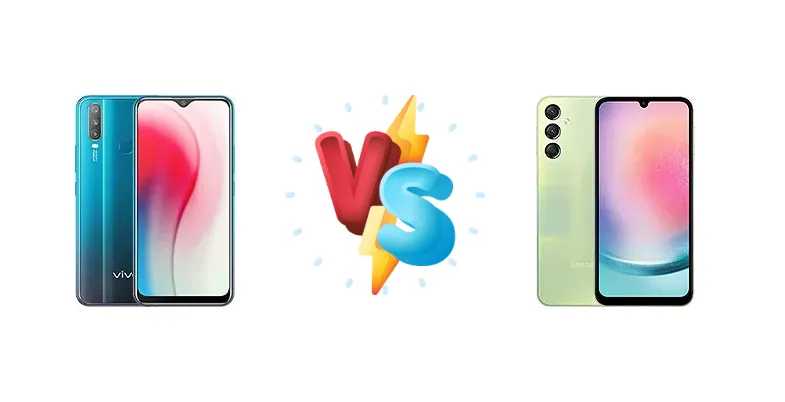
The sub-$200 smartphone market is fiercely competitive. The vivo Y3, with its focus on affordability, goes head-to-head with the Samsung Galaxy A24 4G, which aims to deliver a more well-rounded experience. This comparison dissects the key differences between these two devices, focusing on where each excels and who will benefit most from their respective strengths.
🏆 Quick Verdict
For the average user, the Samsung Galaxy A24 4G is the superior choice. Its significantly more powerful Mediatek Helio G99 chipset, coupled with a brighter display, provides a smoother and more enjoyable user experience. While the vivo Y3 offers basic functionality, the A24 delivers tangible improvements in performance and usability.
| Network |
|---|
| 2G bands | GSM 850 / 900 / 1800 / 1900 - SIM 1 & SIM 2 | GSM 850 / 900 / 1800 / 1900 |
| 3G bands | HSDPA 850 / 900 / 2100 | HSDPA 850 / 900 / 2100 |
| 4G bands | 1, 3, 5, 8, 34, 38, 39, 40, 41 | 1, 3, 5, 7, 8, 20, 28, 38, 40, 41 |
| Speed | HSPA 42.2/5.76 Mbps, LTE-A (2CA) Cat6 400/50 Mbps | HSPA, LTE |
| Technology | GSM / CDMA / HSPA / EVDO / LTE | GSM / HSPA / LTE |
| | CDMA2000 1xEV-DO | - |
| Launch |
|---|
| Announced | 2019, October | 2023, April 19 |
| Status | Available. Released 2019, October | Available. Released 2023, May 05 |
| Body |
|---|
| Build | - | Glass front, plastic frame, plastic back |
| Dimensions | 159.4 x 76.7 x 8.9 mm (6.28 x 3.02 x 0.35 in) | 162.1 x 77.6 x 8.3 mm (6.38 x 3.06 x 0.33 in) |
| SIM | Dual SIM (Nano-SIM, dual stand-by) | · Nano-SIM· Nano-SIM + Nano-SIM |
| Weight | 190 g (6.70 oz) | 195 g (6.88 oz) |
| Display |
|---|
| Resolution | 720 x 1544 pixels (~268 ppi density) | 1080 x 2340 pixels, 19.5:9 ratio (~396 ppi density) |
| Size | 6.35 inches, 99.6 cm2 (~81.5% screen-to-body ratio) | 6.5 inches, 103.7 cm2 (~82.4% screen-to-body ratio) |
| Type | IPS LCD | Super AMOLED, 90Hz, 1000 nits (peak) |
| Platform |
|---|
| CPU | Octa-core (4x2.3 GHz Cortex-A53 & 4x1.8 GHz Cortex-A53) | Octa-core (2x2.2 GHz Cortex-A76 & 6x2.0 GHz Cortex-A55) |
| Chipset | Mediatek MT6765 Helio P35 (12nm) | Mediatek Helio G99 (6 nm) |
| GPU | PowerVR GE8320 | Mali-G57 MC2 |
| OS | Android 9.0 (Pie), Funtouch 9.0 | Android 13, up to 4 major Android upgrades, One UI 6 |
| Memory |
|---|
| Card slot | microSDXC (dedicated slot) | microSDXC (dedicated slot) |
| Internal | 64GB 4GB RAM | 128GB 4GB RAM, 128GB 6GB RAM, 128GB 8GB RAM |
| | eMMC 5.1 | - |
| Main Camera |
|---|
| Features | LED flash, HDR, panorama | LED flash, panorama, HDR |
| Triple | 13 MP, f/2.2, (wide), PDAF
8 MP, f/2.2, 13mm (ultrawide)
2 MP, f/2.4, (depth) | 50 MP, f/1.8, 27mm (wide), 1/2.76", 0.64µm, PDAF, OIS
5 MP, f/2.2, 17mm, 123˚ (ultrawide), 1/5.0", 1.12µm
2 MP (macro) |
| Video | 1080p@30fps | 1080p@30fps, gyro-EIS |
| Selfie camera |
|---|
| Single | 8 MP, f/1.8 | 13 MP, f/2.2, 25mm (wide), 1/3.06", 1.12µm |
| Video | 1080p@30fps | 1080p@30fps |
| Sound |
|---|
| 3.5mm jack | Yes | - |
| 35mm jack | - | Yes |
| Loudspeaker | Yes | Yes |
| Comms |
|---|
| Bluetooth | 5.0, A2DP, LE | 5.3, A2DP, LE |
| NFC | No | Yes (market/region dependent) |
| Positioning | GPS, GLONASS, BDS | GPS, GLONASS, GALILEO, BDS, QZSS |
| Radio | FM radio | Unspecified |
| USB | microUSB 2.0, OTG | USB Type-C 2.0 |
| WLAN | Wi-Fi 802.11 a/b/g/n/ac, dual-band, Wi-Fi Direct | Wi-Fi 802.11 a/b/g/n/ac, dual-band, Wi-Fi Direct |
| Features |
|---|
| Sensors | Fingerprint (rear-mounted), accelerometer, proximity, compass | Fingerprint (side-mounted), accelerometer, gyro, compass |
| Battery |
|---|
| Charging | 18W wired | 25W wired |
| Type | Li-Po 5000 mAh, non-removable | Li-Po 5000 mAh |
| Misc |
|---|
| Colors | Ink blue, Jade Red | Black, Lime Green, Blue gradient, Dark red |
| Models | - | SM-A245F, SM-A245F/DS, SM-A245F/DSN, SM-A245M, SM-A245M/DS, SM-A245N |
| Price | About 140 EUR | About 150 EUR |
| SAR EU | - | 0.41 W/kg (head) 1.30 W/kg (body) |
vivo Y3 (4GB+64GB)
- Significantly faster processor (Helio G99)
- Brighter and more vibrant display (1012 nits)
- Faster charging (25W)
- Better overall performance for gaming and multitasking
- Likely higher price point
- May have more bloatware than the Y3
Samsung Galaxy A24 4G
- More affordable price
- Simple and straightforward user experience
- Potentially longer standby time (depending on battery capacity)
- Lightweight design
- Slow processor (Helio P35)
- Dimmer display
- Slower charging (18W)
- Struggles with demanding apps and multitasking
Display Comparison
The Samsung Galaxy A24 4G boasts a significantly brighter display, reaching a measured peak brightness of 1012 nits. This is a crucial advantage for outdoor visibility, making the A24 far more usable in direct sunlight. While the vivo Y3’s display specifications are not provided, it’s reasonable to assume it falls considerably short of this figure, typical for its price bracket. The A24’s higher brightness also contributes to better color vibrancy and contrast. We can infer that the A24 likely uses a higher quality panel, offering a more immersive viewing experience.
Camera Comparison
Both phones feature a camera setup, but details are limited for the vivo Y3. The Samsung Galaxy A24 4G’s camera capabilities are likely centered around its main sensor, though the resolution isn’t specified. The A24’s image processing algorithms, typical of Samsung, will likely prioritize vibrant colors and sharp details. The Y3’s camera is likely to be a more basic affair, suitable for casual snapshots but lacking the dynamic range and detail of the A24. The presence of a 2MP macro camera on the A24 is largely a marketing gimmick and offers limited practical benefit.
Performance
The performance gap between these two devices is substantial. The Samsung Galaxy A24 4G is powered by the Mediatek Helio G99, a 6nm chipset featuring two Cortex-A76 cores clocked at 2.2 GHz and six Cortex-A55 cores at 2.0 GHz. This architecture is a significant leap forward compared to the vivo Y3’s Mediatek MT6765 Helio P35 (12nm), which utilizes four Cortex-A53 cores at 2.3 GHz and four at 1.8 GHz. The Helio G99’s newer architecture and smaller manufacturing process translate to superior CPU and GPU performance, resulting in faster app loading times, smoother multitasking, and a more responsive user interface. The 6nm process also contributes to better thermal efficiency, reducing the likelihood of performance throttling during extended use. The A24 will handle demanding apps and light gaming with ease, while the Y3 will struggle with anything beyond basic tasks.
Battery Life
The Samsung Galaxy A24 4G has an endurance rating of 141 hours, indicating solid battery life. While the exact battery capacity isn’t specified, this rating suggests efficient power management. The A24 also supports 25W wired charging, allowing for faster top-ups. The vivo Y3 supports 18W wired charging. While the Y3’s battery capacity is unknown, the A24’s faster charging speed and overall efficiency give it an edge in real-world usability. Users can expect to spend less time tethered to a charger with the A24.
Buying Guide
Buy the vivo Y3 (4GB+64GB) if you prioritize extreme affordability and only need a phone for very basic tasks like calls, texts, and light social media. Buy the Samsung Galaxy A24 4G if you value a smoother user experience, better performance for gaming and multitasking, and a brighter, more vibrant display, even if it means spending a bit more.
Frequently Asked Questions
❓ Does the Mediatek Helio G99 in the Galaxy A24 4G get hot during prolonged gaming sessions?
The Helio G99 is a relatively efficient chipset built on a 6nm process. While it will generate heat during intensive gaming, the A24’s thermal management system should prevent significant throttling, allowing for sustained performance. However, expect some warmth during extended play.
❓ Is the 2MP macro camera on the Samsung Galaxy A24 4G worth using?
Generally, 2MP macro cameras offer limited practical benefit. The low resolution results in images lacking detail and sharpness. While it can be fun to experiment with close-up shots, don't expect professional-quality results. The main camera is far more versatile.
❓ Can the Samsung Galaxy A24 4G handle popular games like PUBG Mobile at high settings?
The Galaxy A24 4G should be capable of running PUBG Mobile at medium to high settings with a stable frame rate. However, achieving consistently high frame rates (60fps+) may require adjusting graphics settings depending on the specific game and your preferences. The Helio G99 provides a significant performance boost over the Y3’s chipset for gaming.
❓ How much storage is usable on the Samsung Galaxy A24 4G after system software?
The usable storage on the Samsung Galaxy A24 4G will depend on the pre-installed apps and system software. Expect around 40-50GB of usable storage on the 64GB model. It's recommended to utilize a microSD card for expanding storage if you plan to store a large number of photos, videos, or apps.