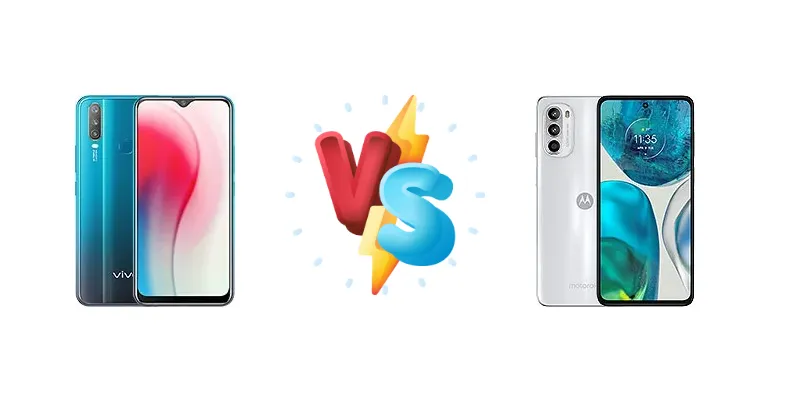
The sub-$200 smartphone market is fiercely competitive. The Motorola Moto G52 and vivo Y3 both aim to deliver essential smartphone functionality at an accessible price point, but they take distinctly different approaches to achieving this. The Moto G52 leverages Qualcomm’s Snapdragon 680, built on a modern 6nm process, while the vivo Y3 relies on MediaTek’s older, 12nm Helio P35. This comparison dives deep into the implications of these core differences, and others, to determine which device offers the best value.
🏆 Quick Verdict
For the average user prioritizing responsiveness and future-proofing, the Motorola Moto G52 is the clear winner. Its Snapdragon 680 chipset, built on a 6nm process, provides a noticeable performance and efficiency advantage over the vivo Y3’s Helio P35. While the Y3 offers a slightly lower price, the G52’s faster charging and more modern architecture justify the small premium.
| Network |
|---|
| 2G bands | GSM 850 / 900 / 1800 / 1900 - SIM 1 & SIM 2 | GSM 850 / 900 / 1800 / 1900 |
| 3G bands | HSDPA 850 / 900 / 2100 | HSDPA 850 / 900 / 1700(AWS) / 1900 / 2100 |
| 4G bands | 1, 3, 5, 8, 34, 38, 39, 40, 41 | LTE |
| Speed | HSPA 42.2/5.76 Mbps, LTE-A (2CA) Cat6 400/50 Mbps | HSPA, LTE |
| Technology | GSM / CDMA / HSPA / EVDO / LTE | GSM / HSPA / LTE |
| | CDMA2000 1xEV-DO | - |
| Launch |
|---|
| Announced | 2019, October | 2022, April 12 |
| Status | Available. Released 2019, October | Available. Released 2022, April 20 |
| Body |
|---|
| Dimensions | 159.4 x 76.7 x 8.9 mm (6.28 x 3.02 x 0.35 in) | 160.1 x 74.5 x 8 mm (6.30 x 2.93 x 0.31 in) |
| SIM | Dual SIM (Nano-SIM, dual stand-by) | Nano-SIM + Nano-SIM |
| Weight | 190 g (6.70 oz) | 169 g (5.96 oz) |
| | - | Water-repellent design |
| Display |
|---|
| Resolution | 720 x 1544 pixels (~268 ppi density) | 1080 x 2400 pixels, 20:9 ratio (~402 ppi density) |
| Size | 6.35 inches, 99.6 cm2 (~81.5% screen-to-body ratio) | 6.6 inches, 103.6 cm2 (~86.9% screen-to-body ratio) |
| Type | IPS LCD | AMOLED, 90Hz |
| Platform |
|---|
| CPU | Octa-core (4x2.3 GHz Cortex-A53 & 4x1.8 GHz Cortex-A53) | Octa-core (4x2.4 GHz Kryo 265 Gold & 4x1.9 GHz Kryo 265 Silver) |
| Chipset | Mediatek MT6765 Helio P35 (12nm) | Qualcomm SM6225 Snapdragon 680 4G (6 nm) |
| GPU | PowerVR GE8320 | Adreno 610 |
| OS | Android 9.0 (Pie), Funtouch 9.0 | Android 12, planned upgrade to Android 13 |
| Memory |
|---|
| Card slot | microSDXC (dedicated slot) | microSDXC (uses shared SIM slot) |
| Internal | 64GB 4GB RAM | 64GB 4GB RAM, 128GB 4GB RAM, 128GB 6GB RAM, 256GB 6GB RAM |
| | eMMC 5.1 | - |
| Main Camera |
|---|
| Features | LED flash, HDR, panorama | LED flash, HDR, panorama |
| Triple | 13 MP, f/2.2, (wide), PDAF
8 MP, f/2.2, 13mm (ultrawide)
2 MP, f/2.4, (depth) | 50 MP, f/1.8 (wide), 1/2.76", 0.64µm, PDAF
8 MP, f/2.2, 118˚ (ultrawide), 1/4.0", 1.12µm
2 MP (macro) |
| Video | 1080p@30fps | 1080p@30fps |
| Selfie camera |
|---|
| Single | 8 MP, f/1.8 | 16 MP, f/2.5, (wide), 1.0µm |
| Video | 1080p@30fps | 1080p@30fps |
| Sound |
|---|
| 3.5mm jack | Yes | Yes |
| 35mm jack | - | Yes |
| Loudspeaker | Yes | Yes, with stereo speakers |
| Comms |
|---|
| Bluetooth | 5.0, A2DP, LE | 5.0, A2DP, LE |
| NFC | No | Yes (market/region dependent) |
| Positioning | GPS, GLONASS, BDS | GPS, GLONASS, GALILEO |
| Radio | FM radio | Unspecified |
| USB | microUSB 2.0, OTG | USB Type-C 2.0 |
| WLAN | Wi-Fi 802.11 a/b/g/n/ac, dual-band, Wi-Fi Direct | Wi-Fi 802.11 a/b/g/n/ac, dual-band, Wi-Fi Direct |
| Features |
|---|
| Sensors | Fingerprint (rear-mounted), accelerometer, proximity, compass | Fingerprint (side-mounted), accelerometer, gyro, proximity, compass |
| Battery |
|---|
| Charging | 18W wired | 30W wired |
| Type | Li-Po 5000 mAh, non-removable | Li-Po 5000 mAh |
| Misc |
|---|
| Colors | Ink blue, Jade Red | Charcoal Gray, Porcelain White |
| Models | - | XT2221-1, XT2221-2 |
| Price | About 140 EUR | About 470 EUR |
vivo Y3 (4GB+64GB)
- Faster and more efficient Snapdragon 680 chipset
- 30W fast charging for quicker top-ups
- Potentially better image processing capabilities
- Likely slightly higher price than the vivo Y3
- May not have a significantly better display
Motorola Moto G52
- Lower price point, making it more accessible
- Adequate performance for basic smartphone tasks
- Sufficient battery life for light usage
- Older and less efficient Helio P35 chipset
- Slower 18W charging
- Potentially struggles with demanding apps and games
Display Comparison
Neither device boasts a standout display. While specific display specs (resolution, panel type) are not provided, the focus here is on the underlying processing power impacting UI smoothness. The Snapdragon 680 in the Moto G52, with its more efficient architecture, can dedicate more resources to rendering the user interface, potentially resulting in a slightly smoother scrolling experience compared to the Helio P35-powered vivo Y3. The difference will be subtle, but noticeable during quick app switching.
Camera Comparison
Without detailed camera specifications, a direct comparison is limited. However, the chipset plays a role in image processing. The Snapdragon 680’s ISP (Image Signal Processor) is more advanced than the Helio P35’s, enabling faster image processing, better noise reduction, and potentially improved dynamic range in photos and videos captured on the Moto G52. The G52 is likely to handle computational photography tasks (like HDR) more effectively. The absence of information on sensor sizes and lens apertures makes a definitive statement impossible, but the processing power leans heavily in the G52’s favor.
Performance
The core differentiator lies in the chipsets. The Motorola Moto G52’s Qualcomm Snapdragon 680 (6nm) is a significant upgrade over the vivo Y3’s MediaTek Helio P35 (12nm). The 6nm process allows for higher transistor density and improved power efficiency, meaning the Snapdragon 680 delivers more performance per watt. The CPU configuration – 4x2.4 GHz Kryo 265 Gold & 4x1.9 GHz Kryo 265 Silver in the G52 versus 4x2.3 GHz Cortex-A53 & 4x1.8 GHz Cortex-A53 in the Y3 – further emphasizes this advantage. The Kryo cores are architecturally more advanced than the Cortex-A53, offering better single-core and multi-core performance. This translates to faster app loading times, smoother multitasking, and a more responsive overall experience on the Moto G52.
Battery Life
Both phones offer adequate battery life for typical usage, but the charging speeds differ significantly. The Motorola Moto G52 supports 30W wired charging, while the vivo Y3 is limited to 18W. This means the G52 can replenish its battery much faster – potentially going from 0-100% in under an hour, compared to a longer timeframe for the Y3. While battery capacity isn’t specified, the Snapdragon 680’s superior power efficiency means the Moto G52 will likely achieve comparable or better battery life despite potentially having a smaller battery cell.
Buying Guide
Buy the vivo Y3 (4GB+64GB) if you need a basic smartphone for essential tasks like calls, messaging, and light social media use, and are on an extremely tight budget. Buy the Motorola Moto G52 if you prefer a smoother, more responsive experience, faster charging, and a chipset that will likely handle software updates and app demands more gracefully over the long term. The G52 is the better choice for anyone who occasionally plays mobile games or uses demanding applications.
Frequently Asked Questions
❓ Will the Motorola Moto G52 handle popular games like PUBG Mobile or Call of Duty?
The Snapdragon 680 in the Moto G52 is capable of running PUBG Mobile and Call of Duty at medium settings with reasonable frame rates. However, don't expect a flagship-level gaming experience. The Helio P35 in the vivo Y3 will struggle with these titles, likely requiring significantly reduced graphics settings and potentially experiencing noticeable lag.
❓ How much faster is the charging on the Motorola Moto G52 compared to the vivo Y3?
The Moto G52’s 30W charging is significantly faster than the Y3’s 18W charging. While exact times depend on battery size (which isn't specified), the G52 can likely charge from 0-100% in around 60-75 minutes, whereas the Y3 could take 90-120 minutes or longer.
❓ Is the Snapdragon 680 in the Moto G52 a 5G chipset? Will I get 5G connectivity?
The Snapdragon 680 is a 4G chipset. The '4G' designation in its name confirms this. Therefore, the Motorola Moto G52 does *not* support 5G connectivity. Both devices are 4G only.