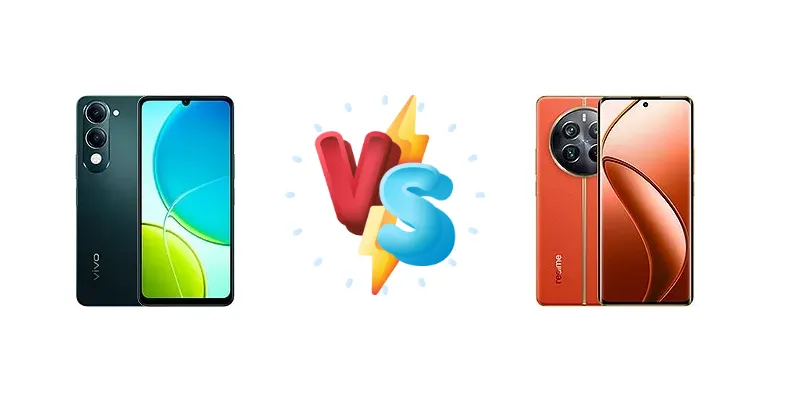
The mid-range smartphone market is fiercely competitive, and the vivo Y29s and Realme 12 Pro+ represent two distinct approaches. The Y29s focuses on maximizing battery endurance, while the 12 Pro+ aims for a more premium experience with faster charging and a brighter display. This comparison dissects their core components to determine which device best suits your needs.
🏆 Quick Verdict
For the average user prioritizing longevity, the vivo Y29s is the clear winner thanks to its exceptional 46:06h battery endurance. However, if rapid charging and a brighter screen are paramount, the Realme 12 Pro+ offers a compelling alternative, despite its shorter battery life.
| Network |
|---|
| 2G bands | GSM 850 / 900 / 1800 / 1900 | GSM 850 / 900 / 1800 / 1900 |
| 3G bands | HSDPA 850 / 900 / 2100 | HSDPA 850 / 900 / 2100 |
| 4G bands | 1, 3, 5, 7, 8, 20, 28, 38, 40, 41 | 1, 3, 5, 8, 28, 40, 41 |
| 5G bands | 1, 3, 5, 7, 8, 20, 28, 38, 40, 41, 77, 78 SA/NSA - Malaysia | 1, 3, 5, 8, 28, 40, 41, 77, 78 SA/NSA |
| Speed | HSPA, LTE | HSPA, LTE, 5G |
| Technology | GSM / HSPA / LTE / 5G | GSM / HSPA / LTE / 5G |
| Launch |
|---|
| Announced | 2025, March 11 | 2024, January 29 |
| Status | Available. Released 2025, April | Available. Released 2024, January 29 |
| Body |
|---|
| Build | Glass front, plastic frame, plastic back | - |
| Dimensions | 167.3 x 77 x 8.2 mm (6.59 x 3.03 x 0.32 in) | 161.5 x 74 x 8.8 mm (6.36 x 2.91 x 0.35 in) |
| SIM | Nano-SIM + Nano-SIM | Nano-SIM + Nano-SIM |
| Weight | 199 g (7.02 oz) | 196 g (6.91 oz) |
| Display |
|---|
| Protection | Mohs level 4 | - |
| Resolution | 720 x 1600 pixels, 20:9 ratio (~260 ppi density) | 1080 x 2412 pixels, 20:9 ratio (~394 ppi density) |
| Size | 6.74 inches, 109.7 cm2 (~85.1% screen-to-body ratio) | 6.7 inches, 108.0 cm2 (~90.4% screen-to-body ratio) |
| Type | IPS LCD, 90Hz, 570 nits (HBM) | AMOLED, 1B colors, 120Hz, 800 nits (HBM), 950 nits (peak) |
| Platform |
|---|
| CPU | Octa-core (2x2.4 GHz Cortex-A76 & 6x2.0 GHz Cortex-A55) | Octa-core (4x2.40 GHz Cortex-A78 & 4x1.95 GHz Cortex-A55) |
| Chipset | Mediatek Dimensity 6300 (6 nm) | Qualcomm SM7435-AB Snapdragon 7s Gen 2 (4 nm) |
| GPU | Mali-G57 MC2 | Adreno 710 |
| OS | Android 15, Funtouch 15 | Android 14, Realme UI 5.0 |
| Memory |
|---|
| Card slot | microSDXC (dedicated slot) | No |
| Internal | 128GB 6GB RAM, 256GB 8GB RAM | 128GB 8GB RAM, 256GB 8GB RAM, 256GB 12GB RAM, 512GB 12GB RAM |
| Main Camera |
|---|
| Features | LED flash, panorama | LED flash, HDR, panorama |
| Single | 50 MP, f/1.8, (wide), PDAF
Auxiliary lens | - |
| Triple | - | 50 MP, f/1.8, 24mm (wide), 1/1.56", 1.0µm, multi-directional PDAF, OIS
64 MP, f/2.8, 71mm, (periscope telephoto), 1/2.0", 0.7µm, PDAF, OIS, 3x optical zoom
8 MP, f/2.2, 16mm, 112˚ (ultrawide), 1/4.0", 1.12µm |
| Video | 1080p@30fps | 4K@30fps, 1080p@30/60/120fps, gyro-EIS |
| Selfie camera |
|---|
| Single | 5 MP, f/2.2, (wide) | 32 MP, f/2.4, 22mm (wide) |
| Video | Yes | 1080p@30fps |
| Sound |
|---|
| 35mm jack | Yes | No |
| Loudspeaker | Yes, with stereo speakers | Yes, with stereo speakers |
| Comms |
|---|
| Bluetooth | 5.4, A2DP, LE | 5.2, A2DP, LE |
| NFC | Yes (market/region dependent) | Yes (market/region dependent) |
| Positioning | GPS, GALILEO, GLONASS, BDS, QZSS | GPS, GLONASS, GALILEO, BDS, QZSS |
| Radio | FM radio | No |
| USB | USB Type-C 2.0, OTG | USB Type-C 2.0 |
| WLAN | Wi-Fi 802.11 a/b/g/n/ac, dual-band | Wi-Fi 802.11 a/b/g/n/ac/6, dual-band |
| Features |
|---|
| Sensors | Fingerprint (side-mounted), accelerometer, proximity, compass | Fingerprint (under display, optical), accelerometer, gyro, proximity, compass |
| Battery |
|---|
| Charging | 15W wired | 67W wired, 50% in 19 min |
| Type | Market-dependent versions:· Li-Ion 5500 mAh - Global· Li-Ion 5150 mAh - EU, LATAM | 5000 mAh |
| Misc |
|---|
| Colors | Titanium Gold, Dark Green | Submarine Blue, Navigator Beige, Explorer Red |
| Models | V2446 | RMX3840, RMX3841 |
| Price | About 170 EUR | $ 465.00 / £ 299.00 / € 344.26 / ₹ 28,400 |
| EU LABEL |
|---|
| Battery | 46:06h endurance, 1000 cycles | - |
| Energy | Class B | - |
| Free fall | Class B (180 falls) | - |
| Repairability | Class C | - |
vivo Y29s
- Exceptional battery life (46:06h endurance)
- Long battery lifespan (1000 charge cycles)
- Potentially more affordable price point
- Slower charging speed (15W)
- Likely less powerful processor
- Display brightness likely lower
Realme 12 Pro+
- Faster charging (67W, 50% in 19 min)
- Brighter display (802 nits)
- More powerful processor (Snapdragon 7s Gen 2)
- Significantly shorter battery life (13:24h)
- Potentially higher price
- May experience more thermal throttling
Display Comparison
The Realme 12 Pro+ immediately distinguishes itself with a measured peak brightness of 802 nits, offering superior visibility in direct sunlight compared to the vivo Y29s (brightness data unavailable). While the Y29s’ panel specifics are unknown, the 12 Pro+ likely benefits from a more advanced panel technology, potentially OLED, contributing to richer colors and deeper blacks. Bezels are expected to be comparable given the price points, but the 12 Pro+'s higher brightness is a significant advantage for outdoor use.
Camera Comparison
Camera details beyond the main sensors are limited for both devices. However, the Realme 12 Pro+ is positioned as a camera-focused device, suggesting a more sophisticated image processing pipeline. While sensor sizes are unknown, the Realme's marketing emphasizes its camera capabilities, implying a larger sensor and potentially better low-light performance. The Y29s likely offers a more basic camera experience, suitable for casual snapshots. We'll assume both phones include standard features like HDR and portrait modes, but the 12 Pro+ is expected to offer more advanced features and image quality.
Performance
The Realme 12 Pro+ leverages the Qualcomm Snapdragon 7s Gen 2 (4nm), built on a more efficient process node than the vivo Y29s’ Mediatek Dimensity 6300 (6nm). This 4nm process translates to better thermal efficiency, potentially reducing throttling during sustained workloads. While both CPUs feature octa-core architectures with similar peak clock speeds (2.4 GHz), the 12 Pro+ utilizes Cortex-A78 cores, which offer a performance uplift over the Y29s’ Cortex-A76 cores. This means the Realme 12 Pro+ will likely handle demanding games and applications more smoothly. The 12 Pro+ also benefits from potentially faster RAM (LPDDR5x is common in this tier) which further enhances responsiveness.
Battery Life
Battery life is where the vivo Y29s truly shines, achieving an astounding 46:06h of endurance. This is significantly longer than the Realme 12 Pro+'s 13:24h active use score. However, the 12 Pro+ compensates with its 67W wired charging, capable of reaching 50% charge in just 19 minutes. The Y29s is limited to a slower 15W charging speed. This creates a trade-off: the Y29s offers multi-day battery life, while the 12 Pro+ provides quick top-ups when needed. The Y29s also claims 1000 charge cycles, suggesting a longer lifespan for the battery itself.
Buying Guide
Buy the vivo Y29s if you need a phone that can reliably last through two full days of moderate use, and aren't concerned with the fastest possible charging speeds. This is ideal for travelers, commuters, or anyone who dislikes frequent charging. Buy the Realme 12 Pro+ if you prefer a more visually vibrant experience with a brighter display and the convenience of 67W fast charging, even if it means charging your phone more often.
Frequently Asked Questions
❓ Does the Mediatek Dimensity 6300 in the vivo Y29s struggle with graphically intensive games like Genshin Impact?
While the Dimensity 6300 is a capable chip, Genshin Impact and similar titles will likely require reduced graphics settings for smooth gameplay. The Snapdragon 7s Gen 2 in the Realme 12 Pro+ offers a more comfortable experience for demanding games, allowing for higher settings and more consistent frame rates.
❓ How significant is the difference in charging speed between 15W and 67W? Is the Realme 12 Pro+'s fast charging worth the trade-off in battery life?
The difference is substantial. 67W charging can add a significant amount of charge in a short time, making it ideal for quick top-ups. 15W charging is considerably slower. Whether it's 'worth it' depends on your usage. If you frequently find yourself needing to charge mid-day, the 12 Pro+'s fast charging is a major convenience. If you can charge overnight, the Y29s' longer battery life is more valuable.
❓ Given the limited information on the vivo Y29s' display, should I be concerned about color accuracy or viewing angles?
Without detailed display specifications, it's reasonable to assume the Y29s' display is more basic than the Realme 12 Pro+'s. Color accuracy and viewing angles may not be as wide, potentially resulting in a less vibrant and immersive viewing experience. If display quality is a priority, the Realme 12 Pro+ is the safer bet.