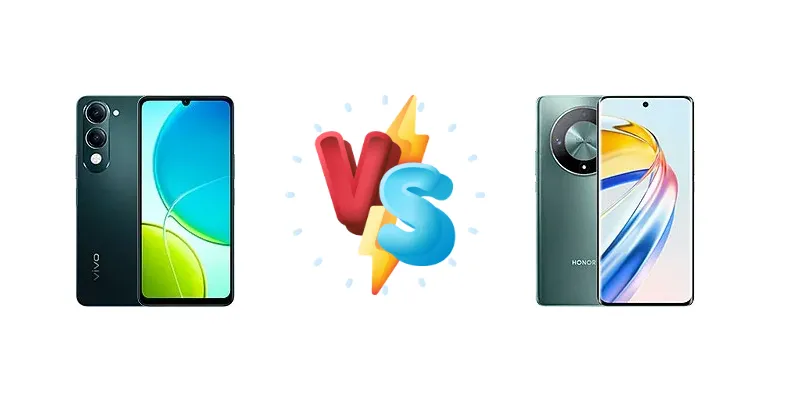
The vivo Y29s and Honor X9b represent compelling options in the increasingly competitive mid-range smartphone market. While both aim to deliver a balanced experience, they take different approaches to processing power and charging technology. This comparison dives deep into the specifications to determine which device best suits your needs.
🏆 Quick Verdict
For the average user prioritizing sustained performance and faster charging, the Honor X9b emerges as the stronger contender. Its Snapdragon 6 Gen 1 chipset, built on a more efficient 4nm process, offers a performance edge, while the 35W charging significantly reduces downtime. However, the vivo Y29s boasts impressive battery endurance.
| Network |
|---|
| 2G bands | GSM 850 / 900 / 1800 / 1900 | GSM 850 / 900 / 1800 / 1900 |
| 3G bands | HSDPA 850 / 900 / 2100 | HSDPA 850 / 900 / 1900 / 2100 |
| 4G bands | 1, 3, 5, 7, 8, 20, 28, 38, 40, 41 | 1, 2, 3, 4, 5, 7, 8, 20, 28, 32, 38, 40, 41 |
| 5G bands | 1, 3, 5, 7, 8, 20, 28, 38, 40, 41, 77, 78 SA/NSA - Malaysia | 1, 3, 7, 8, 20, 28, 38, 40, 41, 77, 78 SA/NSA |
| Speed | HSPA, LTE | HSPA, LTE, 5G |
| Technology | GSM / HSPA / LTE / 5G | GSM / HSPA / LTE / 5G |
| Launch |
|---|
| Announced | 2025, March 11 | 2023, October 18 |
| Status | Available. Released 2025, April | Available. Released 2023, October |
| Body |
|---|
| Build | Glass front, plastic frame, plastic back | - |
| Dimensions | 167.3 x 77 x 8.2 mm (6.59 x 3.03 x 0.32 in) | 163.6 x 75.5 x 8 mm (6.44 x 2.97 x 0.31 in) |
| SIM | Nano-SIM + Nano-SIM | Nano-SIM + Nano-SIM |
| Weight | 199 g (7.02 oz) | 185 g (6.53 oz) |
| Display |
|---|
| Protection | Mohs level 4 | - |
| Resolution | 720 x 1600 pixels, 20:9 ratio (~260 ppi density) | 1220 x 2652 pixels, 19.5:9 ratio (~431 ppi density) |
| Size | 6.74 inches, 109.7 cm2 (~85.1% screen-to-body ratio) | 6.78 inches, 112.6 cm2 (~91.2% screen-to-body ratio) |
| Type | IPS LCD, 90Hz, 570 nits (HBM) | AMOLED, 1B colors, 120Hz, 1200 nits (peak) |
| Platform |
|---|
| CPU | Octa-core (2x2.4 GHz Cortex-A76 & 6x2.0 GHz Cortex-A55) | Octa-core (4x2.2 GHz Cortex-A78 & 4x1.8 GHz Cortex-A55) |
| Chipset | Mediatek Dimensity 6300 (6 nm) | Qualcomm SM6450 Snapdragon 6 Gen 1 (4 nm) |
| GPU | Mali-G57 MC2 | Adreno 710 |
| OS | Android 15, Funtouch 15 | Android 13, Magic OS 7.2 |
| Memory |
|---|
| Card slot | microSDXC (dedicated slot) | No |
| Internal | 128GB 6GB RAM, 256GB 8GB RAM | 256GB 8GB RAM, 256GB 12GB RAM, 512GB 8GB RAM, 512GB 12GB RAM |
| Main Camera |
|---|
| Features | LED flash, panorama | LED flash, panorama, HDR |
| Single | 50 MP, f/1.8, (wide), PDAF
Auxiliary lens | - |
| Triple | - | 108 MP, f/1.8, (wide), 1/1.67", PDAF
5 MP, f/2.2, (ultrawide)
2 MP (macro) |
| Video | 1080p@30fps | 4K@30fps, 1080p@30fps |
| Selfie camera |
|---|
| Single | 5 MP, f/2.2, (wide) | 16 MP, f/2.5, (wide) |
| Video | Yes | 1080p@30fps |
| Sound |
|---|
| 35mm jack | Yes | No |
| Loudspeaker | Yes, with stereo speakers | Yes |
| Comms |
|---|
| Bluetooth | 5.4, A2DP, LE | 5.1, A2DP, LE |
| Infrared port | - | Yes |
| NFC | Yes (market/region dependent) | Yes (market/region dependent) |
| Positioning | GPS, GALILEO, GLONASS, BDS, QZSS | GPS, GLONASS, GALILEO, BDS |
| Radio | FM radio | No |
| USB | USB Type-C 2.0, OTG | USB Type-C 2.0, OTG |
| WLAN | Wi-Fi 802.11 a/b/g/n/ac, dual-band | Wi-Fi 802.11 a/b/g/n/ac, dual-band, Wi-Fi Direct |
| Features |
|---|
| Sensors | Fingerprint (side-mounted), accelerometer, proximity, compass | Fingerprint (under display, optical), accelerometer, gyro, proximity, compass |
| Battery |
|---|
| Charging | 15W wired | 35W wired
Reverse wired |
| Type | Market-dependent versions:· Li-Ion 5500 mAh - Global· Li-Ion 5150 mAh - EU, LATAM | Li-Po 5800 mAh |
| Misc |
|---|
| Colors | Titanium Gold, Dark Green | Sunrise Orange, Midnight Black, Emerald Green |
| Models | V2446 | ALI-NX1 |
| Price | About 170 EUR | About 970 EUR |
| EU LABEL |
|---|
| Battery | 46:06h endurance, 1000 cycles | - |
| Energy | Class B | - |
| Free fall | Class B (180 falls) | - |
| Repairability | Class C | - |
vivo Y29s
- Exceptional battery endurance (46:06h)
- 1000 charge cycles promise long-term battery health
- Potentially lower price point
- Slower 15W charging
- Less powerful chipset (Dimensity 6300)
- 6nm process may lead to more thermal throttling
Honor X9b
- More efficient chipset (Snapdragon 6 Gen 1, 4nm)
- Faster 35W charging with reverse wired charging
- Potentially smoother performance with Cortex-A78 cores
- Likely shorter battery life compared to vivo Y29s
- May be slightly more expensive
- No information on battery cycle life
Display Comparison
Display specifications are absent from the provided data, but considering the price points, both devices likely feature LCD panels. The absence of information regarding refresh rates or resolution suggests a focus on cost optimization. However, the overall user experience will depend heavily on panel quality and color calibration, which are currently unknown. We can assume both will target FHD+ resolution for this segment.
Camera Comparison
Without sensor details, a direct camera comparison is difficult. However, the market segment suggests both phones will feature a multi-camera setup with a primary sensor, likely around 50MP. The absence of information regarding Optical Image Stabilization (OIS) suggests neither phone prioritizes low-light photography. Image processing will be a key differentiator, with vivo historically leaning towards more vibrant, saturated images, while Honor often aims for a more natural look. The usefulness of any secondary cameras (ultrawide, macro) will depend on their quality, which is currently unknown.
Performance
The core difference lies in the chipsets. The Honor X9b’s Qualcomm Snapdragon 6 Gen 1 (4nm) benefits from a smaller fabrication process, translating to improved power efficiency and potentially better sustained performance compared to the vivo Y29s’ Mediatek Dimensity 6300 (6nm). While both are octa-core CPUs, the X9b utilizes 4x Cortex-A78 cores clocked at 2.2 GHz, offering a performance advantage over the Y29s’ 2x Cortex-A76 cores at 2.4 GHz. The A78 architecture is generally more efficient and powerful. This means the X9b will likely handle demanding apps and multitasking more smoothly. The 6nm process of the Dimensity 6300 will likely result in higher temperatures under sustained load.
Battery Life
The vivo Y29s boasts an impressive 46:06h endurance rating, indicating exceptional battery life. This is a significant advantage for users who prioritize longevity. However, the Honor X9b compensates with its 35W wired charging, including reverse wired charging, allowing for significantly faster top-ups. The Y29s’ 15W charging is comparatively slow. While the Y29s may last longer on a single charge, the X9b’s faster charging minimizes downtime, making it more convenient for users who frequently need to recharge.
Buying Guide
Buy the vivo Y29s if you prioritize maximizing battery life and are willing to trade off some processing speed for extended usage. This phone is ideal for users who primarily browse, use social media, and make occasional calls. Buy the Honor X9b if you value a more responsive user experience, faster app loading times, and quicker charging, making it better suited for moderate gaming and multitasking.
Frequently Asked Questions
❓ Will the Snapdragon 6 Gen 1 in the Honor X9b handle demanding games like PUBG or Call of Duty?
The Snapdragon 6 Gen 1 is capable of running PUBG and Call of Duty, but likely at medium settings to maintain a stable frame rate. The 4nm process and Cortex-A78 cores provide a performance boost over the Dimensity 6300, but it's not a gaming-focused chipset. Expect some frame drops during intense action.
❓ How long will it take to fully charge the Honor X9b from 0% with the 35W charger?
While a precise time isn't available, a 35W charger should fully charge the Honor X9b in approximately 60-75 minutes, significantly faster than the vivo Y29s' 15W charging. The inclusion of reverse wired charging also allows you to use the X9b as a power bank for other devices.
❓ Does the vivo Y29s' 1000 charge cycle rating guarantee the battery will still hold a significant charge after that many uses?
The 1000 charge cycle rating indicates the battery is designed to retain at least 80% of its original capacity after 1000 full charge/discharge cycles. However, battery degradation is also affected by usage patterns, temperature, and charging habits. Proper battery care will maximize its lifespan.