
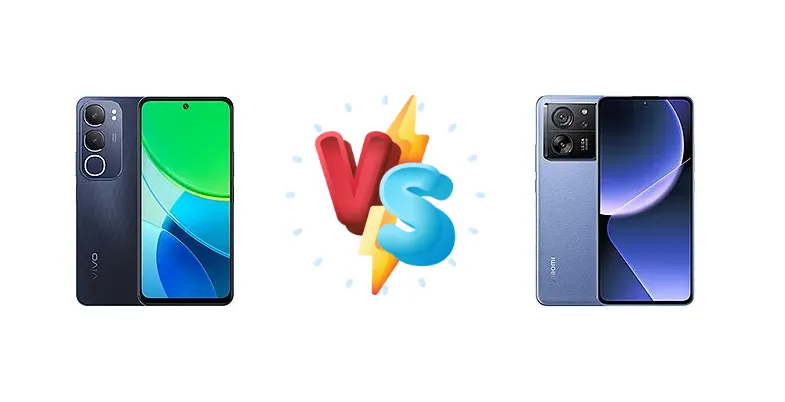
Xiaomi 13T Pro vs. vivo Y29: A Deep Dive into Mid-Range Power and Value
| Phones Images | |||||
|---|---|---|---|---|---|
|
🏆 Quick Verdict
For users prioritizing raw performance, gaming, and incredibly fast charging, the Xiaomi 13T Pro is the clear winner. However, the vivo Y29 offers a compelling value proposition for everyday users who need a reliable smartphone without breaking the bank, making it the better choice for budget-conscious buyers.
| PHONES | ||
|---|---|---|
| Phone Names | vivo Y29 | Xiaomi 13T Pro |
| Network | ||
|---|---|---|
| 2G bands | GSM 850 / 900 / 1800 / 1900 | GSM 850 / 900 / 1800 / 1900 |
| 3G bands | HSDPA 850 / 900 / 2100 | HSDPA 800 / 850 / 900 / 1700(AWS) / 1900 / 2100 |
| 4G bands | 1, 3, 5, 8, 28, 38, 40, 41 | 1, 2, 3, 4, 5, 7, 8, 12, 13, 17, 18, 19, 20, 25, 26, 28, 32, 38, 39, 40, 41, 42, 48, 66 |
| 5G bands | 1, 3, 5, 8, 28, 40, 77, 78 SA/NSA | 1, 3, 5, 7, 8, 20, 28, 38, 40, 41, 66, 75, 77, 78 SA/NSA |
| Speed | HSPA, LTE, 5G | HSPA, LTE, 5G |
| Technology | GSM / HSPA / LTE / 5G | GSM / HSPA / LTE / 5G |
| Launch | ||
|---|---|---|
| Announced | 2024, December 24 | 2023, September 26 |
| Status | Available. Released 2024, December 24 | Available. Released 2023, September 26 |
| Body | ||
|---|---|---|
| Build | Glass front, plastic back, plastic frame | Glass front (Gorilla Glass 5), glass back or silicone polymer back, plastic frame |
| Dimensions | 165.8 x 76.1 x 8.1 mm (6.53 x 3.00 x 0.32 in) | 162.2 x 75.7 x 8.5 mm (6.39 x 2.98 x 0.33 in) |
| SIM | Nano-SIM + Nano-SIM | · Nano-SIM + eSIM· Nano-SIM + Nano-SIM |
| Weight | 198 g (6.98 oz) | 200 g or 206 g (7.05 oz) |
| Display | ||
|---|---|---|
| Protection | - | Corning Gorilla Glass 5 |
| Resolution | 720 x 1608 pixels, 20:9 ratio (~264 ppi density) | 1220 x 2712 pixels, 20:9 ratio (~446 ppi density) |
| Size | 6.68 inches, 107.4 cm2 (~85.1% screen-to-body ratio) | 6.67 inches, 107.4 cm2 (~87.5% screen-to-body ratio) |
| Type | IPS LCD, 120Hz, 1000 nits (HBM) | AMOLED, 68B colors, 144Hz, Dolby Vision, HDR10+, 1200 nits (HBM), 2600 nits (peak) |
| Platform | ||
|---|---|---|
| CPU | Octa-core (2x2.4 GHz Cortex-A76 & 6x2.0 GHz Cortex-A55) | Octa-core (1x3.35 GHz Cortex-X3 & 3x3.0 GHz Cortex-A715 & 4x2.0 GHz Cortex-A510) |
| Chipset | Mediatek Dimensity 6300 (6 nm) | Mediatek Dimensity 9200+ (4 nm) |
| GPU | Mali-G57 MC2 | Immortalis-G715 MC11 |
| OS | Android 14, Funtouch 14 | Android 13, up to 4 major Android upgrades, HyperOS |
| Memory | ||
|---|---|---|
| Card slot | microSDXC (uses shared SIM slot) | No |
| Internal | 128GB 4GB RAM, 128GB 6GB RAM, 128GB 8GB RAM, 256GB 8GB RAM | 256GB 12GB RAM, 512GB 12GB RAM, 1TB 16GB RAM |
| Main Camera | ||
|---|---|---|
| Features | Ring-LED flash, panorama | Leica lens, color spectrum sensor, LED flash, HDR, panorama |
| Single | 50 MP, f/1.8, (wide), 1/1.95", 0.8µm, PDAF Auxiliary lens | - |
| Triple | - | 50 MP, f/1.9, 24mm (wide), 1/1.28", 1.22µm, PDAF, OIS 50 MP, f/1.9, 50mm (telephoto), 1/2.88", 0.61µm, PDAF, 2x optical zoom 12 MP, f/2.2, 15mm (ultrawide), 1/3.06", 1.12µm |
| Video | 1080p@30fps | 8K@24fps, 4K@24/30/60fps, 4K/1080p@30fps HDR10+, 1080p@30/60/120/240fps; 10-bit LOG, gyro-EIS |
| Selfie camera | ||
|---|---|---|
| Features | - | HDR |
| Single | 8 MP, f/2.0, (wide) | 20 MP, f/2.2, (wide), 0.8µm |
| Video | 1080p@30fps | 1080p@30fps, HDR10+ |
| Sound | ||
|---|---|---|
| 35mm jack | Yes | No |
| Loudspeaker | Yes, with dual speakers | Yes, with stereo speakers |
| Comms | ||
|---|---|---|
| Bluetooth | 5.4, A2DP, LE | 5.4, A2DP, LE |
| Infrared port | - | Yes |
| NFC | No | Yes |
| Positioning | GPS, GLONASS, GALILEO, BDS, QZSS | GPS (L1+L5), GLONASS (G1), GALILEO (E1+E5a), NavIC (L5), BDS |
| Radio | FM radio | No |
| USB | USB Type-C 2.0, OTG | USB Type-C 2.0, OTG |
| WLAN | Wi-Fi 802.11 a/b/g/n/ac, dual-band | Wi-Fi 802.11 a/b/g/n/ac/6e/7, dual/tri-band (market/region dependent), Wi-Fi Direct |
| Features | ||
|---|---|---|
| Sensors | Fingerprint (side-mounted), accelerometer, proximity, compass | Fingerprint (under display, optical), accelerometer, gyro, proximity, compass |
| Battery | ||
|---|---|---|
| Charging | 44W wired Reverse wired | 120W wired, PD3.0, QC4, 100% in 19 min |
| Type | Li-Ion 5500 mAh | Li-Po 5000 mAh |
| Misc | ||
|---|---|---|
| Colors | Glacier Blue, Titanium Gold, Diamond Black | Alpine Blue, Meadow Green, Black |
| Models | V2420 | 23078PND5G |
| Price | ₹ 13,999 | $ 370.00 / £ 482.55 / € 301.99 |
| SAR | 0.99 W/kg (head) 0.99 W/kg (body) | - |
| SAR EU | - | 1.00 W/kg (head) 0.99 W/kg (body) |
vivo Y29
- Excellent value for money
- Reliable performance for everyday tasks
- 44W fast charging with reverse wired charging
- Less powerful processor compared to the 13T Pro
- Camera likely lacks advanced features
Xiaomi 13T Pro
- Blazing-fast performance with Dimensity 9200+
- Ultra-fast 120W charging (0-100% in 19 minutes)
- Bright and vibrant display (1094 nits)
- Higher price point
- May be overkill for basic users
Display Comparison
The Xiaomi 13T Pro boasts a significantly brighter display, reaching a measured 1094 nits, ensuring excellent visibility even in direct sunlight. While the vivo Y29’s display specifications are not provided, it’s likely to be considerably dimmer. The 13T Pro’s higher brightness is particularly beneficial for media consumption and outdoor photography. We can assume the Y29 will prioritize power efficiency over peak brightness, given its more budget-focused positioning.
Camera Comparison
While both phones feature cameras, the Xiaomi 13T Pro is expected to offer a more versatile and higher-quality imaging experience. The context data only mentions 'Photo / Video' for the 13T Pro, suggesting a focus on overall camera capabilities. The Dimensity 9200+ also includes a more powerful ISP (Image Signal Processor) for faster image processing and better low-light performance. The Y29’s camera specifications are unknown, but given its price point, it likely features a simpler camera system with less advanced features like Optical Image Stabilization (OIS).
Performance
The performance gap between these two devices is substantial. The Xiaomi 13T Pro’s Mediatek Dimensity 9200+ (4nm) features a Cortex-X3 prime core clocked at 3.35 GHz, offering a significant leap in CPU performance compared to the vivo Y29’s Dimensity 6300 (6nm). The 9200+’s more advanced architecture and smaller node size translate to both faster processing speeds and improved thermal efficiency, crucial for sustained performance during demanding tasks like gaming. The Y29’s Cortex-A76 cores, while capable, are older generation and will struggle to keep pace. The 13T Pro’s likely use of faster LPDDR5X RAM further enhances its performance advantage.
Battery Life
The Xiaomi 13T Pro’s 120W wired charging is a game-changer, capable of fully charging the device in just 19 minutes. This is a massive advantage over the vivo Y29’s 44W charging. While the 13T Pro’s battery capacity isn’t specified, its endurance rating of 102 hours and active use score of 11:50h indicate excellent battery life. The Y29’s battery capacity is also unknown, but its slower charging speed suggests it may require more frequent top-ups, despite potentially having a larger capacity.
Buying Guide
Buy the vivo Y29 if you need a dependable daily driver for communication, social media, and light tasks, and value affordability above all else. Its 44W charging and efficient Dimensity 6300 are sufficient for typical usage. Buy the Xiaomi 13T Pro if you're a power user who demands smooth multitasking, enjoys mobile gaming, and appreciates the convenience of 120W charging, even if it comes at a higher cost.