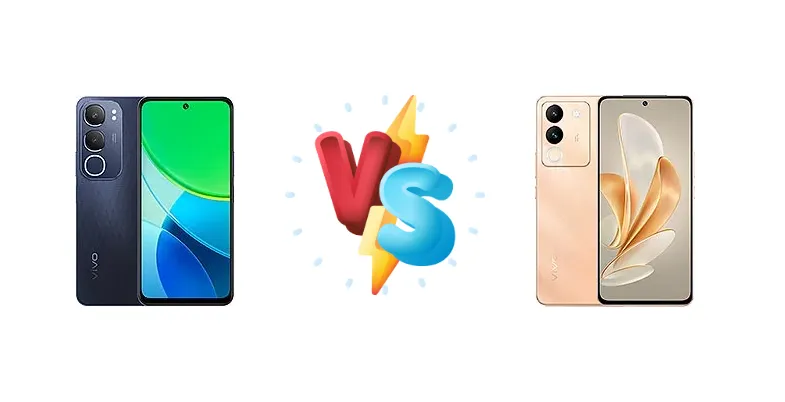
vivo's Y and V series represent distinct approaches to the budget smartphone market. The Y29 focuses on delivering a strong core experience at an aggressive price point, while the V29e aims for a slightly more refined package with a different chipset. This comparison dissects the key differences between these two devices, focusing on performance, charging, and overall value.
🏆 Quick Verdict
For the average user prioritizing consistent performance and a slightly more established platform, the vivo V29e emerges as the better choice. While the Dimensity 6300 in the Y29 is capable, the Snapdragon 695 offers a more mature software ecosystem and potentially better sustained performance in demanding tasks, despite similar peak CPU clock speeds.
| Network |
|---|
| 2G bands | GSM 850 / 900 / 1800 / 1900 | GSM 850 / 900 / 1800 / 1900 |
| 3G bands | HSDPA 850 / 900 / 2100 | HSDPA 850 / 900 / 1700(AWS) / 1900 / 2100 |
| 4G bands | 1, 3, 5, 8, 28, 38, 40, 41 | 1, 2, 3, 4, 5, 7, 8, 18, 19, 20, 26, 28, 38, 39, 40, 41 |
| 5G bands | 1, 3, 5, 8, 28, 40, 77, 78 SA/NSA | 1, 3, 5, 7, 8, 28, 38, 40, 41, 77, 78 SA/NSA |
| Speed | HSPA, LTE, 5G | HSPA, LTE, 5G |
| Technology | GSM / HSPA / LTE / 5G | GSM / HSPA / LTE / 5G |
| Launch |
|---|
| Announced | 2024, December 24 | 2023, October 23 |
| Status | Available. Released 2024, December 24 | Available. Released 2023, October 23 |
| Body |
|---|
| Build | Glass front, plastic back, plastic frame | Glass front, plastic frame, glass back |
| Dimensions | 165.8 x 76.1 x 8.1 mm (6.53 x 3.00 x 0.32 in) | 162.4 x 74.9 x 7.7 mm (6.39 x 2.95 x 0.30 in) |
| SIM | Nano-SIM + Nano-SIM | Nano-SIM + Nano-SIM |
| Weight | 198 g (6.98 oz) | 190 g (6.70 oz) |
| Display |
|---|
| Resolution | 720 x 1608 pixels, 20:9 ratio (~264 ppi density) | 1080 x 2400 pixels, 20:9 ratio (~395 ppi density) |
| Size | 6.68 inches, 107.4 cm2 (~85.1% screen-to-body ratio) | 6.67 inches, 107.4 cm2 (~88.3% screen-to-body ratio) |
| Type | IPS LCD, 120Hz, 1000 nits (HBM) | AMOLED, 120Hz, 1150 nits (peak) |
| Platform |
|---|
| CPU | Octa-core (2x2.4 GHz Cortex-A76 & 6x2.0 GHz Cortex-A55) | Octa-core (2x2.2 GHz Kryo 660 Gold & 6x1.8 GHz Kryo 660 Silver) |
| Chipset | Mediatek Dimensity 6300 (6 nm) | Qualcomm SM6375 Snapdragon 695 5G (6 nm) |
| GPU | Mali-G57 MC2 | Adreno 619 |
| OS | Android 14, Funtouch 14 | Android 13, Funtouch 13 |
| Memory |
|---|
| Card slot | microSDXC (uses shared SIM slot) | No |
| Internal | 128GB 4GB RAM, 128GB 6GB RAM, 128GB 8GB RAM, 256GB 8GB RAM | 256GB 8GB RAM, 256GB 12GB RAM |
| Main Camera |
|---|
| Dual | - | 64 MP, f/1.8, (wide), PDAF, OIS
8 MP, f/2.2, (ultrawide) |
| Features | Ring-LED flash, panorama | Ring-LED flash, panorama, HDR |
| Single | 50 MP, f/1.8, (wide), 1/1.95", 0.8µm, PDAF
Auxiliary lens | - |
| Video | 1080p@30fps | 1080p@30fps |
| Selfie camera |
|---|
| Single | 8 MP, f/2.0, (wide) | 50 MP, f/2.0, 22mm (wide), AF |
| Video | 1080p@30fps | 1080p@30fps |
| Sound |
|---|
| 35mm jack | Yes | No |
| Loudspeaker | Yes, with dual speakers | Yes |
| Comms |
|---|
| Bluetooth | 5.4, A2DP, LE | 5.1, A2DP, LE |
| NFC | No | No |
| Positioning | GPS, GLONASS, GALILEO, BDS, QZSS | GPS, GLONASS, GALILEO, BDS, QZSS |
| Radio | FM radio | No |
| USB | USB Type-C 2.0, OTG | USB Type-C 2.0, OTG |
| WLAN | Wi-Fi 802.11 a/b/g/n/ac, dual-band | Wi-Fi 802.11 a/b/g/n/ac, dual-band |
| Features |
|---|
| Sensors | Fingerprint (side-mounted), accelerometer, proximity, compass | Fingerprint (under display, optical), accelerometer, gyro, proximity, compass |
| Battery |
|---|
| Charging | 44W wired
Reverse wired | 44W wired |
| Type | Li-Ion 5500 mAh | Li-Ion 4800 mAh |
| Misc |
|---|
| Colors | Glacier Blue, Titanium Gold, Diamond Black | Forest Black, Rose Gold, Ice Creek Blue |
| Models | V2420 | V2317 |
| Price | ₹ 13,999 | About 320 EUR |
| SAR | 0.99 W/kg (head) 0.99 W/kg (body) | - |
vivo Y29
- Potentially higher peak CPU performance with Cortex-A76 cores.
- Aggressive pricing likely makes it the more affordable option.
- 44W fast charging for quick top-ups.
- Dimensity 6300 may have less optimized software support.
- Potential for more thermal throttling under sustained load.
vivo V29e
- Snapdragon 695 offers a more mature and optimized platform.
- Potentially better long-term software support from Qualcomm.
- 44W fast charging for convenient power replenishment.
- Slightly lower peak CPU clock speeds compared to the Y29.
- May be slightly more expensive than the Y29.
Display Comparison
Both the vivo Y29 and V29e lack detailed display specifications in the provided data. However, given their market positioning, we can expect both to feature LCD panels with FHD+ resolution. The absence of information regarding refresh rates suggests a standard 60Hz panel on both. Color accuracy and peak brightness are likely to be similar, leaning towards the adequate rather than exceptional, prioritizing cost-effectiveness over premium display features.
Camera Comparison
Without detailed camera specifications beyond the chipsets, a direct comparison is limited. Both phones likely feature a multi-camera setup, but the quality will heavily depend on the main sensor and image processing algorithms. Given the price bracket, we can anticipate a focus on software enhancements to improve image quality rather than relying on high-end hardware. The absence of OIS on either device suggests reliance on digital stabilization, which can introduce artifacts in low-light conditions. Any secondary cameras (ultrawide, macro) are likely to be of limited utility.
Performance
The core difference lies in the chipsets: the vivo Y29 utilizes the Mediatek Dimensity 6300 (6nm) with a 2x2.4 GHz Cortex-A76 & 6x2.0 GHz Cortex-A55 CPU, while the V29e features the Qualcomm Snapdragon 695 5G (6nm) with a 2x2.2 GHz Kryo 660 Gold & 6x1.8 GHz Kryo 660 Silver CPU. While clock speeds are comparable, the Snapdragon 695 benefits from Qualcomm’s optimized CPU architecture and potentially more efficient power management. Both are 6nm chips, suggesting similar efficiency, but Qualcomm’s experience in mobile platforms often translates to better thermal throttling management under sustained load. The Y29’s Cortex-A76 cores are generally faster than the Kryo 660 Gold cores, but the Snapdragon’s overall system optimization may provide a more consistent experience.
Battery Life
Both the vivo Y29 and V29e support 44W wired charging, which is a significant advantage in this price segment. This charging speed should allow for a full charge in approximately 60-75 minutes. The actual battery capacity isn't specified, but a typical capacity for these devices would be around 5000mAh. The 44W charging effectively mitigates any potential disadvantage from a slightly smaller battery capacity on either device, providing a convenient and relatively fast charging experience.
Buying Guide
Buy the vivo Y29 if you need a reliable 5G smartphone for everyday tasks like browsing, social media, and light gaming, and are prioritizing the lowest possible price. Buy the vivo V29e if you prefer a device with a more established chipset, potentially better long-term software support, and a slightly smoother experience when multitasking or playing graphically intensive games.
Frequently Asked Questions
❓ Will the Snapdragon 695 in the V29e handle demanding games like PUBG Mobile smoothly?
The Snapdragon 695 is capable of running PUBG Mobile, but you'll likely need to stick to medium graphics settings for a consistently smooth experience. While not a gaming powerhouse, it offers a more stable frame rate than the Dimensity 6300 under sustained gaming loads due to better thermal management.
❓ Does the 44W charging on either phone support Power Delivery (PD) or Quick Charge standards?
While both phones support 44W charging, it's unlikely they fully support the latest Power Delivery (PD) or Quick Charge standards. vivo typically uses its own proprietary charging protocols, meaning you'll get the fastest charging speeds with the included charger. Using a standard USB-PD charger may result in slower charging times.
❓ Which phone is likely to receive more software updates and security patches?
The vivo V29e, powered by the Snapdragon 695, is likely to receive more consistent and timely software updates. Qualcomm generally provides longer software support for its chipsets compared to MediaTek, ensuring better security and feature enhancements over the device's lifespan.