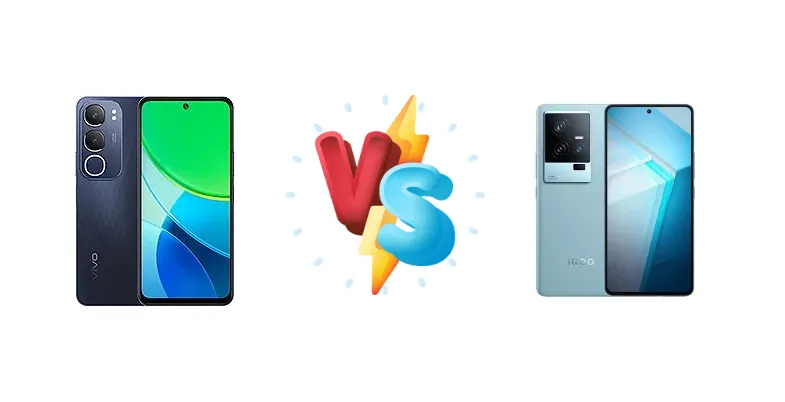
The vivo Y29 and iQOO 11S represent distinct approaches within vivo’s smartphone lineup. The Y29 targets the budget-conscious user prioritizing affordability, while the iQOO 11S aims for a flagship experience with cutting-edge performance. This comparison dissects the core differences between these two devices, focusing on their chipsets, charging capabilities, and overall user experience.
🏆 Quick Verdict
For the average user, the iQOO 11S is the superior device, offering significantly faster performance thanks to the Snapdragon 8 Gen 2. However, the vivo Y29 provides a compelling value proposition for those on a tighter budget who don't require top-tier gaming or intensive multitasking capabilities.
| Network |
|---|
| 2G bands | GSM 850 / 900 / 1800 / 1900 | GSM 850 / 900 / 1800 / 1900 |
| 3G bands | HSDPA 850 / 900 / 2100 | HSDPA 800 / 850 / 900 / 1700(AWS) / 1900 / 2100 |
| 4G bands | 1, 3, 5, 8, 28, 38, 40, 41 | 1, 2, 3, 4, 5, 7, 8, 12, 17, 18, 19, 20, 26, 28, 34, 38, 39, 40, 41 |
| 5G bands | 1, 3, 5, 8, 28, 40, 77, 78 SA/NSA | 1, 3, 5, 8, 28, 40, 41, 77, 78 SA/NSA |
| Speed | HSPA, LTE, 5G | HSPA, LTE, 5G |
| Technology | GSM / HSPA / LTE / 5G | GSM / CDMA / HSPA / CDMA2000 / LTE / 5G |
| Launch |
|---|
| Announced | 2024, December 24 | 2023, July 04 |
| Status | Available. Released 2024, December 24 | Available. Released 2023, July 10 |
| Body |
|---|
| Build | Glass front, plastic back, plastic frame | - |
| Dimensions | 165.8 x 76.1 x 8.1 mm (6.53 x 3.00 x 0.32 in) | 164.9 x 77.1 x 8.4 mm or 8.7 mm |
| SIM | Nano-SIM + Nano-SIM | Nano-SIM + Nano-SIM |
| Weight | 198 g (6.98 oz) | 207 g or 210 g (7.30 oz) |
| Display |
|---|
| Protection | - | Corning Gorilla Glass Victus |
| Resolution | 720 x 1608 pixels, 20:9 ratio (~264 ppi density) | 1440 x 3200 pixels, 20:9 ratio (~518 ppi density) |
| Size | 6.68 inches, 107.4 cm2 (~85.1% screen-to-body ratio) | 6.78 inches, 111.0 cm2 (~87.3% screen-to-body ratio) |
| Type | IPS LCD, 120Hz, 1000 nits (HBM) | LTPO4 AMOLED, 1B colors, 144Hz, HDR10+, 1800 nits (peak) |
| Platform |
|---|
| CPU | Octa-core (2x2.4 GHz Cortex-A76 & 6x2.0 GHz Cortex-A55) | Octa-core (1x3.2 GHz Cortex-X3 & 2x2.8 GHz Cortex-A715 & 2x2.8 GHz Cortex-A710 & 3x2.0 GHz Cortex-A510) |
| Chipset | Mediatek Dimensity 6300 (6 nm) | Qualcomm SM8550-AB Snapdragon 8 Gen 2 (4 nm) |
| GPU | Mali-G57 MC2 | Adreno 740 |
| OS | Android 14, Funtouch 14 | Android 13, OriginOS 3 (China) |
| Memory |
|---|
| Card slot | microSDXC (uses shared SIM slot) | No |
| Internal | 128GB 4GB RAM, 128GB 6GB RAM, 128GB 8GB RAM, 256GB 8GB RAM | 256GB 12GB RAM, 256GB 16GB RAM, 512GB 16GB RAM, 1TB 16GB RAM |
| Main Camera |
|---|
| Features | Ring-LED flash, panorama | Dual-LED flash, HDR, panorama |
| Single | 50 MP, f/1.8, (wide), 1/1.95", 0.8µm, PDAF
Auxiliary lens | - |
| Triple | - | 50 MP, f/1.9, 23mm (wide), 1/1.49", 1.0µm, PDAF, OIS
13 MP, f/2.5, 47mm (telephoto), PDAF, 2x optical zoom
8 MP, f/2.2, 16mm (ultrawide) |
| Video | 1080p@30fps | 8K@30fps, 4K@30/60fps, 1080p@30/60/120/240fps, gyro-EIS |
| Selfie camera |
|---|
| Features | - | HDR |
| Single | 8 MP, f/2.0, (wide) | 16 MP, f/2.5, (wide) |
| Video | 1080p@30fps | 1080p@30fps, gyro-EIS |
| Sound |
|---|
| 35mm jack | Yes | No |
| Loudspeaker | Yes, with dual speakers | Yes, with stereo speakers |
| Comms |
|---|
| Bluetooth | 5.4, A2DP, LE | 5.3, A2DP, LE, aptX HD, aptX Adaptive, aptX Lossless |
| Infrared port | - | Yes |
| NFC | No | Yes |
| Positioning | GPS, GLONASS, GALILEO, BDS, QZSS | GPS, GLONASS, GALILEO, BDS, NavIC |
| Radio | FM radio | No |
| USB | USB Type-C 2.0, OTG | USB Type-C 2.0, OTG |
| WLAN | Wi-Fi 802.11 a/b/g/n/ac, dual-band | Wi-Fi 802.11 a/b/g/n/ac/6, dual-band, Wi-Fi Direct |
| Features |
|---|
| Sensors | Fingerprint (side-mounted), accelerometer, proximity, compass | Fingerprint (under display, optical), accelerometer, gyro, proximity, compass |
| Battery |
|---|
| Charging | 44W wired
Reverse wired | 200W wired, PD3.0, UFCS |
| Type | Li-Ion 5500 mAh | 4700 mAh |
| Misc |
|---|
| Colors | Glacier Blue, Titanium Gold, Diamond Black | Black, Sky Blue, Legendary White (BMW M branding) |
| Models | V2420 | V2304A |
| Price | ₹ 13,999 | About 500 EUR |
| SAR | 0.99 W/kg (head) 0.99 W/kg (body) | - |
vivo Y29
- More affordable price point
- Efficient processor for everyday tasks
- 44W wired charging with reverse wired charging
- Significantly lower performance compared to the iQOO 11S
- Likely a less advanced camera system
vivo iQOO 11S
- Flagship-level performance with Snapdragon 8 Gen 2
- Ultra-fast 200W wired charging
- Advanced camera system (expected)
- Higher price tag
- Potentially higher power consumption
Display Comparison
While display specifications aren't provided, it's reasonable to assume the iQOO 11S features a higher-quality panel given its flagship positioning. The iQOO 11S likely boasts a higher refresh rate and peak brightness. The Y29 will likely prioritize cost-effectiveness, potentially using an LCD panel. The iQOO 11S's display will likely benefit from a more sophisticated color calibration process, resulting in greater accuracy for content creators.
Camera Comparison
Without specific camera specs, it's difficult to make a direct comparison. However, the iQOO 11S, as a flagship, is expected to have a more advanced camera system with a larger sensor, optical image stabilization (OIS), and more sophisticated image processing algorithms. The Y29 will likely feature a more basic camera setup focused on providing acceptable image quality in good lighting conditions. The iQOO 11S will likely offer better low-light performance and more detailed images.
Performance
The core difference lies in the chipsets. The iQOO 11S’s Snapdragon 8 Gen 2 (4nm) is a substantial leap ahead of the Y29’s Mediatek Dimensity 6300 (6nm). The Snapdragon 8 Gen 2’s Cortex-X3 prime core, clocked at 3.2 GHz, provides significantly higher single-core performance, crucial for responsive app launches and smooth multitasking. The 4nm process node of the Snapdragon 8 Gen 2 also translates to improved thermal efficiency, reducing throttling during sustained workloads. The Dimensity 6300, while capable, is geared towards efficient power consumption rather than raw power. The iQOO 11S will excel in graphically intensive games and demanding applications, while the Y29 will handle everyday tasks adequately.
Battery Life
The iQOO 11S’s 200W wired charging is a game-changer, capable of fully charging the device in a matter of minutes. This is a significant advantage over the Y29’s 44W charging. While battery capacity isn't specified, the iQOO 11S’s superior charging speed mitigates the impact of a potentially smaller battery. The Y29’s 44W charging is still respectable, but it will take considerably longer to reach a full charge. The iQOO 11S also supports PD3.0 and UFCS, offering wider compatibility with chargers.
Buying Guide
Buy the vivo Y29 if you need a reliable smartphone for everyday tasks like browsing, social media, and light photography, and prioritize battery life and affordability. Buy the vivo iQOO 11S if you demand the fastest possible performance for gaming, video editing, or running demanding applications, and are willing to pay a premium for features like 200W charging and a more powerful processor.
Frequently Asked Questions
❓ Will the Dimensity 6300 in the vivo Y29 struggle with demanding games like Genshin Impact?
Yes, the Dimensity 6300 is a mid-range chip and will likely require significant graphics settings reductions to achieve playable frame rates in graphically intensive games like Genshin Impact. Expect noticeable frame drops and potential stuttering.
❓ How long does it realistically take to charge the iQOO 11S from 0% to 100% with the 200W charger?
The iQOO 11S can charge from 0% to 100% in approximately 8-10 minutes with the included 200W charger. This is a substantial time saving compared to traditional charging methods.
❓ Does the vivo Y29 support 5G connectivity?
While not explicitly stated, the Dimensity 6300 chipset *does* support 5G connectivity. However, 5G availability will depend on your carrier and region.
❓ Is the 44W charging on the vivo Y29 sufficient for most users?
Yes, 44W charging is still a respectable charging speed and will fully charge the device in around 1-1.5 hours. It's adequate for overnight charging or topping up throughout the day.