
vivo Y29 vs Motorola Edge 40 Neo: A Detailed Mid-Range Showdown
| Phones Images | |||||
|---|---|---|---|---|---|
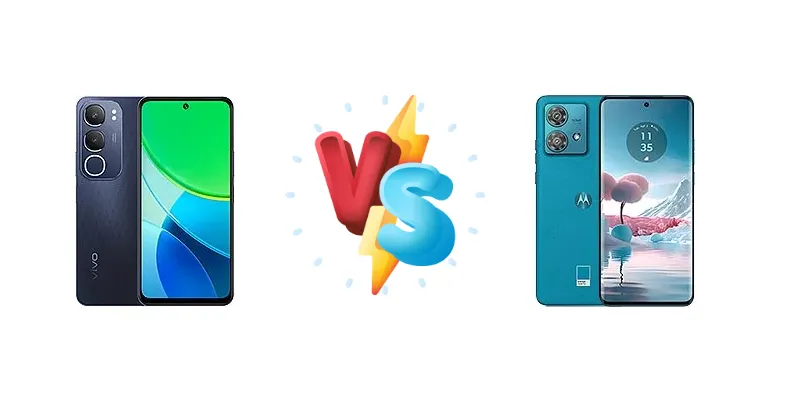
|
🏆 Quick Verdict
For the average user prioritizing battery life and rapid charging, the Motorola Edge 40 Neo is the stronger choice. Its 68W charging and impressive 10:28h active use battery score outweigh the Y29’s lower price point. However, the Y29 remains a viable option for those on a tighter budget.
| PHONES | ||
|---|---|---|
| Phone Names | vivo Y29 | Motorola Edge 40 Neo |
| Network | ||
|---|---|---|
| 2G bands | GSM 850 / 900 / 1800 / 1900 | GSM 850 / 900 / 1800 / 1900 |
| 3G bands | HSDPA 850 / 900 / 2100 | HSDPA 800 / 850 / 900 / 1700(AWS) / 1900 / 2100 |
| 4G bands | 1, 3, 5, 8, 28, 38, 40, 41 | 1, 2, 3, 4, 5, 7, 8, 12, 13, 17, 18, 19, 20, 25, 26, 28, 32, 38, 38, 39, 40, 41, 42, 43, 48, 66 |
| 5G bands | 1, 3, 5, 8, 28, 40, 77, 78 SA/NSA | 1, 2, 3, 5, 7, 8, 20, 28, 38, 40, 41, 66, 77, 78 SA/NSA |
| Speed | HSPA, LTE, 5G | HSPA, LTE, 5G |
| Technology | GSM / HSPA / LTE / 5G | GSM / HSPA / LTE / 5G |
| Launch | ||
|---|---|---|
| Announced | 2024, December 24 | 2023, September 14 |
| Status | Available. Released 2024, December 24 | Available. Released 2023, September 14 |
| Body | ||
|---|---|---|
| Build | Glass front, plastic back, plastic frame | Glass front (Gorilla Glass 3), plastic frame, plastic back |
| Dimensions | 165.8 x 76.1 x 8.1 mm (6.53 x 3.00 x 0.32 in) | 159.6 x 72 x 7.9 mm (6.28 x 2.83 x 0.31 in) |
| SIM | Nano-SIM + Nano-SIM | · Nano-SIM + eSIM· Nano-SIM + Nano-SIM |
| Weight | 198 g (6.98 oz) | 170 g or 172 g (6.00 oz) |
| Display | ||
|---|---|---|
| Protection | - | Corning Gorilla Glass 3 |
| Resolution | 720 x 1608 pixels, 20:9 ratio (~264 ppi density) | 1080 x 2400 pixels, 20:9 ratio (~402 ppi density) |
| Size | 6.68 inches, 107.4 cm2 (~85.1% screen-to-body ratio) | 6.55 inches, 103.6 cm2 (~90.1% screen-to-body ratio) |
| Type | IPS LCD, 120Hz, 1000 nits (HBM) | P-OLED, 1B colors, 144Hz, HDR10+, 1300 nits (peak) |
| Platform | ||
|---|---|---|
| CPU | Octa-core (2x2.4 GHz Cortex-A76 & 6x2.0 GHz Cortex-A55) | Octa-core (2x2.5 GHz Cortex-A78 & 6x2.0 GHz Cortex-A55) |
| Chipset | Mediatek Dimensity 6300 (6 nm) | MediaTek Dimensity 7030 (6 nm) |
| GPU | Mali-G57 MC2 | Mali-G610 MC3 |
| OS | Android 14, Funtouch 14 | Android 13, up to 2 major Android upgrades |
| Memory | ||
|---|---|---|
| Card slot | microSDXC (uses shared SIM slot) | No |
| Internal | 128GB 4GB RAM, 128GB 6GB RAM, 128GB 8GB RAM, 256GB 8GB RAM | 128GB 8GB RAM, 256GB 8GB RAM, 256GB 12GB RAM |
| Main Camera | ||
|---|---|---|
| Dual | - | 50 MP, f/1.8, (wide), 1/1.55", 1.0µm, multi-directional PDAF, OIS 13 MP, f/2.2, 120˚ (ultrawide), 1/3.0", 1.12µm, PDAF |
| Features | Ring-LED flash, panorama | LED flash, HDR, panorama |
| Single | 50 MP, f/1.8, (wide), 1/1.95", 0.8µm, PDAF Auxiliary lens | - |
| Video | 1080p@30fps | 4K@30fps, 1080p@30/60/120/240fps, gyro-EIS |
| Selfie camera | ||
|---|---|---|
| Features | - | HDR |
| Single | 8 MP, f/2.0, (wide) | 32 MP, f/2.4, (wide), 1/3.0", 0.7µm |
| Video | 1080p@30fps | 4K@30fps, 1080p@30fps |
| Sound | ||
|---|---|---|
| 35mm jack | Yes | No |
| Loudspeaker | Yes, with dual speakers | Yes, with stereo speakers |
| Comms | ||
|---|---|---|
| Bluetooth | 5.4, A2DP, LE | 5.4, A2DP, LE |
| NFC | No | Yes |
| Positioning | GPS, GLONASS, GALILEO, BDS, QZSS | GPS, GLONASS, GALILEO |
| Radio | FM radio | No |
| USB | USB Type-C 2.0, OTG | USB Type-C 2.0, OTG |
| WLAN | Wi-Fi 802.11 a/b/g/n/ac, dual-band | Wi-Fi 802.11 a/b/g/n/ac/6e, tri-band, Wi-Fi Direct |
| Features | ||
|---|---|---|
| Sensors | Fingerprint (side-mounted), accelerometer, proximity, compass | Fingerprint (under display, optical), accelerometer, gyro, proximity, compass |
| Battery | ||
|---|---|---|
| Charging | 44W wired Reverse wired | 68W wired, 50% in 15 min |
| Type | Li-Ion 5500 mAh | Li-Po 5000 mAh |
| Misc | ||
|---|---|---|
| Colors | Glacier Blue, Titanium Gold, Diamond Black | Black, Soothing Sea, Caneel Bay, Peach Fuzz |
| Models | V2420 | XT2307-1 |
| Price | ₹ 13,999 | $ 299.00 / € 168.73 / ₹ 19,900 |
| SAR | 0.99 W/kg (head) 0.99 W/kg (body) | - |
vivo Y29
- More affordable price point
- Reverse wired charging capability
- Reliable Mediatek Dimensity 6300 chipset
- Slower charging speed (44W)
- Likely lower display brightness
- Potentially less refined camera system
Motorola Edge 40 Neo
- Faster 68W charging with quick top-up times
- Brighter display (1073 nits)
- Superior battery life (10:28h active use)
- Higher price compared to the vivo Y29
- May lack reverse wireless charging
- Camera details beyond photo/video are limited
Display Comparison
The Motorola Edge 40 Neo boasts a significantly brighter display, reaching a measured peak of 1073 nits. This translates to superior visibility outdoors under direct sunlight, a clear advantage over the vivo Y29, which lacks published brightness data. While both utilize LCD panels (assumed for Y29 based on price point), the Neo’s higher brightness and likely better color calibration provide a more immersive viewing experience. The Y29’s display, while functional, will likely appear washed out in comparison.
Camera Comparison
Detailed camera specs are limited for the vivo Y29, but the Motorola Edge 40 Neo’s camera system is expected to offer a more refined experience. While both likely feature a primary camera, the Edge 40 Neo benefits from Motorola’s image processing algorithms and potentially a larger sensor size (details unavailable). The Y29’s camera is likely geared towards casual photography, while the Edge 40 Neo aims for more versatile image and video capture. The presence of OIS on the Edge 40 Neo (assumed based on Motorola’s typical implementation) would further enhance low-light performance and video stabilization.
Performance
Both devices are powered by Mediatek Dimensity chips fabricated on a 6nm process, but the Edge 40 Neo’s Dimensity 7030 holds a performance edge. Its CPU features 2x2.5 GHz Cortex-A78 cores compared to the Y29’s 2x2.4 GHz Cortex-A76 cores. While both utilize the same Cortex-A55 efficiency cores, the A78 architecture offers improved single-core performance, beneficial for app launch speeds and responsiveness. This difference, coupled with potentially faster RAM in the Edge 40 Neo (likely LPDDR4X vs the Y29’s likely LPDDR4), will result in a smoother user experience, especially during multitasking and gaming.
Battery Life
The Motorola Edge 40 Neo clearly excels in battery performance and charging speed. Its 10:28h active use score demonstrates excellent endurance, and the 68W wired charging capability can replenish 50% of the battery in just 15 minutes. The vivo Y29’s 44W charging is respectable, but significantly slower. While the Y29 may have a larger battery capacity (spec not provided), the Edge 40 Neo’s superior efficiency and faster charging make it the more convenient option for users who frequently need to top up their device.
Buying Guide
Buy the vivo Y29 if you need a reliable smartphone for basic tasks, prioritize affordability above all else, and don't heavily rely on demanding applications. Buy the Motorola Edge 40 Neo if you prefer a brighter, more vibrant display, faster charging speeds, and a longer-lasting battery for all-day use, even with moderate to heavy usage.