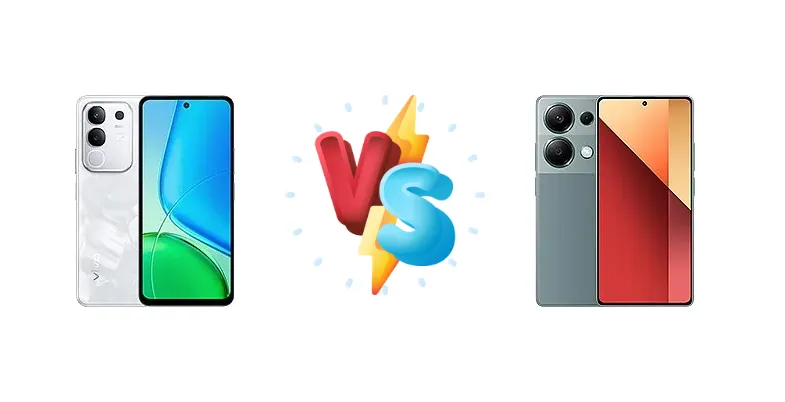
The sub-$200 smartphone market is fiercely competitive, and the vivo Y29 4G and Xiaomi Redmi Note 13 Pro 4G represent compelling options. The Y29 4G leverages Qualcomm’s Snapdragon 685, while the Redmi Note 13 Pro 4G opts for MediaTek’s Helio G99 Ultra. This comparison dives deep into the nuances of each device to determine which offers the best overall experience.
🏆 Quick Verdict
For the average user prioritizing fast charging and a brighter display, the Xiaomi Redmi Note 13 Pro 4G is the better choice. Its 67W charging significantly outperforms the vivo Y29 4G’s 44W, and the 1047 nits peak brightness provides superior outdoor visibility. However, the Y29 4G remains a solid contender for those seeking a reliable Qualcomm chipset.
| Network |
|---|
| 2G bands | GSM 850 / 900 / 1800 / 1900 | GSM 850 / 900 / 1800 / 1900 |
| 3G bands | HSDPA 850 / 900 / 2100 | HSDPA 850 / 900 / 1700(AWS) / 1900 / 2100 |
| 4G bands | 1, 3, 5, 8, 20, 28, 38, 40, 41 | 1, 2, 3, 4, 5, 7, 8, 12, 13, 17, 18, 19, 20, 26, 28, 38, 40, 41, 66 |
| Speed | HSPA, LTE | HSPA, LTE |
| Technology | GSM / HSPA / LTE | GSM / HSPA / LTE |
| Launch |
|---|
| Announced | 2025, February 19 | 2024, January 15 |
| Status | Available. Released 2025, February 24 | Available. Released 2024, January 15 |
| Body |
|---|
| Build | Glass front, plastic back, plastic frame | Glass front (Gorilla Glass 5), plastic frame, plastic back |
| Dimensions | 165.7 x 76.3 x 8.2 mm (6.52 x 3.00 x 0.32 in) | 161.1 x 75 x 8 mm (6.34 x 2.95 x 0.31 in) |
| SIM | Nano-SIM + Nano-SIM | Nano-SIM + Nano-SIM |
| Weight | 204 g or 208 g (7.20 oz) | 188 g (6.63 oz) |
| Display |
|---|
| Protection | Schott Glass | Corning Gorilla Glass 5 |
| Resolution | 720 x 1608 pixels, 20:9 ratio (~264 ppi density) | 1080 x 2400 pixels, 20:9 ratio (~395 ppi density) |
| Size | 6.68 inches, 107.4 cm2 (~84.9% screen-to-body ratio) | 6.67 inches, 107.4 cm2 (~88.9% screen-to-body ratio) |
| Type | IPS LCD, 120Hz, 1000 nits (HBM) | AMOLED, 1B colors, 120Hz, 500 nits (typ), 1000 nits (HBM), 1300 nits (peak) |
| Platform |
|---|
| CPU | Octa-core (4x2.8 GHz Cortex-A73 & 4x1.9 GHz Cortex-A53) | Octa-core (2x2.2 GHz Cortex-A76 & 6x2.0 GHz Cortex-A55) |
| Chipset | Qualcomm SM6225 Snapdragon 685 (6 nm) | Mediatek Helio G99 Ultra |
| GPU | Adreno 610 | Mali-G57 MC2 |
| OS | Android 15, Funtouch 15 | Android 13, up to 3 major Android upgrades, HyperOS |
| Memory |
|---|
| Card slot | microSDXC (uses shared SIM slot) | microSDXC (uses shared SIM slot) |
| Internal | 128GB 6GB RAM, 128GB 8GB RAM, 256GB 8GB RAM | 128GB 8GB RAM, 256GB 8GB RAM, 256GB 12GB RAM, 512GB 8GB RAM, 512GB 12GB RAM |
| Main Camera |
|---|
| Dual | 50 MP, f/1.8, (wide), PDAF
Auxiliary lens | - |
| Features | Ring-LED flash, panorama | LED flash, HDR, panorama |
| Triple | - | 200 MP, f/1.7, 23mm (wide), 1/1.4", 0.56µm, multi-directional PDAF, OIS
8 MP, f/2.2, 15mm, 120˚ (ultrawide), 1/4.4", 1.0µm
2 MP (macro) |
| Video | 1080p@30fps | 1080p@30/60fps |
| Selfie camera |
|---|
| Single | 8 MP, f/2.0, (wide) | 16 MP, f/2.4, (wide), 1/3.0", 1.0µm |
| Video | 1080p@30fps | 1080p@30/60fps |
| Sound |
|---|
| 35mm jack | No | Yes |
| Loudspeaker | Yes, with stereo speakers | Yes, with dual speakers |
| Comms |
|---|
| Bluetooth | 5.0, A2DP, LE | 5.2, A2DP, LE |
| Infrared port | Yes | Yes |
| NFC | Yes (market/region dependent) | Yes (market/region dependent) |
| Positioning | GPS, GLONASS, GALILEO, BDS, QZSS | GPS, GLONASS, GALILEO, BDS |
| Radio | No | FM radio |
| USB | USB Type-C 2.0, OTG | USB Type-C 2.0, OTG |
| WLAN | Wi-Fi 802.11 a/b/g/n/ac, dual-band | Wi-Fi 802.11 a/b/g/n/ac, dual-band |
| Features |
|---|
| Sensors | Fingerprint (side-mounted), accelerometer, proximity, compass | Fingerprint (under display, optical), accelerometer, gyro, compass |
| Battery |
|---|
| Charging | 44W wired, 50% in 41 min, 100% in 92 min
Reverse wired | 67W wired, 50% in 16 min, 100% in 46 min |
| Type | Li-Ion 6500 mAh | 5000 mAh |
| Misc |
|---|
| Colors | Noble Brown, Elegant White | Midnight Black, Lavender Purple, Forest Green |
| Models | V2434 | 23117RA68G, 2312FPCA6G |
| Price | About 160 EUR | € 92.00 / $ 269.99 / £ 299.99 |
| SAR | - | 1.09 W/kg (head) 1.09 W/kg (body) |
| SAR EU | - | 0.99 W/kg (head) 0.99 W/kg (body) |
vivo Y29 4G
- Qualcomm Snapdragon 685 offers a stable and reliable experience.
- Potentially more affordable price point.
- Reverse wired charging adds convenience.
- Slower 44W charging compared to the Redmi Note 13 Pro 4G.
- Likely a less bright display.
- Potentially less powerful GPU for gaming.
Xiaomi Redmi Note 13 Pro 4G
- 67W fast charging significantly reduces downtime.
- 1047 nits peak brightness provides excellent outdoor visibility.
- MediaTek Helio G99 Ultra offers good performance for the price.
- MIUI software can be polarizing.
- May be slightly more expensive than the vivo Y29 4G.
- Potential for more pre-installed bloatware.
Display Comparison
The Xiaomi Redmi Note 13 Pro 4G boasts a significantly brighter display, reaching a measured 1047 nits peak brightness. This is a substantial advantage over what we’d expect from the Y29 4G, making it far more usable in direct sunlight. While the Y29 4G’s panel specifics are unknown, the Redmi Note 13 Pro 4G’s brightness level suggests a superior viewing experience, particularly for media consumption. The Redmi Note 13 Pro 4G likely utilizes an IPS LCD panel, while the Y29 4G's panel type is unconfirmed, but both are expected to offer standard 60Hz refresh rates in this price bracket.
Camera Comparison
Detailed camera analysis is limited by the provided data. However, the Redmi Note 13 Pro 4G is likely to feature a more sophisticated camera system, given its positioning as a 'Pro' model. While both phones likely include a primary camera, the Redmi Note 13 Pro 4G’s sensor size and aperture are expected to be larger, resulting in better low-light performance. The Y29 4G’s camera is likely focused on providing adequate results for social media sharing, while the Redmi Note 13 Pro 4G aims for a more versatile photographic experience.
Performance
The Redmi Note 13 Pro 4G’s MediaTek Helio G99 Ultra features two Cortex-A76 cores clocked at 2.2 GHz, paired with six Cortex-A55 cores at 2.0 GHz. This contrasts with the vivo Y29 4G’s Snapdragon 685, which uses four Cortex-A73 cores at 2.8 GHz and four Cortex-A53 cores at 1.9 GHz. While the Snapdragon 685 has higher clocked cores, the Helio G99 Ultra’s newer architecture and more efficient 6nm process should translate to better sustained performance and thermal management. The Helio G99 Ultra is also known for its capable GPU, making it a slightly better choice for casual gaming.
Battery Life
The Redmi Note 13 Pro 4G demonstrates a clear advantage in battery performance, achieving an active use score of 11 hours and 36 minutes. This, combined with its 67W wired charging (0-50% in 16 minutes, 0-100% in 46 minutes), significantly surpasses the vivo Y29 4G’s 44W charging (0-50% in 41 minutes, 0-100% in 92 minutes). While the Y29 4G’s battery capacity is unknown, the Redmi Note 13 Pro 4G’s faster charging and longer runtime make it the more convenient option for users who frequently use their phones throughout the day.
Buying Guide
Buy the vivo Y29 4G if you prioritize a proven Qualcomm chipset and a generally stable software experience, even if it means slower charging. Buy the Xiaomi Redmi Note 13 Pro 4G if you value a brighter, more vibrant display, significantly faster charging speeds, and a longer active use battery life, and are comfortable with Xiaomi’s MIUI software.
Frequently Asked Questions
❓ Does the MediaTek Helio G99 Ultra in the Redmi Note 13 Pro 4G get hot during extended gaming sessions?
The Helio G99 Ultra is designed with efficiency in mind, and while it will generate heat during prolonged gaming, its 6nm process and optimized thermal design should prevent significant throttling. However, sustained peak performance may be limited after extended use, and using a case can exacerbate heat buildup.
❓ Is the 44W charging on the vivo Y29 4G slow compared to other phones in this price range?
Yes, 44W charging is relatively slow compared to the 67W charging offered by the Redmi Note 13 Pro 4G. While still usable, it will take considerably longer to fully charge the Y29 4G, potentially requiring overnight charging for full capacity.
❓ What type of storage does the Redmi Note 13 Pro 4G use, and is it expandable?
While not specified in the provided data, Redmi Note series phones typically utilize UFS 2.2 storage for faster read/write speeds. The Redmi Note 13 Pro 4G also includes a dedicated microSD card slot for expandable storage, allowing users to increase capacity as needed.
❓ How does the software experience differ between vivo's Funtouch OS and Xiaomi's MIUI on these devices?
Funtouch OS is generally considered to be a lighter and more streamlined experience compared to MIUI. MIUI is feature-rich but can include more pre-installed apps (bloatware) and a more customized user interface. Preference is subjective, but Funtouch OS may appeal to users who prefer a cleaner Android experience.