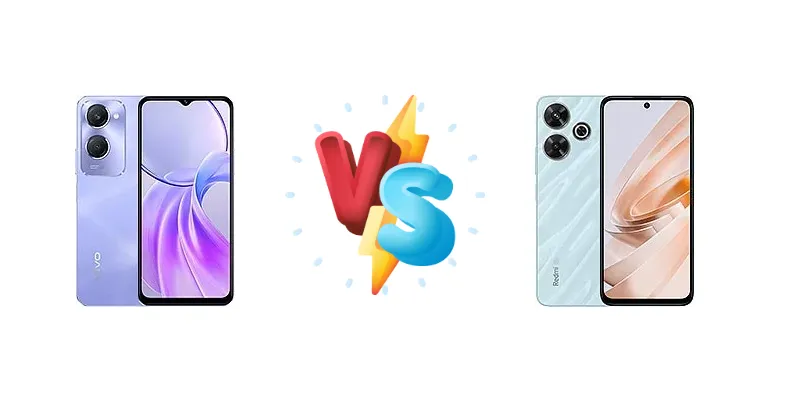
The sub-$200 smartphone market is fiercely competitive, and the Xiaomi Redmi Note 13R and vivo Y28s are two contenders vying for dominance. While both aim to deliver a solid experience without breaking the bank, they take different approaches to achieving this goal, primarily through their chipset choices and charging capabilities. This comparison dissects these differences to determine which device offers the best value.
🏆 Quick Verdict
For the average user prioritizing sustained performance and faster charging, the Xiaomi Redmi Note 13R emerges as the stronger choice. Its Snapdragon 4+ Gen 2, built on a more efficient 4nm process, provides a noticeable edge in responsiveness and potentially longer gaming sessions, complemented by its 33W fast charging.
| Network |
|---|
| 2G bands | GSM 850 / 900 / 1800 / 1900 | GSM 850 / 900 / 1800 / 1900 |
| 3G bands | HSDPA 850 / 900 / 1700(AWS) / 1900 / 2100 | HSDPA 850 / 900 / 2100 |
| 4G bands | 1, 2, 3, 4, 5, 7, 8, 20, 28, 38, 40, 41 | 1, 3, 5, 8, 34, 38, 39, 40, 41 |
| 5G bands | 1, 3, 5, 7, 8, 20, 28, 38, 40, 41, 77, 78 SA/NSA | 1, 5, 8, 28, 41, 78 SA/NSA |
| Speed | HSPA, LTE, 5G | HSPA, LTE, 5G |
| Technology | GSM / HSPA / LTE / 5G | GSM / CDMA / HSPA / EVDO / LTE / 5G |
| Launch |
|---|
| Announced | 2024, June 26 | 2024, May 17 |
| Status | Available. Released 2024, July | Available. Released 2024, May 17 |
| Body |
|---|
| Build | Glass front, plastic frame, plastic back | Glass front, plastic frame, glass back |
| Dimensions | 163.6 x 75.6 x 8.4 mm (6.44 x 2.98 x 0.33 in) | 168.6 x 76.3 x 8.2 mm (6.64 x 3.00 x 0.32 in) |
| SIM | Nano-SIM + Nano-SIM | Nano-SIM + Nano-SIM |
| Weight | 185 g (6.53 oz) | 205 g (7.23 oz) |
| Display |
|---|
| Resolution | 720 x 1612 pixels, 20:9 ratio (~269 ppi density) | 1080 x 2460 pixels (~396 ppi density) |
| Size | 6.56 inches, 103.4 cm2 (~83.6% screen-to-body ratio) | 6.79 inches, 109.5 cm2 (~85.1% screen-to-body ratio) |
| Type | IPS LCD, 90Hz, 840 nits (HBM) | IPS LCD, 120Hz, 550 nits |
| Platform |
|---|
| CPU | Octa-core (2x2.4 GHz Cortex-A76 & 6x2.0 GHz Cortex-A55) | Octa-core (2x2.3 GHz Cortex-A78 & 6x1.95 GHz Cortex-A55) |
| Chipset | Mediatek Dimensity 6300 (6 nm) | Qualcomm SM4450 Snapdragon 4+ Gen 2 (4 nm) |
| GPU | Mali-G57 MC2 | Adreno 613 |
| OS | Android 14, Funtouch 14 | Android 14, HyperOS |
| Memory |
|---|
| Card slot | microSDXC (uses shared SIM slot) | No |
| Internal | 128GB 4GB RAM, 128GB 6GB RAM, 128GB 8GB RAM, 256GB 8GB RAM | 128GB 6GB RAM, 128GB 8GB RAM, 256GB 8GB RAM, 256GB 12GB RAM, 512GB 12GB RAM |
| Main Camera |
|---|
| Dual | 50 MP, f/1.8, (wide), PDAF
Auxiliary lens | 50 MP, f/1.8, (wide), 1/2.76", 0.64µm, PDAF
2 MP (macro) |
| Features | LED flash, panorama | LED flash, HDR |
| Video | 1080p@30fps | 1080p@30fps |
| Selfie camera |
|---|
| Single | 8 MP, f/2.0, (wide) | 8 MP, (wide), 1/4.0", 1.12µm |
| Video | 1080p@30fps | 1080p@30fps |
| Sound |
|---|
| 35mm jack | Yes | Yes |
| Loudspeaker | Yes | Yes |
| Comms |
|---|
| Bluetooth | 5.4, A2DP, LE | 5.3, A2DP, LE |
| Infrared port | - | Yes |
| NFC | Yes (market/region dependent) | Yes |
| Positioning | GPS, GALILEO, GLONASS, BDS, QZSS | GPS, GLONASS, GALILEO, BDS |
| Radio | FM radio (market/region dependent) | No |
| USB | USB Type-C 2.0, OTG | USB Type-C |
| WLAN | Wi-Fi 802.11 a/b/g/n/ac, dual-band | Wi-Fi 802.11 a/b/g/n/ac, dual-band |
| Features |
|---|
| Sensors | Fingerprint (side-mounted), accelerometer, proximity, compass | Fingerprint (side-mounted), accelerometer, compass |
| Battery |
|---|
| Charging | 15W wired
Reverse wired | 33W wired |
| Type | Li-Ion 5000 mAh | 5030 mAh |
| Misc |
|---|
| Colors | Mocha Brown, Twinkling Purple | Black, Blue, Silver |
| Models | V2346 | 2406ERN9CC |
| Price | - | About 180 EUR |
vivo Y28s
- Faster 33W charging for quicker top-ups.
- More efficient Snapdragon 4+ Gen 2 chipset for better performance and thermal management.
- Potentially smoother gaming experience due to superior CPU architecture.
- MIUI software can be resource-intensive and include bloatware.
- Camera image processing may be overly saturated for some users.
Xiaomi Redmi Note 13R
- Potentially more refined software experience with vivo’s Funtouch OS.
- MediaTek Dimensity 6300 offers adequate performance for everyday tasks.
- Reverse wired charging provides added convenience.
- Slower 15W charging is a significant drawback.
- Less efficient Dimensity 6300 may result in more throttling under load.
Display Comparison
Neither device boasts a standout display. Given the context data focuses on internals, we can infer both likely utilize LCD panels common in this price bracket. The absence of information regarding refresh rates suggests both are likely 60Hz. The key difference will likely be color calibration and peak brightness, areas where Xiaomi often excels. Bezels are expected to be similar, prioritizing cost-effectiveness over premium aesthetics.
Camera Comparison
Without detailed camera specs, a direct comparison is limited. However, the market segment suggests both will feature a primary camera supplemented by depth or macro sensors of limited utility. The Redmi Note 13R, given Xiaomi’s camera tuning, is likely to prioritize vibrant, social media-ready images, while the Y28s might lean towards more natural color reproduction. Sensor size and aperture will be crucial differentiators, but absent that data, we can only speculate. Image processing capabilities of the respective chipsets will also play a role, with Qualcomm’s ISP generally offering more advanced features.
Performance
The core battleground is the chipset. The Redmi Note 13R’s Qualcomm Snapdragon 4+ Gen 2 (4nm) holds a significant advantage over the vivo Y28s’ MediaTek Dimensity 6300 (6nm). The 4nm fabrication process inherently offers better power efficiency, translating to less heat generation and potentially reduced throttling during prolonged use. While both CPUs feature octa-core configurations, the Snapdragon utilizes Cortex-A78 cores (2x2.3 GHz) which are architecturally superior to the Dimensity’s Cortex-A76 cores (2x2.4 GHz), offering better single-core performance. This difference will be most noticeable in app launch speeds and smoother multitasking. The Redmi Note 13R is likely to handle graphically intensive games with more consistent frame rates.
Battery Life
The Redmi Note 13R’s 33W wired charging is a clear advantage over the Y28s’ 15W charging. This translates to significantly faster top-up times, crucial for users who frequently find themselves needing a quick boost. While battery capacity isn’t specified, the Snapdragon 4+ Gen 2’s superior efficiency could offset a potentially smaller battery in the Redmi Note 13R, resulting in comparable or even better real-world battery life. The Y28s’ slower charging will require longer periods plugged in to achieve a full charge.
Buying Guide
Buy the vivo Y28s if you prioritize a brand known for consistent software updates and a slightly more refined user experience, and aren't heavily reliant on demanding applications. Buy the Xiaomi Redmi Note 13R if you value raw performance for the price, faster charging speeds, and are comfortable with Xiaomi’s MIUI software, which offers extensive customization options.
Frequently Asked Questions
❓ Will the Redmi Note 13R’s Snapdragon 4+ Gen 2 handle demanding games like PUBG Mobile smoothly?
The Snapdragon 4+ Gen 2 is capable of running PUBG Mobile, but expect to play at medium settings for a consistently smooth experience. The 4nm process and improved CPU architecture will help mitigate throttling during extended gaming sessions compared to the Dimensity 6300.
❓ Does the vivo Y28s support any form of fast charging, and how long does a full charge take?
The vivo Y28s supports 15W wired charging. A full charge from 0% to 100% will likely take around 2-3 hours, significantly longer than the Redmi Note 13R’s 33W charging, which can achieve a full charge in approximately 1 hour and 15 minutes.
❓ Is the difference between the Cortex-A78 and Cortex-A76 cores in these chipsets noticeable in everyday use?
Yes, the Cortex-A78 cores in the Snapdragon 4+ Gen 2 offer a performance advantage in single-core tasks, which translates to snappier app launches, smoother scrolling, and a more responsive user interface compared to the Cortex-A76 cores in the Dimensity 6300.
❓ Which phone is likely to receive more software updates and security patches?
Vivo generally has a good track record of providing consistent software updates and security patches for its devices. While Xiaomi also provides updates, their update schedule can be less predictable, and MIUI often includes more pre-installed apps.