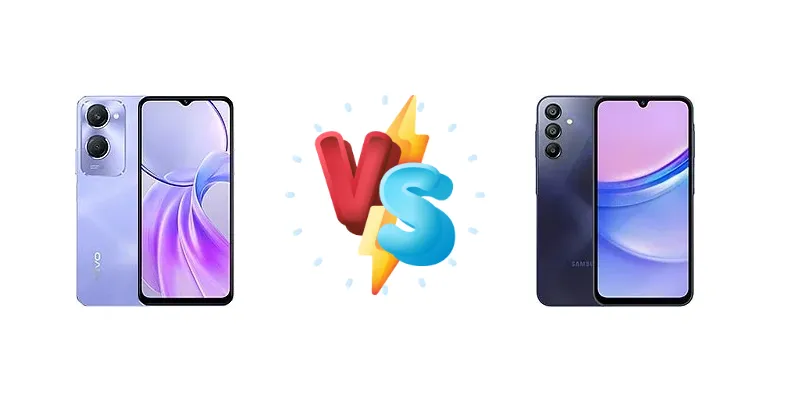
The sub-$200 smartphone market is fiercely competitive. The vivo Y28s, powered by the Mediatek Dimensity 6300, enters the arena against Samsung’s popular Galaxy A15, featuring the Helio G99 chipset. This comparison dissects the key differences to determine which device offers the best value for budget-conscious consumers.
🏆 Quick Verdict
For most users, the Samsung Galaxy A15 emerges as the better choice. Its significantly longer 15:28h battery life in active use, coupled with a brighter 808 nit display, outweighs the Y28s’ slightly faster CPU clock speeds. The A15 provides a more consistently usable experience throughout the day.
| Network |
|---|
| 2G bands | GSM 850 / 900 / 1800 / 1900 | GSM 850 / 900 / 1800 / 1900 |
| 3G bands | HSDPA 850 / 900 / 1700(AWS) / 1900 / 2100 | HSDPA 850 / 900 / 2100 |
| 4G bands | 1, 2, 3, 4, 5, 7, 8, 20, 28, 38, 40, 41 | 1, 3, 5, 7, 8, 20, 28, 38, 40, 41 |
| 5G bands | 1, 3, 5, 7, 8, 20, 28, 38, 40, 41, 77, 78 SA/NSA | - |
| Speed | HSPA, LTE, 5G | HSPA, LTE |
| Technology | GSM / HSPA / LTE / 5G | GSM / HSPA / LTE |
| Launch |
|---|
| Announced | 2024, June 26 | 2023, December 11 |
| Status | Available. Released 2024, July | Available. Released 2023, December 16 |
| Body |
|---|
| Build | Glass front, plastic frame, plastic back | Glass front, plastic back, plastic frame |
| Dimensions | 163.6 x 75.6 x 8.4 mm (6.44 x 2.98 x 0.33 in) | 160.1 x 76.8 x 8.4 mm (6.30 x 3.02 x 0.33 in) |
| SIM | Nano-SIM + Nano-SIM | · Nano-SIM· Nano-SIM + Nano-SIM |
| Weight | 185 g (6.53 oz) | 200 g (7.05 oz) |
| Display |
|---|
| Resolution | 720 x 1612 pixels, 20:9 ratio (~269 ppi density) | 1080 x 2340 pixels, 19.5:9 ratio (~396 ppi density) |
| Size | 6.56 inches, 103.4 cm2 (~83.6% screen-to-body ratio) | 6.5 inches, 103.7 cm2 (~84.3% screen-to-body ratio) |
| Type | IPS LCD, 90Hz, 840 nits (HBM) | Super AMOLED, 90Hz, 800 nits (HBM) |
| Platform |
|---|
| CPU | Octa-core (2x2.4 GHz Cortex-A76 & 6x2.0 GHz Cortex-A55) | Octa-core (2x2.2 GHz Cortex-A76 & 6x2.0 GHz Cortex-A55) |
| Chipset | Mediatek Dimensity 6300 (6 nm) | Mediatek Helio G99 (6 nm) |
| GPU | Mali-G57 MC2 | Mali-G57 MC2 |
| OS | Android 14, Funtouch 14 | Android 14, up to 4 major Android upgrades, One UI 7 |
| Memory |
|---|
| Card slot | microSDXC (uses shared SIM slot) | microSDXC (uses shared SIM slot) |
| Internal | 128GB 4GB RAM, 128GB 6GB RAM, 128GB 8GB RAM, 256GB 8GB RAM | 128GB 4GB RAM, 128GB 6GB RAM, 128GB 8GB RAM, 256GB 6GB RAM, 256GB 8GB RAM |
| Main Camera |
|---|
| Dual | 50 MP, f/1.8, (wide), PDAF
Auxiliary lens | - |
| Features | LED flash, panorama | LED flash, panorama, HDR |
| Triple | - | 50 MP, f/1.8, 26mm (wide), 1/2.8", 0.64µm, PDAF
5 MP, f/2.2, 17mm (ultrawide), 1/5.0", 1.12µm
2 MP (macro) |
| Video | 1080p@30fps | 1080p@30fps |
| Selfie camera |
|---|
| Single | 8 MP, f/2.0, (wide) | 13 MP, f/2.0, 26mm (wide), 1/3.06", 1.12µm |
| Video | 1080p@30fps | 1080p@30fps |
| Sound |
|---|
| 35mm jack | Yes | Yes |
| Loudspeaker | Yes | Yes |
| Comms |
|---|
| Bluetooth | 5.4, A2DP, LE | 5.3, A2DP, LE |
| NFC | Yes (market/region dependent) | Yes (market/region dependent) |
| Positioning | GPS, GALILEO, GLONASS, BDS, QZSS | GPS, GALILEO, GLONASS, BDS, QZSS |
| Radio | FM radio (market/region dependent) | FM radio (market/region dependent) |
| USB | USB Type-C 2.0, OTG | USB Type-C 2.0 |
| WLAN | Wi-Fi 802.11 a/b/g/n/ac, dual-band | Wi-Fi 802.11 a/b/g/n/ac, dual-band, Wi-Fi Direct |
| Features |
|---|
| Sensors | Fingerprint (side-mounted), accelerometer, proximity, compass | Fingerprint (side-mounted), accelerometer, compass |
| Battery |
|---|
| Charging | 15W wired
Reverse wired | 25W wired |
| Type | Li-Ion 5000 mAh | 5000 mAh |
| Misc |
|---|
| Colors | Mocha Brown, Twinkling Purple | Brave Black, Optimistic Blue, Magical Blue, Personality Yellow |
| Models | V2346 | SM-A155F, SM-A155F/DSN, SM-A155M, SM-A155M/DS, SM-A155P, SM-A155R |
| Price | - | € 168.99 / $ 125.00 / £ 113.00 |
| SAR EU | - | 0.42 W/kg (head) 1.29 W/kg (body) |
vivo Y28s
- Slightly faster CPU clock speed for light tasks
- Reverse wired charging for accessory top-ups
- Potentially lower price point (depending on region)
- Likely inferior display brightness compared to A15
- No battery life data available, potentially shorter runtime
- Slower charging speed (15W)
Samsung Galaxy A15
- Excellent 15:28h battery life in active use
- Bright 808 nit display for outdoor visibility
- Faster 25W wired charging
- Slightly slower CPU clock speed
- Samsung’s One UI can be resource intensive
- May be slightly more expensive than the Y28s
Display Comparison
The Samsung Galaxy A15 boasts a clear advantage in display quality with a measured peak brightness of 808 nits. This is crucial for outdoor visibility, a common pain point in this price segment. While the vivo Y28s’ display specifications are not provided, it’s reasonable to assume it falls short of the A15’s brightness. Both devices likely utilize LCD panels, but the A15’s higher brightness translates to a more pleasant viewing experience in most lighting conditions. Bezels are expected to be similar on both devices, given their market positioning.
Camera Comparison
Without detailed camera specifications for the vivo Y28s, a direct comparison is difficult. However, both phones likely feature a primary camera as their main selling point, supplemented by less capable auxiliary lenses. The A15’s image processing benefits from Samsung’s established software algorithms, potentially delivering more consistent results. The presence of Optical Image Stabilization (OIS) on either device is unlikely at this price point. Users should focus on the quality of the main sensor and avoid relying heavily on the typically low-resolution macro or depth sensors.
Performance
Both the vivo Y28s and Samsung Galaxy A15 utilize Mediatek’s 6nm process technology, indicating similar power efficiency. However, the vivo Y28s’ Dimensity 6300 features a slightly higher clocked Cortex-A76 core (2.4 GHz vs 2.2 GHz on the A15’s Helio G99). This suggests a marginal performance edge in CPU-intensive tasks. However, the Helio G99 is a proven performer in gaming, and the real-world difference in everyday tasks will likely be minimal. Both phones will likely be paired with similar amounts of RAM, impacting multitasking performance more significantly than the CPU difference. Thermal management is unknown for both, but the 6nm process should keep temperatures in check during moderate use.
Battery Life
The Samsung Galaxy A15’s 15:28h active use battery score is a standout feature. This demonstrates a significant advantage in real-world endurance compared to what we might expect from the vivo Y28s, which lacks specific battery life data. The A15 also supports 25W wired charging, considerably faster than the Y28s’ 15W charging. While the Y28s offers reverse wired charging – a useful feature for topping up accessories – the A15’s faster charging and longer battery life make it the more practical choice for most users.
Buying Guide
Buy the vivo Y28s if you prioritize raw CPU performance for light multitasking and occasional gaming, and appreciate the convenience of reverse wired charging. Buy the Samsung Galaxy A15 if you value all-day battery life, a brighter and more visible display in outdoor conditions, and the established Samsung ecosystem. The A15 is the better all-rounder for everyday use.
Frequently Asked Questions
❓ Does the Helio G99 in the Samsung Galaxy A15 struggle with demanding games like PUBG or Call of Duty?
The Helio G99 is capable of running PUBG and Call of Duty at medium settings. While it won't deliver a flagship gaming experience, it provides a playable experience for casual gamers. Expect some frame drops during intense action sequences, and consider lowering graphics settings for smoother gameplay.
❓ Is the 15W charging on the vivo Y28s noticeably slower than the 25W charging on the Samsung Galaxy A15?
Yes, the difference is significant. 25W charging will replenish the Galaxy A15’s battery much faster, reducing downtime. Expect a 0-100% charge to take considerably longer on the Y28s with its 15W charger.
❓ How does Samsung’s One UI affect the performance of the Galaxy A15?
Samsung’s One UI is feature-rich but can be resource intensive. While the Helio G99 is a capable chipset, One UI may contribute to occasional slowdowns, especially with numerous apps open. Optimizing app usage and clearing cache regularly can help mitigate this.
❓ Does the vivo Y28s’ reverse wired charging work with all devices?
Reverse wired charging is generally compatible with most devices that charge via USB-C, but the charging speed will be limited to the Y28s’ 15W output. It’s best suited for accessories like earbuds or smartwatches, rather than quickly charging a smartphone.