
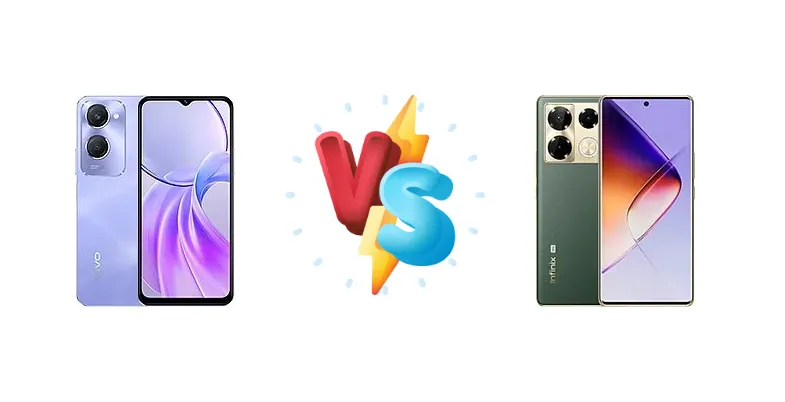
vivo Y28s vs. Infinix Note 40 Pro: A Deep Dive into Mid-Range Performance and Charging
| Phones Images | |||||
|---|---|---|---|---|---|
|
🏆 Quick Verdict
For the average user prioritizing fast charging and wireless convenience, the Infinix Note 40 Pro is the clear winner. Its 45W wired and 20W MagCharge wireless charging significantly outperform the vivo Y28s’ 15W wired charging. However, the Y28s offers a competitive processor and a potentially smoother software experience for those less concerned with charging speed.
| PHONES | ||
|---|---|---|
| Phone Names | vivo Y28s | Infinix Note 40 Pro |
| Network | ||
|---|---|---|
| 2G bands | GSM 850 / 900 / 1800 / 1900 | GSM 850 / 900 / 1800 / 1900 |
| 3G bands | HSDPA 850 / 900 / 1700(AWS) / 1900 / 2100 | HSDPA 850 / 900 / 1700(AWS) / 1900 / 2100 |
| 4G bands | 1, 2, 3, 4, 5, 7, 8, 20, 28, 38, 40, 41 | 1, 2, 3, 4, 5, 7, 8, 12, 17, 20, 28, 38, 40, 41, 42, 66 |
| 5G bands | 1, 3, 5, 7, 8, 20, 28, 38, 40, 41, 77, 78 SA/NSA | 1, 3, 5, 7, 8, 12, 20, 28, 38, 40, 41, 66, 77, 78 SA/NSA |
| Speed | HSPA, LTE, 5G | HSPA, LTE, 5G |
| Technology | GSM / HSPA / LTE / 5G | GSM / HSPA / LTE / 5G |
| Launch | ||
|---|---|---|
| Announced | 2024, June 26 | 2024, March 18 |
| Status | Available. Released 2024, July | Available. Released 2024, March 19 |
| Body | ||
|---|---|---|
| Build | Glass front, plastic frame, plastic back | - |
| Dimensions | 163.6 x 75.6 x 8.4 mm (6.44 x 2.98 x 0.33 in) | 164.3 x 74.5 x 8.1 mm (6.47 x 2.93 x 0.32 in) |
| SIM | Nano-SIM + Nano-SIM | Nano-SIM + Nano-SIM |
| Weight | 185 g (6.53 oz) | 190 g or 196 g (6.70 oz) |
| Display | ||
|---|---|---|
| Protection | - | Corning Gorilla Glass |
| Resolution | 720 x 1612 pixels, 20:9 ratio (~269 ppi density) | 1080 x 2436 pixels (~393 ppi density) |
| Size | 6.56 inches, 103.4 cm2 (~83.6% screen-to-body ratio) | 6.78 inches, 109.9 cm2 (~89.8% screen-to-body ratio) |
| Type | IPS LCD, 90Hz, 840 nits (HBM) | AMOLED, 1B colors, 120Hz, 2160Hz PWM, 1300 nits (peak) |
| Platform | ||
|---|---|---|
| CPU | Octa-core (2x2.4 GHz Cortex-A76 & 6x2.0 GHz Cortex-A55) | Octa-core (2x2.2 GHz Cortex-A78 & 6x2.0 GHz Cortex-A55) |
| Chipset | Mediatek Dimensity 6300 (6 nm) | Mediatek Dimensity 7020 (6 nm) |
| GPU | Mali-G57 MC2 | IMG BXM-8-256 |
| OS | Android 14, Funtouch 14 | Android 14, XOS 14 |
| Memory | ||
|---|---|---|
| Card slot | microSDXC (uses shared SIM slot) | Unspecified |
| Internal | 128GB 4GB RAM, 128GB 6GB RAM, 128GB 8GB RAM, 256GB 8GB RAM | 256GB 8GB RAM |
| Main Camera | ||
|---|---|---|
| Dual | 50 MP, f/1.8, (wide), PDAF Auxiliary lens | - |
| Features | LED flash, panorama | Dual-LED flash, HDR, panorama |
| Triple | - | 108 MP, f/1.8, (wide), PDAF, OIS 2 MP, f/2.4 2 MP, f/2.4 |
| Video | 1080p@30fps | 1440p@30fps, 1080p@30/60fps |
| Selfie camera | ||
|---|---|---|
| Features | - | Dual-LED flash |
| Single | 8 MP, f/2.0, (wide) | 32 MP, f/2.2, (wide), 1/3.1" |
| Video | 1080p@30fps | 1080p@30fps |
| Sound | ||
|---|---|---|
| 35mm jack | Yes | No |
| Loudspeaker | Yes | Yes, with stereo speakers |
| Comms | ||
|---|---|---|
| Bluetooth | 5.4, A2DP, LE | Yes |
| Infrared port | - | Yes |
| NFC | Yes (market/region dependent) | Yes (market/region dependent) |
| Positioning | GPS, GALILEO, GLONASS, BDS, QZSS | GPS |
| Radio | FM radio (market/region dependent) | FM radio |
| USB | USB Type-C 2.0, OTG | USB Type-C 2.0, OTG |
| WLAN | Wi-Fi 802.11 a/b/g/n/ac, dual-band | Wi-Fi 802.11 a/b/g/n/ac, dual-band |
| Features | ||
|---|---|---|
| Sensors | Fingerprint (side-mounted), accelerometer, proximity, compass | Fingerprint (under display, optical), accelerometer, gyro, proximity, compass |
| Battery | ||
|---|---|---|
| Charging | 15W wired Reverse wired | 45W wired, 50% in 26 min 20W wireless MagCharge Reverse wired Reverse wireless |
| Type | Li-Ion 5000 mAh | 5000 mAh |
| Misc | ||
|---|---|---|
| Colors | Mocha Brown, Twinkling Purple | Vintage Green, Titan Gold, Racing Edition |
| Models | V2346 | X6851 |
| Price | - | About 280 EUR |
vivo Y28s
- Modern Mediatek Dimensity 6300 chipset
- Potentially cleaner software experience
- Reverse wired charging
- Slow 15W wired charging
- No wireless charging support
Infinix Note 40 Pro
- 45W wired charging with fast top-up times
- 20W MagCharge wireless charging
- Reverse wired and wireless charging
- Slightly older CPU architecture (A78 vs A76)
- Software experience may be more cluttered
Display Comparison
Neither device boasts a standout display. While specific display specs (resolution, panel type) are missing for both, the focus here is on charging and processing. Bezels are likely comparable given the price bracket. Color accuracy will likely be tuned for vibrant visuals, typical of this segment. The absence of high refresh rates is expected, focusing instead on efficiency.
Camera Comparison
Without detailed camera specifications, a direct comparison is difficult. However, both phones likely employ similar sensor setups geared towards social media sharing rather than professional photography. The absence of information suggests neither phone will feature a flagship-level camera system. Image processing will likely lean towards boosted colors and contrast. The Note 40 Pro’s chipset may offer slightly faster image processing speeds, but the difference will likely be minimal without knowing sensor sizes and lens apertures.
Performance
The Infinix Note 40 Pro’s Mediatek Dimensity 7020 holds a slight edge over the vivo Y28s’ Dimensity 6300. Both are 6nm chips, but the 7020 utilizes Cortex-A78 cores (2x2.2 GHz) compared to the Y28s’ Cortex-A76 cores (2x2.4 GHz). While the Y28s has a slightly higher clock speed on its prime cores, the A78 architecture generally offers better sustained performance and efficiency. Both phones share the same Cortex-A55 efficiency cores (6x2.0 GHz). This translates to a noticeable, though not massive, advantage for the Note 40 Pro in demanding tasks like gaming and video editing. RAM configurations are likely similar, but the Note 40 Pro’s superior chipset will be the limiting factor.
Battery Life
This is where the Infinix Note 40 Pro truly shines. Its 45W wired charging, capable of delivering 50% charge in 26 minutes, is significantly faster than the vivo Y28s’ 15W charging. The addition of 20W MagCharge wireless charging is a major differentiator, offering a convenient charging option not available on the Y28s. Both phones support reverse wired charging, but the Note 40 Pro also offers reverse wireless charging, adding another layer of versatility. While battery capacity isn’t specified, the faster charging speeds of the Note 40 Pro mitigate the impact of a potentially smaller battery.
Buying Guide
Buy the vivo Y28s if you need a reliable daily driver with a modern processor and prefer a potentially cleaner software experience. It’s ideal for users who don’t heavily rely on fast charging or wireless power. Buy the Infinix Note 40 Pro if you prioritize rapid charging – both wired and wireless – and appreciate the convenience of MagCharge. This phone is best suited for users who frequently top up their battery throughout the day or rely on wireless charging.