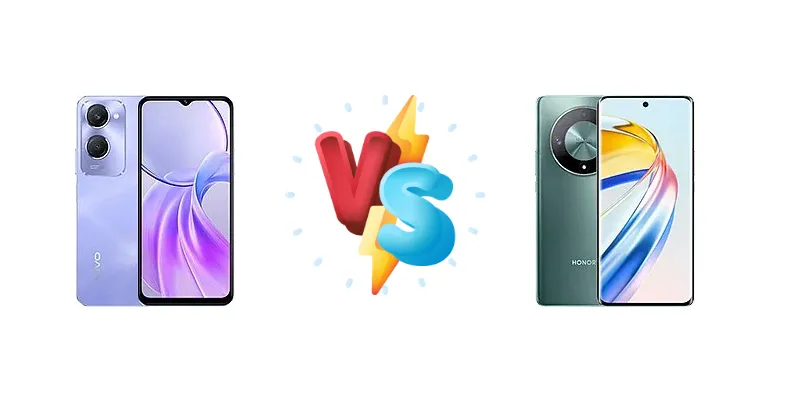
The mid-range smartphone market is fiercely competitive, and the vivo Y28s and Honor X9b represent compelling options for budget-conscious buyers. While both aim to deliver a solid experience, they take different approaches to achieving it – the vivo Y28s prioritizing raw CPU power, and the Honor X9b focusing on chipset efficiency and faster charging. This comparison will dissect their key specifications to determine which device offers the best overall package.
🏆 Quick Verdict
For the average user prioritizing all-day battery life and faster charging, the Honor X9b emerges as the stronger contender. Its Snapdragon 6 Gen 1, built on a 4nm process, offers superior power efficiency, translating to longer usage times and less heat. While the vivo Y28s boasts a slightly faster peak CPU clock speed, the X9b’s overall system optimization provides a smoother, more consistent experience.
| Network |
|---|
| 2G bands | GSM 850 / 900 / 1800 / 1900 | GSM 850 / 900 / 1800 / 1900 |
| 3G bands | HSDPA 850 / 900 / 1700(AWS) / 1900 / 2100 | HSDPA 850 / 900 / 1900 / 2100 |
| 4G bands | 1, 2, 3, 4, 5, 7, 8, 20, 28, 38, 40, 41 | 1, 2, 3, 4, 5, 7, 8, 20, 28, 32, 38, 40, 41 |
| 5G bands | 1, 3, 5, 7, 8, 20, 28, 38, 40, 41, 77, 78 SA/NSA | 1, 3, 7, 8, 20, 28, 38, 40, 41, 77, 78 SA/NSA |
| Speed | HSPA, LTE, 5G | HSPA, LTE, 5G |
| Technology | GSM / HSPA / LTE / 5G | GSM / HSPA / LTE / 5G |
| Launch |
|---|
| Announced | 2024, June 26 | 2023, October 18 |
| Status | Available. Released 2024, July | Available. Released 2023, October |
| Body |
|---|
| Build | Glass front, plastic frame, plastic back | - |
| Dimensions | 163.6 x 75.6 x 8.4 mm (6.44 x 2.98 x 0.33 in) | 163.6 x 75.5 x 8 mm (6.44 x 2.97 x 0.31 in) |
| SIM | Nano-SIM + Nano-SIM | Nano-SIM + Nano-SIM |
| Weight | 185 g (6.53 oz) | 185 g (6.53 oz) |
| Display |
|---|
| Resolution | 720 x 1612 pixels, 20:9 ratio (~269 ppi density) | 1220 x 2652 pixels, 19.5:9 ratio (~431 ppi density) |
| Size | 6.56 inches, 103.4 cm2 (~83.6% screen-to-body ratio) | 6.78 inches, 112.6 cm2 (~91.2% screen-to-body ratio) |
| Type | IPS LCD, 90Hz, 840 nits (HBM) | AMOLED, 1B colors, 120Hz, 1200 nits (peak) |
| Platform |
|---|
| CPU | Octa-core (2x2.4 GHz Cortex-A76 & 6x2.0 GHz Cortex-A55) | Octa-core (4x2.2 GHz Cortex-A78 & 4x1.8 GHz Cortex-A55) |
| Chipset | Mediatek Dimensity 6300 (6 nm) | Qualcomm SM6450 Snapdragon 6 Gen 1 (4 nm) |
| GPU | Mali-G57 MC2 | Adreno 710 |
| OS | Android 14, Funtouch 14 | Android 13, Magic OS 7.2 |
| Memory |
|---|
| Card slot | microSDXC (uses shared SIM slot) | No |
| Internal | 128GB 4GB RAM, 128GB 6GB RAM, 128GB 8GB RAM, 256GB 8GB RAM | 256GB 8GB RAM, 256GB 12GB RAM, 512GB 8GB RAM, 512GB 12GB RAM |
| Main Camera |
|---|
| Dual | 50 MP, f/1.8, (wide), PDAF
Auxiliary lens | - |
| Features | LED flash, panorama | LED flash, panorama, HDR |
| Triple | - | 108 MP, f/1.8, (wide), 1/1.67", PDAF
5 MP, f/2.2, (ultrawide)
2 MP (macro) |
| Video | 1080p@30fps | 4K@30fps, 1080p@30fps |
| Selfie camera |
|---|
| Single | 8 MP, f/2.0, (wide) | 16 MP, f/2.5, (wide) |
| Video | 1080p@30fps | 1080p@30fps |
| Sound |
|---|
| 35mm jack | Yes | No |
| Loudspeaker | Yes | Yes |
| Comms |
|---|
| Bluetooth | 5.4, A2DP, LE | 5.1, A2DP, LE |
| Infrared port | - | Yes |
| NFC | Yes (market/region dependent) | Yes (market/region dependent) |
| Positioning | GPS, GALILEO, GLONASS, BDS, QZSS | GPS, GLONASS, GALILEO, BDS |
| Radio | FM radio (market/region dependent) | No |
| USB | USB Type-C 2.0, OTG | USB Type-C 2.0, OTG |
| WLAN | Wi-Fi 802.11 a/b/g/n/ac, dual-band | Wi-Fi 802.11 a/b/g/n/ac, dual-band, Wi-Fi Direct |
| Features |
|---|
| Sensors | Fingerprint (side-mounted), accelerometer, proximity, compass | Fingerprint (under display, optical), accelerometer, gyro, proximity, compass |
| Battery |
|---|
| Charging | 15W wired
Reverse wired | 35W wired
Reverse wired |
| Type | Li-Ion 5000 mAh | Li-Po 5800 mAh |
| Misc |
|---|
| Colors | Mocha Brown, Twinkling Purple | Sunrise Orange, Midnight Black, Emerald Green |
| Models | V2346 | ALI-NX1 |
| Price | - | About 970 EUR |
vivo Y28s
- Potentially higher peak CPU performance due to Cortex-A76 cores.
- Reverse wired charging for accessory top-ups.
- May be more readily available in certain markets.
- Less efficient 6nm Dimensity 6300 chipset.
- Slower 15W charging.
- Likely to run warmer under sustained load.
Honor X9b
- More efficient 4nm Snapdragon 6 Gen 1 chipset.
- Faster 35W wired charging.
- Better thermal management for sustained performance.
- Reverse wired charging for accessory top-ups.
- Slightly lower peak CPU clock speeds.
- May be less widely available depending on region.
Display Comparison
Neither device’s display specifications are provided, so a direct comparison is limited. However, given their price points, we can expect both to feature LCD panels with FHD+ resolution. The absence of details like refresh rate or peak brightness suggests neither phone will excel in this area. Users seeking vibrant colors and high refresh rates will likely need to look at more expensive options.
Camera Comparison
Without specific camera sensor details, a detailed comparison is impossible. However, it’s reasonable to assume both phones will feature a multi-camera setup with a primary sensor and supporting lenses. The absence of information regarding OIS (Optical Image Stabilization) suggests neither phone will offer advanced stabilization features. Image processing will likely be a key differentiator, with Honor typically leaning towards more saturated colors and vivo favoring a more natural look. Users prioritizing photography should look for detailed camera reviews beyond the basic specifications.
Performance
The core difference lies in the chipsets. The Honor X9b’s Qualcomm Snapdragon 6 Gen 1 (4nm) is a significant advantage over the vivo Y28s’ MediaTek Dimensity 6300 (6nm). The 4nm fabrication process inherently leads to better power efficiency, meaning the X9b will draw less power for the same level of performance, resulting in cooler operation and longer battery life. While the Y28s’ Dimensity 6300 features two Cortex-A76 cores clocked at 2.4GHz, compared to the X9b’s four Cortex-A78 cores at 2.2GHz, the architectural improvements and process node of the Snapdragon chip likely offset the clock speed difference. The X9b’s CPU configuration is better suited for sustained workloads.
Battery Life
The Honor X9b’s 35W wired charging is a clear advantage over the vivo Y28s’ 15W charging. This translates to significantly faster charging times – potentially reducing a full charge from over two hours on the Y28s to around an hour on the X9b. While battery capacity isn’t specified, the Snapdragon 6 Gen 1’s superior efficiency means the X9b will likely deliver comparable or better battery life even with a similar capacity battery. The inclusion of reverse wired charging on both devices is a convenient feature for topping up accessories.
Buying Guide
Buy the vivo Y28s if you frequently engage in CPU-intensive tasks like video editing or running multiple apps simultaneously and need the highest possible peak processing power. Buy the Honor X9b if you prioritize battery life, fast charging, and a more thermally efficient device for everyday use, including gaming and media consumption. The X9b is the better choice for users who value longevity and consistent performance over raw, bursty power.
Frequently Asked Questions
❓ Will the Snapdragon 6 Gen 1 in the Honor X9b struggle with demanding games like PUBG or Genshin Impact?
While not a flagship-level chipset, the Snapdragon 6 Gen 1 is capable of running PUBG and Genshin Impact at medium settings with reasonable frame rates. The 4nm process and improved thermal management will help prevent significant throttling during extended gaming sessions, providing a more consistent experience than the Dimensity 6300 in the vivo Y28s.
❓ Does the vivo Y28s’ faster CPU clock speed translate to a noticeable performance difference in everyday tasks?
In short bursts, the higher clock speed of the Y28s’ Cortex-A76 cores might offer a slight advantage in single-core tasks. However, for most everyday tasks like browsing, social media, and video playback, the difference will be negligible. The Snapdragon 6 Gen 1’s superior architecture and efficiency provide a smoother, more responsive experience overall.
❓ How long will it take to fully charge each phone from 0%?
With 35W charging, the Honor X9b is estimated to charge from 0% to 100% in approximately 60-75 minutes. The vivo Y28s, with its 15W charging, will likely take over two hours to achieve a full charge.