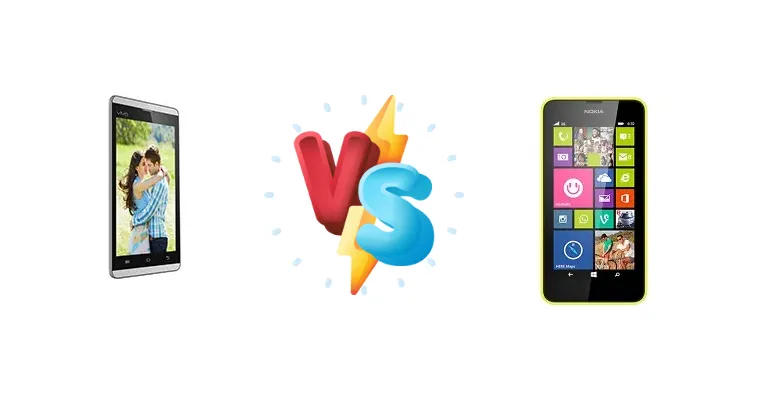
Released in 2014, the vivo Y28 and Nokia Lumia 630 represent distinct approaches to the entry-level smartphone market. The Y28 ran Android, while the Lumia 630 championed Windows Phone 8.1. Both aimed to deliver smartphone functionality at an accessible price point, but differed significantly in their hardware and software philosophies. This comparison dissects their key specifications to determine which device holds up better in retrospect.
🏆 Quick Verdict
For the average user seeking a functional, albeit dated, smartphone, the Nokia Lumia 630 emerges as the slightly better choice. Its Snapdragon 400 chipset, coupled with a reported 66-hour endurance rating, provides a more reliable and efficient experience than the vivo Y28’s Mediatek MT6582, despite the similar Cortex-A7 architecture.
| Network |
|---|
| 2G bands | GSM 850 / 900 / 1800 / 1900 | GSM 850 / 900 / 1800 / 1900 - all versions |
| 3G bands | HSDPA 850 / 900 / 2100 | HSDPA 900 / 2100 - RM-976 |
| Speed | HSPA 21.1/5.76 Mbps | HSPA 21.1/5.76 Mbps |
| Technology | GSM / HSPA | GSM / HSPA |
| | - | HSDPA 850 / 900 / 1900 / 2100 - RM-977 |
| Launch |
|---|
| Announced | 2014, December. Released 2014, December | 2014, April. Released 2014, May |
| Status | Discontinued | Discontinued |
| Body |
|---|
| Dimensions | 137.4 x 68.6 x 9.8 mm (5.41 x 2.70 x 0.39 in) | 129.5 x 66.7 x 9.2 mm, 78.5 cc (5.10 x 2.63 x 0.36 in) |
| SIM | Micro-SIM | Micro-SIM |
| Weight | 156 g (5.50 oz) | 134 g (4.73 oz) |
| Display |
|---|
| Protection | - | Corning Gorilla Glass 3 |
| Resolution | 540 x 960 pixels, 16:10 ratio (~216 ppi density) | 480 x 854 pixels, 16:9 ratio (~221 ppi density) |
| Size | 4.7 inches, 64.2 cm2 (~68.1% screen-to-body ratio) | 4.5 inches, 54.3 cm2 (~62.9% screen-to-body ratio) |
| Type | IPS LCD | IPS LCD |
| | - | ClearBlack display |
| Platform |
|---|
| CPU | Quad-core 1.3 GHz Cortex-A7 | Quad-core 1.2 GHz Cortex-A7 |
| Chipset | Mediatek MT6582 (28 nm) | Qualcomm Snapdragon 400 (28 nm) |
| GPU | Mali-400MP2 | Adreno 305 |
| OS | Android 4.2.2 (Jelly Bean) | Microsoft Windows Phone 8.1 |
| Memory |
|---|
| Card slot | microSDXC (dedicated slot) | microSDXC (dedicated slot) |
| Internal | 8GB 1GB RAM | 8GB 512MB RAM |
| | - | eMMC 4.5 |
| Main Camera |
|---|
| Features | LED flash | Panorama |
| Single | 8 MP, AF | 5 MP, 1/4.0", AF |
| Video | 1080p@30fps | 720p@30fps |
| Selfie camera |
|---|
| Single | 5 MP | - |
| | - | No |
| Sound |
|---|
| 3.5mm jack | - | Yes |
| 35mm jack | Yes | Yes |
| Loudspeaker | Yes | Yes |
| Comms |
|---|
| Bluetooth | 4.0, A2DP, EDR | 4.0, A2DP, LE/ aptX after WP8 Denim update |
| Infrared port | Yes | - |
| NFC | No | No |
| Positioning | GPS | GPS, GLONASS |
| Radio | FM radio | FM radio |
| USB | microUSB 2.0 | microUSB 2.0 |
| WLAN | Wi-Fi 802.11 b/g/n, hotspot | Wi-Fi 802.11 b/g/n, DLNA, hotspot |
| Features |
|---|
| Sensors | Accelerometer, proximity, compass | Accelerometer, sensor core |
| Battery |
|---|
| Music play | Up to 32 h | Up to 58 h |
| Stand-by | Up to 430 h (2G) / Up to 430 h (3G) | Up to 600 h |
| Talk time | Up to 14 h (2G) / Up to 13 h (3G) | Up to 16 h 20 min (2G) / Up to 13 h 10 min (3G) |
| Type | 2100 mAh, removable | Li-Ion 1830 mAh, removable (BL-5H) |
| Misc |
|---|
| Colors | White | Bright Orange, bright green, bright yellow, white, black |
| Models | Y28 | - |
| Price | About 100 EUR | About 110 EUR |
| SAR | - | 1.52 W/kg (head) 1.25 W/kg (body) |
| SAR EU | - | 1.51 W/kg (head) 1.52 W/kg (body) |
| Tests |
|---|
| Battery life | - | Endurance rating 66h |
| Camera | - |
Photo / Video |
| Display | - |
Contrast ratio: 771:1 (nominal), 2.056 (sunlight) |
| Loudspeaker | - |
Voice 68dB / Noise 65dB / Ring 75dB |
vivo Y28 (2014)
- Runs Android OS, offering wider app compatibility.
- Potentially lower initial cost (depending on market).
- Mediatek chipset may offer slightly higher CPU clock speed.
- Likely shorter battery life due to less efficient chipset.
- Unspecified display quality could be inferior.
- Android experience may be fragmented due to lack of updates.
Nokia Lumia 630
- Excellent battery life with 66-hour endurance rating.
- Qualcomm Snapdragon 400 offers better efficiency.
- Windows Phone 8.1 provided a unique and stable experience (at the time).
- Limited app ecosystem compared to Android.
- Windows Phone OS is no longer actively supported.
- Smaller display size compared to some competitors.
Display Comparison
Both the vivo Y28 and Nokia Lumia 630 share a contrast ratio of 771:1 (nominal) and 2.056 (sunlight), suggesting similar outdoor visibility. However, the specific panel technology and resolution remain unspecified for the Y28. The Lumia 630’s 4.5-inch display, while small by today’s standards, benefits from the contrast ratio, making it reasonably usable in bright conditions. Without knowing the Y28’s panel type (IPS vs. TFT), it’s difficult to assess color accuracy or viewing angles, but the Lumia 630’s display is known for being adequate for its price point.
Camera Comparison
Both devices are listed with basic 'Photo / Video' capabilities, lacking any specific details regarding sensor size, resolution, or features. Given their market segment, image quality is likely to be subpar by modern standards. It’s safe to assume both cameras struggle in low-light conditions and offer limited detail. Without further information, a direct comparison is impossible, but the Lumia 630’s camera app, while basic, was generally considered functional for casual snapshots.
Performance
The core difference lies in the chipsets. The vivo Y28 utilizes the Mediatek MT6582, a 28nm quad-core processor clocked at 1.3 GHz, while the Nokia Lumia 630 features the Qualcomm Snapdragon 400, also 28nm, but clocked slightly lower at 1.2 GHz. While clock speed isn't everything, Qualcomm’s Snapdragon 400 generally offered better GPU performance and more efficient power management compared to the MT6582. This translates to smoother multitasking and potentially longer battery life for the Lumia 630. Both CPUs utilize the Cortex-A7 architecture, meaning the performance gap isn’t massive, but is noticeable in sustained workloads.
Battery Life
The Nokia Lumia 630 boasts a significant advantage in battery life, with an endurance rating of 66 hours. This rating, based on Nokia’s testing methodology, indicates excellent standby and talk time. The vivo Y28’s battery capacity is unspecified, but given the less efficient Mediatek MT6582 chipset, it’s likely to fall short of the Lumia 630’s endurance. The Snapdragon 400’s power efficiency directly contributes to the Lumia 630’s superior battery performance, making it a better choice for users who prioritize longevity.
Buying Guide
Buy the vivo Y28 (2014) if you specifically require Android’s open ecosystem and app availability, and are comfortable with potentially shorter battery life. Buy the Nokia Lumia 630 if you prioritize battery endurance, a relatively smooth Windows Phone experience (for its time), and a potentially more stable software experience given its limited app ecosystem. Both are best suited for users needing basic calling, texting, and light web browsing.
Frequently Asked Questions
❓ Is the Nokia Lumia 630 still usable in 2024, considering Windows Phone support has ended?
While Microsoft no longer supports Windows Phone 8.1, the Lumia 630 can still function for basic tasks like calling, texting, and using pre-installed apps. However, accessing new apps or receiving security updates is no longer possible, making it a security risk for sensitive data.
❓ Would either of these phones be suitable for running modern social media apps like TikTok or Instagram?
No. Both the vivo Y28 and Nokia Lumia 630 lack the processing power and RAM to run modern, resource-intensive social media apps smoothly. The Lumia 630's app availability is also severely limited due to the discontinued Windows Phone platform.
❓ Given the age of these devices, what is the biggest potential reliability concern?
The biggest concern is battery degradation. Lithium-ion batteries degrade over time, and after nearly a decade, the batteries in both devices are likely to hold significantly less charge than when new. Replacing the battery may be difficult due to parts availability.