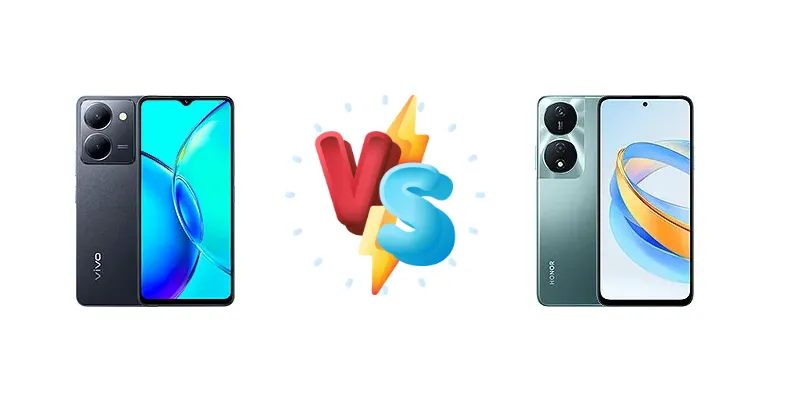
The sub-$250 5G smartphone market is fiercely competitive. Both the vivo Y27 5G and the Honor X7b 5G (50 MP) leverage the Mediatek Dimensity 6020 to deliver 5G connectivity at an accessible price point. However, beyond the shared chipset, key differences in charging capabilities and potentially other areas dictate which device is the better fit for different users.
🏆 Quick Verdict
For the average user prioritizing convenience and minimizing downtime, the Honor X7b 5G emerges as the winner. Its 35W charging significantly outperforms the vivo Y27 5G’s 15W charging, making it ideal for those who need to quickly top up their battery throughout the day. While performance is identical, the faster charging is a compelling advantage.
| Network |
|---|
| 2G bands | GSM 850 / 900 / 1800 / 1900 | GSM 850 / 900 / 1800 / 1900 |
| 3G bands | HSDPA 850 / 900 / 1700(AWS) / 1900 / 2100 | HSDPA 850 / 900 / 1900 / 2100 |
| 4G bands | 1, 2, 3, 4, 5, 7, 8, 12, 13, 17, 18, 19, 26, 28, 38, 40, 41, 66 | LTE |
| 5G bands | 1, 2, 5, 7, 26, 28, 38, 40, 41, 66, 77, 78 SA/NSA | SA/NSA |
| Speed | HSPA, LTE, 5G | HSPA, LTE, 5G |
| Technology | GSM / HSPA / LTE / 5G | GSM / HSPA / LTE / 5G |
| Launch |
|---|
| Announced | 2023, July 12 | 2024, June |
| Status | Available. Released 2023, July | Available. Released 2024, June |
| Body |
|---|
| Build | Glass front, plastic frame, plastic back | - |
| Dimensions | 164.1 x 76.2 x 8.1 mm (6.46 x 3.00 x 0.32 in) | 166.7 x 76.5 x 8.2 mm (6.56 x 3.01 x 0.32 in) |
| SIM | Nano-SIM + Nano-SIM | Nano-SIM + Nano-SIM |
| Weight | 190 g (6.70 oz) | 199 g (7.02 oz) |
| Display |
|---|
| Resolution | 1080 x 2388 pixels (~395 ppi density) | 1080 x 2412 pixels, 20:9 ratio (~389 ppi density) |
| Size | 6.64 inches, 106.8 cm2 (~85.4% screen-to-body ratio) | 6.8 inches, 111.3 cm2 (~87.3% screen-to-body ratio) |
| Type | IPS LCD, 600 nits (peak) | IPS LCD, 90Hz, 850 nits (peak) |
| Platform |
|---|
| CPU | Octa-core (2x2.2 GHz Cortex-A76 & 6x2.0 GHz Cortex-A55) | Octa-core (2x2.2 GHz Cortex-A76 & 6x2.0 GHz Cortex-A55) |
| Chipset | Mediatek Dimensity 6020 (7 nm) | Mediatek Dimensity 6020 (7 nm) |
| GPU | Mali-G57 MC2 | Mali-G57 MC2 |
| OS | Android 13, Funtouch 13 | Android 13, Magic OS 7.2 |
| Memory |
|---|
| Card slot | No | No |
| Internal | 128GB 4GB RAM, 128GB 6GB RAM, 128GB 8GB RAM, 256GB 8GB RAM | 256GB 8GB RAM |
| Main Camera |
|---|
| Dual | 50 MP, f/1.8, (wide), PDAF
Auxiliary lens | 50 MP, f/1.8, (wide), PDAF
Auxiliary lens |
| Features | LED flash, panorama | LED flash, HDR, panorama |
| Video | 1080p@30fps | 1080p@30fps |
| Selfie camera |
|---|
| Single | 8 MP, f/2.0, (wide) | 8 MP, f/2.0, (wide) |
| Video | 1080p@30fps | 1080p@30fps |
| Sound |
|---|
| 35mm jack | Yes | Yes |
| Loudspeaker | Yes | Yes, with stereo speakers |
| Comms |
|---|
| Bluetooth | 5.1, A2DP, LE | 5.1, A2DP, LE, aptX HD |
| NFC | Yes (market/region dependent) | Yes (market/region dependent) |
| Positioning | GPS, GLONASS, GALILEO, BDS | GPS, GLONASS, GALILEO, BDS |
| Radio | No | No |
| USB | USB Type-C 2.0, OTG | USB Type-C 2.0, OTG |
| WLAN | Wi-Fi 802.11 a/b/g/n/ac, dual-band | Wi-Fi 802.11 a/b/g/n/ac, dual-band, Wi-Fi Direct |
| Features |
|---|
| Sensors | Fingerprint (side-mounted), accelerometer, proximity, compass | Fingerprint (side-mounted), accelerometer, compass |
| Battery |
|---|
| Charging | 15W wired
Reverse wired | 35W wired |
| Type | 5000 mAh | Li-Po 6000 mAh |
| Misc |
|---|
| Colors | Satin Purple, Mystic Black | Crystal Silver, Emerald Green, Midnight Black |
| Models | V2302 | - |
| Price | - | About 200 EUR |
vivo Y27 5G
- Potentially lower initial price
- Reverse wired charging for accessories
- Identical performance to Honor X7b 5G
- Significantly slower 15W charging
- Likely less optimized camera software
- May have a less vibrant display
Honor X7b 5G (50 MP)
- Much faster 35W wired charging
- Potentially better camera image processing
- Focus on visual experience (50MP camera marketing)
- Slightly higher initial price
- No reverse wired charging
- Identical performance to vivo Y27 5G
Display Comparison
Both devices are expected to feature LCD panels, typical for this price bracket. Without specific display specs like resolution or peak brightness, it’s difficult to differentiate. However, the Honor X7b 5G’s marketing emphasizes its 50MP camera, suggesting a focus on visual experience, potentially hinting at better image processing that could translate to a more vibrant display. Bezels are likely comparable, and color accuracy will depend on software calibration, an area where both brands have historically been middle-of-the-road.
Camera Comparison
The Honor X7b 5G’s emphasis on its 50 MP main camera suggests a potential advantage in image quality, though megapixel count isn’t everything. Sensor size and lens aperture are crucial factors missing from the provided data. Without these details, it’s difficult to assess the low-light performance or dynamic range. Both phones likely include standard auxiliary cameras (depth or macro), but these are typically of limited utility. Image processing algorithms will play a significant role in the final image quality, and Honor’s software often leans towards more saturated colors, while vivo tends to favor a more natural look.
Performance
The core performance of both the vivo Y27 5G and the Honor X7b 5G is identical, powered by the Mediatek Dimensity 6020 (7nm). This octa-core processor, with its 2x2.2 GHz Cortex-A76 and 6x2.0 GHz Cortex-A55 configuration, provides a solid foundation for everyday tasks and moderate gaming. The shared chipset means app launch times, multitasking, and general responsiveness will be virtually indistinguishable. RAM configurations are likely similar, and the 7nm process node ensures reasonable thermal efficiency, minimizing throttling during sustained workloads. Neither phone is positioned as a gaming powerhouse, but they will handle popular titles at medium settings.
Battery Life
This is where the Honor X7b 5G truly differentiates itself. While both phones likely house batteries of similar capacity (estimated around 5000mAh, based on market trends), the Honor X7b 5G’s 35W wired charging is a game-changer compared to the vivo Y27 5G’s 15W charging. This translates to significantly faster charging times – potentially reducing a full charge from over 2 hours to under 1.5 hours. The vivo Y27 5G also offers reverse wired charging, a niche feature useful for topping up accessories, but the slower charging speed limits its practicality. The faster charging of the Honor X7b 5G directly addresses a common pain point for smartphone users.
Buying Guide
Buy the vivo Y27 5G if you prioritize a potentially lower initial cost and are comfortable with slower charging speeds. This phone suits users who primarily charge overnight or have ample time to top up. Buy the Honor X7b 5G (50 MP) if you value fast charging and need to quickly replenish your battery during the day, even if it means a slightly higher upfront investment. This is the better choice for busy individuals and travelers.
Frequently Asked Questions
❓ Does the Mediatek Dimensity 6020 in either phone struggle with demanding games like Genshin Impact?
The Dimensity 6020 is a capable processor for casual gaming, but demanding titles like Genshin Impact will likely require significant graphics settings reductions to achieve playable frame rates. Expect to play at low to medium settings, and be prepared for some frame drops during intense scenes. Neither phone is optimized for hardcore gaming.
❓ How long does it realistically take to fully charge the Honor X7b 5G with the 35W charger?
Based on typical 35W charging profiles, the Honor X7b 5G should fully charge from 0% to 100% in approximately 1 hour and 30 minutes to 1 hour and 45 minutes. This is a substantial improvement over the vivo Y27 5G’s 15W charging, which would likely take over 2.5 hours.
❓ Is the 50MP camera on the Honor X7b 5G a significant upgrade over a standard 48MP camera?
While a higher megapixel count doesn't automatically equate to better image quality, the 50MP sensor on the Honor X7b 5G *potentially* allows for more detail capture and better cropping flexibility. The actual benefit depends on the sensor size, lens quality, and image processing algorithms employed by Honor.