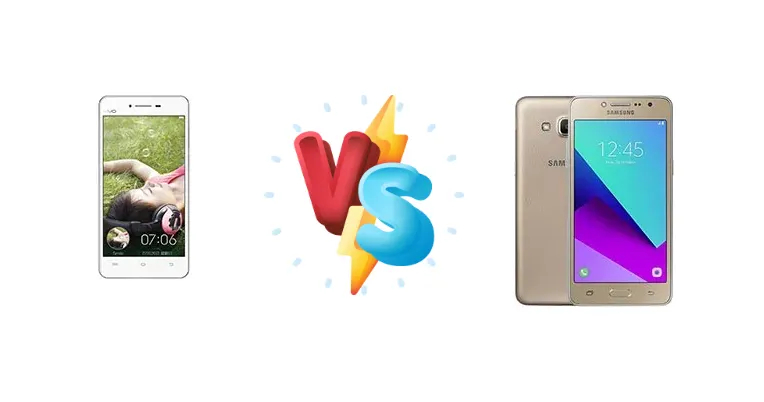
Released in the same era of budget-focused Android devices, the vivo Y27 (2014) and Samsung Galaxy Grand Prime Plus represent attempts to deliver smartphone functionality at an accessible price point. Both devices utilize quad-core processors and 28nm fabrication, but differ in chipset manufacturer and clock speed, leading to subtle but important performance variations. This comparison dissects these differences to determine which device offers the best value for users seeking a basic smartphone experience.
🏆 Quick Verdict
For the average user prioritizing slightly smoother application loading and multitasking, the Samsung Galaxy Grand Prime Plus is the better choice. Its Mediatek MT6737T chipset, clocked at 1.4 GHz, provides a modest performance advantage over the vivo Y27’s Snapdragon 410, despite both being built on the same 28nm process. However, the difference is unlikely to be dramatic in everyday use.
| Network |
|---|
| 2G bands | GSM 850 / 900 / 1800 / 1900 - SIM 1 & SIM 2 | GSM 850 / 900 / 1800 / 1900 - SIM 1 & SIM 2 |
| 3G bands | HSDPA 850 / 900 / 2100 | HSDPA 850 / 900 / 1900 / 2100 |
| 4G bands | 1, 3, 7 | 1, 3, 5, 7, 8, 20 |
| Speed | HSPA 42.2/5.76 Mbps, LTE Cat4 150/50 Mbps | HSPA 42.2/5.76 Mbps, LTE Cat4 150/50 Mbps |
| Technology | GSM / HSPA / LTE | GSM / HSPA / LTE |
| Launch |
|---|
| Announced | 2014, December. Released 2014, December | 2016, November. Released 2016, November |
| Status | Discontinued | Discontinued |
| Body |
|---|
| Build | - | Glass front, plastic back, plastic frame |
| Dimensions | 136.9 x 68.1 x 7 mm (5.39 x 2.68 x 0.28 in) | 144.8 x 72.1 x 8.9 mm (5.70 x 2.84 x 0.35 in) |
| SIM | Dual SIM (Micro-SIM, dual stand-by) | Hybrid Dual SIM (Micro-SIM, dual stand-by) |
| Weight | 137 g (4.83 oz) | 160 g (5.64 oz) |
| Display |
|---|
| Resolution | 720 x 1280 pixels, 16:9 ratio (~312 ppi density) | 540 x 960 pixels, 16:9 ratio (~220 ppi density) |
| Size | 4.7 inches, 60.9 cm2 (~65.3% screen-to-body ratio) | 5.0 inches, 68.9 cm2 (~66.0% screen-to-body ratio) |
| Type | IPS LCD | PLS LCD |
| Platform |
|---|
| CPU | Quad-core 1.2 GHz Cortex-A53 | Quad-core 1.4 GHz Cortex-A53 |
| Chipset | Qualcomm MSM8916 Snapdragon 410 (28 nm) | Mediatek MT6737T (28 nm) |
| GPU | Adreno 306 | Mali-T720MP2 |
| OS | Android 4.4.4 (KitKat) | Android 6.0 (Marshmallow) |
| Memory |
|---|
| Card slot | microSDXC (dedicated slot) | microSDXC (uses shared SIM slot) |
| Internal | 16GB 1GB RAM | 8GB 1.5GB RAM, 16GB 1.5GB RAM |
| | - | eMMC 5.0 |
| Main Camera |
|---|
| Features | LED flash | LED flash |
| Single | 8 MP, AF | 8 MP, f/2.2, AF |
| Video | 1080p@30fps | 720p@30fps |
| Selfie camera |
|---|
| Features | - | LED flash |
| Single | 5 MP | 5 MP, f/2.2, 28mm (wide) |
| Sound |
|---|
| 3.5mm jack | - | Yes |
| 35mm jack | Yes | Yes |
| Loudspeaker | Yes | Yes |
| Comms |
|---|
| Bluetooth | 4.0, A2DP, EDR | 4.2, A2DP, LE |
| Infrared port | Yes | - |
| NFC | No | No |
| Positioning | GPS, GLONASS, BDS | GPS, GLONASS |
| Radio | FM radio | FM radio, RDS, recording |
| USB | microUSB 2.0 | microUSB 2.0, OTG |
| WLAN | Wi-Fi 802.11 b/g/n, Wi-Fi Direct, hotspot | Wi-Fi 802.11 b/g/n, Wi-Fi Direct |
| Features |
|---|
| Sensors | Accelerometer, gyro, proximity, compass | Accelerometer, proximity |
| Battery |
|---|
| Music play | Up to 32 h | Up to 59 h |
| Stand-by | Up to 410 h (2G) / Up to 410 h (3G) | - |
| Talk time | Up to 13 h (2G) / Up to 13 h (3G) | Up to 12 h (3G) |
| Type | 2260 mAh, non-removable | Li-Ion 2600 mAh, removable |
| Misc |
|---|
| Colors | White | Black, Gold, Silver |
| Models | Y27L | SM-G532F |
| Price | - | About 140 EUR |
| SAR EU | 0.40 W/kg (head) 0.48 W/kg (body) | 0.53 W/kg (head) 1.27 W/kg (body) |
vivo Y27 (2014)
- Qualcomm chipset offers potentially better software support.
- Slightly better potential for battery efficiency due to lower clock speed.
- Established Qualcomm ecosystem.
- Slower processor compared to the Grand Prime Plus.
- May be harder to find software updates.
Samsung Galaxy Grand Prime Plus
- Faster processor for smoother multitasking.
- Samsung brand recognition and user interface.
- Potentially wider availability of accessories.
- Mediatek chipset may have limited long-term software support.
- Slightly higher power consumption.
Display Comparison
Neither device boasts a particularly impressive display. Given the context of 2014 budget phones, details regarding panel type (IPS vs TFT) and resolution are often omitted in readily available specs. However, both likely feature similar low-resolution panels. The focus here is on the processing power needed to drive the display, and neither chipset is likely to be a bottleneck. Bezels were substantial on both devices, typical for the era, and color accuracy was likely average at best.
Camera Comparison
Camera performance on both devices was likely limited. Details regarding sensor size and aperture are scarce. Both phones likely featured a primary camera around 8MP, and a front-facing camera for selfies. Image quality would have been acceptable in good lighting conditions, but suffered in low light. The presence of a 2MP macro camera on either device is largely marketing fluff; the low resolution provides minimal detail. Image processing capabilities were basic, with limited dynamic range and noise reduction.
Performance
The core difference lies in the chipsets: Qualcomm’s MSM8916 Snapdragon 410 versus Mediatek’s MT6737T. Both utilize a quad-core Cortex-A53 architecture, but the MT6737T boasts a 1.4 GHz clock speed compared to the Snapdragon 410’s 1.2 GHz. While the architecture is identical, the higher clock speed translates to approximately a 16% performance increase in CPU-bound tasks. This difference would be noticeable in app loading times and multitasking, but not in graphically intensive games. Both chipsets are built on a 28nm process, meaning thermal efficiency and power consumption will be comparable. The Snapdragon 410 benefits from Qualcomm’s optimized software and driver support, potentially leading to better long-term stability.
Battery Life
Battery capacity details are often missing for these older models. However, given their specifications, both devices likely featured batteries in the 2000-2500 mAh range. The slightly more efficient Snapdragon 410 *could* translate to marginally longer battery life for the vivo Y27, but the difference would be minimal. Charging speeds were slow by modern standards, likely utilizing a 5W charger, resulting in several hours to reach a full charge. The real-world impact of battery life would depend heavily on usage patterns.
Buying Guide
Buy the vivo Y27 (2014) if you prioritize Qualcomm’s established ecosystem and potential for wider software compatibility, or if you find it at a significantly lower price. Buy the Samsung Galaxy Grand Prime Plus if you prefer a slightly faster processor for smoother multitasking and app launches, and appreciate Samsung’s brand recognition and user interface.
Frequently Asked Questions
❓ Is the Mediatek MT6737T prone to overheating during extended use?
Given the 28nm fabrication process and relatively low clock speed, the MT6737T is unlikely to experience significant overheating during typical usage. However, prolonged gaming or demanding tasks could lead to thermal throttling, reducing performance to prevent damage.
❓ Will either of these phones receive Android updates beyond their original release versions?
It is highly unlikely that either the vivo Y27 (2014) or the Samsung Galaxy Grand Prime Plus will receive any further Android updates. Both devices are several years old and have likely reached the end of their software support lifecycle. Expect to be running an older version of Android.
❓ Can either phone handle basic social media apps like Facebook and WhatsApp without significant lag?
Yes, both the vivo Y27 (2014) and the Samsung Galaxy Grand Prime Plus should be capable of running basic social media apps like Facebook and WhatsApp without significant lag. However, multitasking between several apps may result in slower performance.