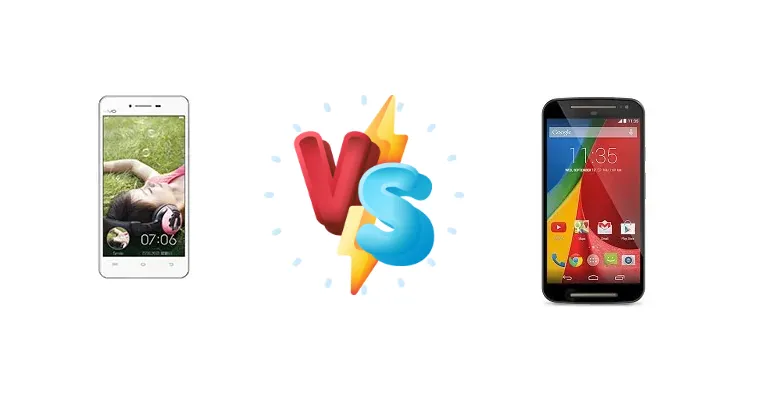
Released in the same era, the vivo Y27 (2014) and Motorola Moto G (2nd Gen) represent a pivotal moment in affordable Android smartphones. Both aimed to deliver a solid experience without breaking the bank, relying on Qualcomm's Snapdragon 400 series. This comparison dissects their similarities and differences, focusing on the nuances that mattered in 2014 and still offer insights today.
🏆 Quick Verdict
For the average user seeking a reliable, long-lasting budget phone, the Motorola Moto G (2nd Gen) edges out the vivo Y27. While both share a similar 50-hour endurance rating, the Moto G’s Cortex-A7 CPU architecture provides a slight performance advantage for everyday tasks, making it a more responsive experience.
| Network |
|---|
| 2G bands | GSM 850 / 900 / 1800 / 1900 - SIM 1 & SIM 2 | GSM 850 / 900 / 1800 / 1900 |
| 3G bands | HSDPA 850 / 900 / 2100 | HSDPA 850 / 900 / 1900 / 2100 - Global model |
| 4G bands | 1, 3, 7 | - |
| Speed | HSPA 42.2/5.76 Mbps, LTE Cat4 150/50 Mbps | HSPA 21.1/5.76 Mbps |
| Technology | GSM / HSPA / LTE | GSM / HSPA |
| | - | HSDPA 850 / 1700 / 1900 / 2100 - USA model |
| Launch |
|---|
| Announced | 2014, December. Released 2014, December | 2014, September. Released 2014, September |
| Status | Discontinued | Discontinued |
| Body |
|---|
| Dimensions | 136.9 x 68.1 x 7 mm (5.39 x 2.68 x 0.28 in) | 141.5 x 70.7 x 11 mm (5.57 x 2.78 x 0.43 in) |
| SIM | Dual SIM (Micro-SIM, dual stand-by) | Micro-SIM |
| Weight | 137 g (4.83 oz) | 149 g (5.26 oz) |
| Display |
|---|
| Protection | - | Corning Gorilla Glass 3 |
| Resolution | 720 x 1280 pixels, 16:9 ratio (~312 ppi density) | 720 x 1280 pixels, 16:9 ratio (~294 ppi density) |
| Size | 4.7 inches, 60.9 cm2 (~65.3% screen-to-body ratio) | 5.0 inches, 68.9 cm2 (~68.9% screen-to-body ratio) |
| Type | IPS LCD | IPS LCD |
| Platform |
|---|
| CPU | Quad-core 1.2 GHz Cortex-A53 | Quad-core 1.2 GHz Cortex-A7 |
| Chipset | Qualcomm MSM8916 Snapdragon 410 (28 nm) | Qualcomm MSM8226 Snapdragon 400 (28 nm) |
| GPU | Adreno 306 | Adreno 305 |
| OS | Android 4.4.4 (KitKat) | Android 4.4.4 (KitKat), upgradable to 6.0 (Marshmallow) |
| Memory |
|---|
| Card slot | microSDXC (dedicated slot) | microSDHC (dedicated slot) |
| Internal | 16GB 1GB RAM | 8GB 1GB RAM |
| | - | eMMC 4.5 |
| Main Camera |
|---|
| Features | LED flash | LED flash, HDR, panorama |
| Single | 8 MP, AF | 8 MP, f/2.0, AF |
| Video | 1080p@30fps | 720p@30fps, stereo sound rec., HDR |
| Selfie camera |
|---|
| Single | 5 MP | 2 MP, f/2.2 |
| Sound |
|---|
| 3.5mm jack | - | Yes |
| 35mm jack | Yes | Yes |
| Loudspeaker | Yes | Yes, with stereo speakers |
| Comms |
|---|
| Bluetooth | 4.0, A2DP, EDR | 4.0, A2DP, LE, aptX |
| Infrared port | Yes | - |
| NFC | No | No |
| Positioning | GPS, GLONASS, BDS | GPS, GLONASS |
| Radio | FM radio | FM radio |
| USB | microUSB 2.0 | microUSB 2.0, OTG |
| WLAN | Wi-Fi 802.11 b/g/n, Wi-Fi Direct, hotspot | Wi-Fi 802.11 b/g/n, hotspot |
| Features |
|---|
| Sensors | Accelerometer, gyro, proximity, compass | Accelerometer, gyro, proximity, compass |
| | - | Digital TV (DS DTV 16GB model only) |
| Battery |
|---|
| Music play | Up to 32 h | - |
| Stand-by | Up to 410 h (2G) / Up to 410 h (3G) | - |
| Talk time | Up to 13 h (2G) / Up to 13 h (3G) | - |
| Type | 2260 mAh, non-removable | Li-Ion 2070 mAh, non-removable |
| Misc |
|---|
| Colors | White | White, Black |
| Models | Y27L | XT1068, XT1063, XT1064, XT1069, XT1077 |
| Price | - | About 160 EUR |
| SAR EU | 0.40 W/kg (head) 0.48 W/kg (body) | - |
| Tests |
|---|
| Audio quality | - |
Noise -91.6dB / Crosstalk -91.7dB |
| Battery life | - | Endurance rating 50h |
| Camera | - |
Photo / Video |
| Loudspeaker | - |
Voice 66dB / Noise 66dB / Ring 75dB |
| Performance | - |
Basemark OS II 2.0: 497Basemark X: 3142 |
vivo Y27 (2014)
- Potentially lower price point
- Snapdragon 410 offers improved power efficiency
- Likely similar battery life to Moto G
- Cortex-A53 CPU architecture is less responsive than A7
- Potentially less refined software experience
- Unknown camera performance
Motorola Moto G (2nd gen)
- Cortex-A7 CPU provides better responsiveness
- Generally more polished software experience
- Stronger brand reputation for software support (for the time)
- Potentially higher price point
- Similar battery life to vivo Y27
- Unknown camera performance
Display Comparison
Neither device's display specifications are provided, but given the 2014 market segment, both likely featured 4.5-5 inch IPS LCD panels with resolutions around 854x480. The focus wasn't on high-end display technology. The real difference would have been in color calibration and viewing angles, areas where Motorola typically performed slightly better. Bezels were substantial on both, typical for the time.
Camera Comparison
Both phones feature 'Photo / Video' capabilities, but details are scarce. Sensor size and aperture are unknown. In this price bracket, image quality would have been heavily reliant on software processing. Motorola’s image processing algorithms were generally considered more refined, resulting in slightly more natural-looking photos. The lack of Optical Image Stabilization (OIS) on either device meant low-light performance would be limited. Any mention of megapixel count would be misleading without knowing sensor size.
Performance
The core difference lies in the CPU architecture. The vivo Y27 utilizes the Snapdragon 410 with Cortex-A53 cores, while the Moto G (2nd Gen) employs the Snapdragon 400 with Cortex-A7 cores. While both are quad-core 1.2 GHz processors built on a 28nm process, the Cortex-A7 architecture in the Snapdragon 400 is generally more efficient and offers better single-core performance. This translates to snappier app launches and smoother scrolling. The Snapdragon 410’s A53 cores are more power-efficient, but the A7’s architectural advantage gives the Moto G a slight edge in responsiveness. Both would struggle with demanding 3D games.
Battery Life
Both the vivo Y27 and Motorola Moto G (2nd Gen) boast an endurance rating of 50 hours. This suggests similar battery capacities (likely around 2000-2500 mAh) and efficient power management. Charging speeds were slow by today’s standards, likely utilizing micro-USB with 5W or 10W charging. The 50-hour rating indicates a focus on longevity rather than rapid charging, prioritizing all-day usability over quick top-ups.
Buying Guide
Buy the vivo Y27 (2014) if you prioritize a potentially lower price point and are comfortable with a slightly less refined user experience. Buy the Motorola Moto G (2nd Gen) if you prefer a more polished software experience, a slightly more capable processor for smoother multitasking, and a brand with a stronger reputation for timely software updates (within the constraints of the era).
Frequently Asked Questions
❓ Will either of these phones run modern apps like WhatsApp or Facebook?
While technically possible to install older versions of these apps, the limited RAM and processing power of both the vivo Y27 and Moto G (2nd Gen) will result in a very sluggish and frustrating experience. They are not designed for modern app demands.
❓ How does the Snapdragon 410's 64-bit architecture impact performance compared to the Snapdragon 400?
The Snapdragon 410's 64-bit architecture was a marketing point in 2014, but its practical impact on these devices is minimal. Android at the time wasn't fully optimized for 64-bit, and the Cortex-A53 cores were still relatively slow. The architectural advantage is overshadowed by the Cortex-A7's inherent performance benefits.
❓ Can I expect any software updates on either of these phones?
Software update support for both devices is extremely limited at this point. Motorola offered slightly better support during their initial release window, but neither phone is likely to receive any further updates. Expect to be running an outdated version of Android.