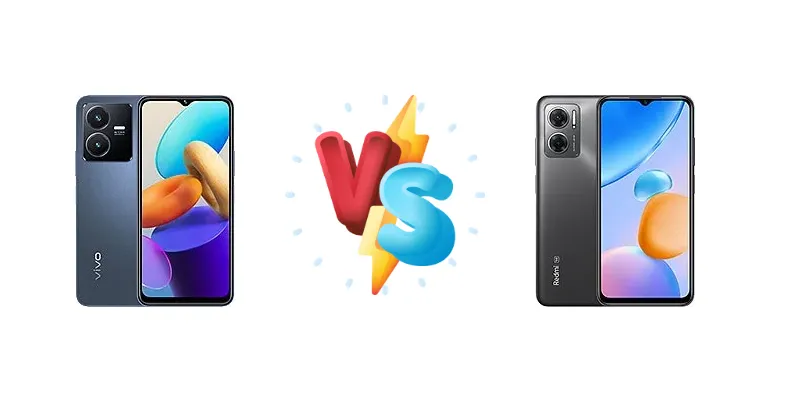
The sub-$200 smartphone market is fiercely competitive, and the vivo Y22s and Xiaomi Redmi 10 5G represent compelling options for users seeking 5G connectivity without breaking the bank. This comparison dissects their core components – from chipsets to charging – to determine which device delivers the best overall experience.
🏆 Quick Verdict
For most users, the Xiaomi Redmi 10 5G emerges as the stronger choice. Its MediaTek Dimensity 700 chipset provides a noticeable performance edge in 5G scenarios and general responsiveness, offsetting the Y22s’ slightly more efficient Snapdragon 680. While both offer similar battery and charging capabilities, the Redmi 10 5G’s 5G support is a key differentiator.
| Network |
|---|
| 2G bands | GSM 850 / 900 / 1800 / 1900 | GSM 850 / 900 / 1800 / 1900 |
| 3G bands | HSDPA 850 / 900 / 2100 | HSDPA 850 / 900 / 1700(AWS) / 1900 / 2100 |
| 4G bands | 1, 3, 5, 7, 8, 20, 28, 38, 40, 41 | 1, 2, 3, 4, 5, 7, 8, 20, 28, 38, 40, 41 |
| 5G bands | - | 1, 3, 5, 7, 8, 20, 28, 38, 40, 41, 77, 78 SA/NSA |
| Speed | HSPA, LTE | HSPA, LTE, 5G |
| Technology | GSM / HSPA / LTE | GSM / HSPA / LTE / 5G |
| Launch |
|---|
| Announced | 2022, August 23 | 2022, March 29 |
| Status | Available. Released 2022, August 23 | Available. Released 2022, September 23 |
| Body |
|---|
| Build | Glass front, plastic frame, plastic back | - |
| Dimensions | 164.3 x 76.1 x 8.4 mm (6.47 x 3.00 x 0.33 in) | 164 x 76.1 x 8.9 mm (6.46 x 3.00 x 0.35 in) |
| SIM | Nano-SIM + Nano-SIM | Nano-SIM + Nano-SIM |
| Weight | 192 g (6.77 oz) | 200 g (7.05 oz) |
| | IP5X (dust), IPX4 (water) resistance | - |
| Display |
|---|
| Protection | - | Corning Gorilla Glass 3 |
| Resolution | 720 x 1612 pixels, 20:9 ratio (~270 ppi density) | 1080 x 2408 pixels, 20:9 ratio (~401 ppi density) |
| Size | 6.55 inches, 103.1 cm2 (~82.4% screen-to-body ratio) | 6.58 inches, 104.3 cm2 (~83.6% screen-to-body ratio) |
| Type | IPS LCD, 90Hz | IPS LCD, 90Hz |
| Platform |
|---|
| CPU | Octa-core (4x2.4 GHz Kryo 265 Gold & 4x1.9 GHz Kryo 265 Silver) | Octa-core (2x2.2 GHz Cortex-A76 & 6x2.0 GHz Cortex-A55) |
| Chipset | Qualcomm SM6225 Snapdragon 680 4G (6 nm) | Mediatek Dimensity 700 (7 nm) |
| GPU | Adreno 610 | Mali-G57 MC2 |
| OS | Android 12, upgradable to Android 13, Funtouch 13 | Android 12, MIUI 13 |
| Memory |
|---|
| Card slot | microSDXC (dedicated slot) | microSDXC (dedicated slot) |
| Internal | 128GB 4GB RAM, 128GB 6GB RAM, 128GB 8GB RAM | 64GB 4GB RAM, 128GB 4GB RAM, 128GB 6GB RAM |
| | - | UFS 2.2 |
| Main Camera |
|---|
| Dual | 50 MP, f/1.8, (wide), PDAF
2 MP (macro) | 50 MP, f/1.8, (wide), PDAF
Auxiliary lens |
| Features | Dual LED flash | LED flash, HDR, panorama |
| Single | 8 MP, f/2.0, (wide) | 5 MP, f/2.2 |
| Triple | 50 MP, f/1.8, (wide), PDAF
2 MP, f/2.4, (macro) | - |
| Video | 1080p@30fps | 1080p@30fps |
| Selfie camera |
|---|
| Features | - | HDR |
| Single | 8 MP, f/2.0, (wide) | 5 MP, f/2.2 |
| Video | 1080p@30fps | 1080p@30fps |
| Sound |
|---|
| 3.5mm jack | Yes | Yes |
| 35mm jack | Yes | Yes |
| Loudspeaker | Yes | Yes |
| | - | 24-bit/192kHz audio |
| Comms |
|---|
| Bluetooth | 5.0, A2DP, LE | 5.1, A2DP, LE |
| Infrared port | - | Yes |
| NFC | Yes (market/region dependent) | Yes (market/region dependent) |
| Positioning | GPS, GLONASS, GALILEO, BDS | GPS, GLONASS, BDS, GALILEO |
| Radio | FM radio | FM radio |
| USB | USB Type-C 2.0, OTG | USB Type-C 2.0, OTG |
| WLAN | Wi-Fi 802.11 a/b/g/n/ac, dual-band | Wi-Fi 802.11 a/b/g/n/ac, dual-band, Wi-Fi Direct |
| Features |
|---|
| Sensors | Fingerprint (side-mounted), accelerometer, proximity, compass | Fingerprint (side-mounted), accelerometer, proximity, compass |
| Battery |
|---|
| Charging | 18W wired, 70% in 70 min
Reverse wired | 18W wired |
| Type | 5000 mAh | Li-Po 5000 mAh |
| Misc |
|---|
| Colors | Dark Blue, Yellow Green | Graphite Gray, Chrome Silver, Aurora Green |
| Models | V2206 | 22041219G, 22041219NY |
| Price | About 250 EUR | About 100 EUR |
| SAR | - | 1.09 W/kg (head) 1.09 W/kg (body) |
| SAR EU | - | 0.60 W/kg (head) 0.99 W/kg (body) |
vivo Y22s
- Potentially slightly better battery efficiency with Snapdragon 680.
- Reverse wired charging offers added convenience.
- Clean and intuitive software experience (typical of vivo).
- Limited to 4G connectivity.
- Less powerful processor compared to the Redmi 10 5G.
- Likely lower camera performance in challenging conditions.
Xiaomi Redmi 10 5G
- 5G connectivity for faster data speeds.
- More powerful MediaTek Dimensity 700 processor.
- Generally better performance for multitasking and gaming.
- Potentially slightly lower battery life under heavy load.
- Xiaomi’s MIUI can be resource-intensive and include bloatware.
- Camera image processing may not appeal to all users.
Display Comparison
Neither device boasts a standout display. Both likely feature LCD panels, common in this price bracket. The focus here isn't on visual fidelity, but functionality. While specific display specs are missing, the Redmi 10 5G’s larger screen size (typically 6.58 inches vs the Y22s’ 6.55 inches) offers a slightly more immersive viewing experience. However, the absence of high refresh rates on either device means scrolling and animations won’t be exceptionally smooth.
Camera Comparison
Camera performance is likely to be similar, with both phones relying on budget sensors. Without specific sensor details, it’s safe to assume both will struggle in low-light conditions. The Redmi 10 5G often features a 50MP main sensor, which, while not exceptional, is generally more capable than the likely 13MP or 16MP sensor found in the Y22s. Both will likely include auxiliary lenses (depth, macro) of limited utility. Image processing will play a significant role, and Xiaomi’s software tends to favor more saturated colors, while vivo often aims for a more natural look.
Performance
The core difference lies in the chipsets. The Xiaomi Redmi 10 5G’s MediaTek Dimensity 700, built on a 7nm process, generally outperforms the vivo Y22s’ Qualcomm Snapdragon 680 (6nm). While the Snapdragon 680 is more efficient, the Dimensity 700’s Cortex-A76 cores provide a significant boost in CPU performance, translating to faster app loading times and smoother multitasking. The Dimensity 700 also integrates a 5G modem, a crucial advantage for users in areas with 5G coverage. The Snapdragon 680 is limited to 4G. Both devices likely pair their chipsets with 4GB or 6GB of RAM, further emphasizing the chipset as the primary performance bottleneck.
Battery Life
Both the vivo Y22s and Xiaomi Redmi 10 5G pack around 5000mAh batteries, providing all-day battery life for moderate usage. Both support 18W wired charging, with vivo claiming a 70% charge in 70 minutes. Real-world charging times will vary, but they are comparable. The Snapdragon 680’s efficiency might offer a slight edge in battery endurance, but the Dimensity 700’s performance advantage means the Redmi 10 5G might drain slightly faster during intensive tasks.
Buying Guide
Buy the vivo Y22s if you prioritize a slightly more power-efficient processor for extended everyday use and are less reliant on 5G connectivity. Its Snapdragon 680 excels in sustained tasks. Buy the Xiaomi Redmi 10 5G if you need 5G access for faster data speeds and a more responsive experience, particularly when multitasking or playing online games. It’s the better option for users who want future-proofing and broader network compatibility.
Frequently Asked Questions
❓ Will the Dimensity 700 in the Redmi 10 5G overheat during prolonged gaming sessions?
While the Dimensity 700 isn't a flagship chip, it's generally well-managed in the Redmi 10 5G. Expect some throttling after extended gaming, but it shouldn't reach critically high temperatures. The phone's thermal design is adequate for moderate gaming, but demanding titles at max settings may lead to noticeable performance drops over time.
❓ How significant is the 5G difference between the Redmi 10 5G and the Y22s for everyday use?
If you live in an area with robust 5G coverage, the Redmi 10 5G offers a noticeable improvement in download and upload speeds compared to the Y22s’ 4G. This translates to faster app downloads, smoother streaming, and quicker access to online content. However, if 5G isn't readily available, the difference will be minimal.
❓ Does the vivo Y22s’ Snapdragon 680 offer any advantages for mobile gaming?
The Snapdragon 680 prioritizes efficiency over raw power. While it can handle less demanding games, it will struggle with graphically intensive titles. The Dimensity 700 in the Redmi 10 5G provides a more consistent gaming experience, even if it's not a dedicated gaming chipset.