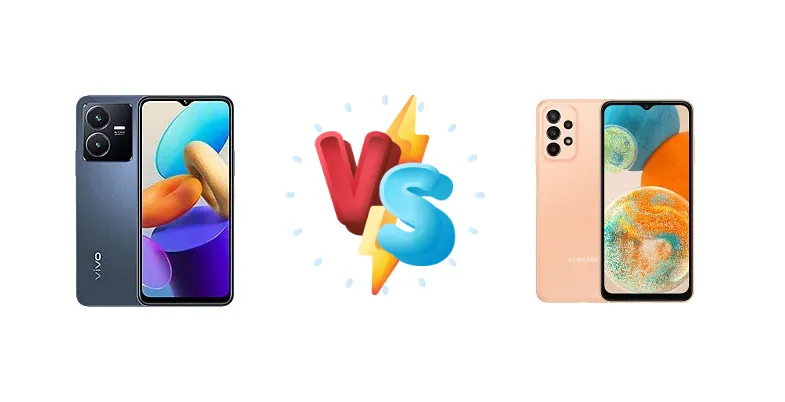
The sub-$200 smartphone market is fiercely competitive. Both the vivo Y22s and the Samsung Galaxy A23 5G aim to deliver a solid experience without breaking the bank. However, they take different approaches: the Y22s focuses on a streamlined experience with a Snapdragon 680, while the A23 5G adds 5G connectivity and a slightly more powerful Snapdragon 695. This comparison dives deep into the specifics to determine which phone offers the best value.
🏆 Quick Verdict
For the average user prioritizing future-proofing and faster charging, the Samsung Galaxy A23 5G is the better choice. Its Snapdragon 695 offers 5G support and a slight performance edge, complemented by 25W charging. However, the vivo Y22s remains a compelling option for those who don't need 5G and value a potentially more efficient processor.
| Network |
|---|
| 2G bands | GSM 850 / 900 / 1800 / 1900 | GSM 850 / 900 / 1800 / 1900 |
| 3G bands | HSDPA 850 / 900 / 2100 | HSDPA 850 / 900 / 1700(AWS) / 1900 / 2100 |
| 4G bands | 1, 3, 5, 7, 8, 20, 28, 38, 40, 41 | 1, 2, 3, 4, 5, 7, 8, 12, 17, 20, 26, 28, 32, 38, 40, 41, 66 - International |
| 5G bands | - | 1, 3, 7, 8, 20, 28, 38, 40, 41, 77, 78 SA/NSA/Sub6 - International |
| Speed | HSPA, LTE | HSPA, LTE, 5G |
| Technology | GSM / HSPA / LTE | GSM / HSPA / LTE / 5G |
| | - | 2, 5, 30, 66, 77 SA/NSA/Sub6/mmWave - USA |
| Launch |
|---|
| Announced | 2022, August 23 | 2022, August 05 |
| Status | Available. Released 2022, August 23 | Available. Released 2022, September 02 |
| Body |
|---|
| Build | Glass front, plastic frame, plastic back | Glass front (Gorilla Glass 5), plastic frame, plastic back |
| Dimensions | 164.3 x 76.1 x 8.4 mm (6.47 x 3.00 x 0.33 in) | 165.4 x 76.9 x 8.4 mm (6.51 x 3.03 x 0.33 in) |
| SIM | Nano-SIM + Nano-SIM | · Nano-SIM· Nano-SIM + Nano-SIM |
| Weight | 192 g (6.77 oz) | 197 g (6.95 oz) |
| | IP5X (dust), IPX4 (water) resistance | - |
| Display |
|---|
| Protection | - | Corning Gorilla Glass 5 |
| Resolution | 720 x 1612 pixels, 20:9 ratio (~270 ppi density) | 1080 x 2408 pixels, 20:9 ratio (~400 ppi density) |
| Size | 6.55 inches, 103.1 cm2 (~82.4% screen-to-body ratio) | 6.6 inches, 104.9 cm2 (~82.5% screen-to-body ratio) |
| Type | IPS LCD, 90Hz | PLS LCD, 120Hz |
| Platform |
|---|
| CPU | Octa-core (4x2.4 GHz Kryo 265 Gold & 4x1.9 GHz Kryo 265 Silver) | Octa-core (2x2.2 GHz Kryo 660 Gold & 6x1.7 GHz Kryo 660 Silver) |
| Chipset | Qualcomm SM6225 Snapdragon 680 4G (6 nm) | Qualcomm SM6375 Snapdragon 695 5G (6 nm) |
| GPU | Adreno 610 | Adreno 619 |
| OS | Android 12, upgradable to Android 13, Funtouch 13 | Android 12, upgradable to Android 14, One UI 6 |
| Memory |
|---|
| Card slot | microSDXC (dedicated slot) | microSDXC (dedicated slot) |
| Internal | 128GB 4GB RAM, 128GB 6GB RAM, 128GB 8GB RAM | 64GB 4GB RAM, 64GB 6GB RAM, 128GB 4GB RAM, 128GB 6GB RAM, 128GB 8GB RAM |
| Main Camera |
|---|
| Dual | 50 MP, f/1.8, (wide), PDAF
2 MP (macro) | - |
| Features | Dual LED flash | LED flash, panorama, HDR |
| Quad | - | 50 MP, f/1.8, 26mm (wide), 1/2.76", 0.64µm, PDAF, OIS
5 MP, f/2.2, 13mm, 123˚ (ultrawide), 1/5.0", 1.12µm
2 MP (macro)
Auxiliary lens |
| Single | 8 MP, f/2.0, (wide) | - |
| Triple | 50 MP, f/1.8, (wide), PDAF
2 MP, f/2.4, (macro) | - |
| Video | 1080p@30fps | 1080p@30fps |
| Selfie camera |
|---|
| Single | 8 MP, f/2.0, (wide) | 8 MP, f/2.0, 25mm (wide), 1/4.0", 1.12µm - USA
8 MP, f/2.2, 25mm (wide), 1/4.0", 1.12µm - International |
| Video | 1080p@30fps | 1080p@30fps |
| Sound |
|---|
| 3.5mm jack | Yes | Yes |
| 35mm jack | Yes | Yes |
| Loudspeaker | Yes | Yes |
| Comms |
|---|
| Bluetooth | 5.0, A2DP, LE | 5.1, A2DP, LE |
| NFC | Yes (market/region dependent) | Yes |
| Positioning | GPS, GLONASS, GALILEO, BDS | GPS, GLONASS, GALILEO, BDS |
| Radio | FM radio | FM radio (market/region dependent) |
| USB | USB Type-C 2.0, OTG | USB Type-C 2.0 |
| WLAN | Wi-Fi 802.11 a/b/g/n/ac, dual-band | Wi-Fi 802.11 a/b/g/n/ac, dual-band, Wi-Fi Direct |
| Features |
|---|
| Sensors | Fingerprint (side-mounted), accelerometer, proximity, compass | Fingerprint (side-mounted), accelerometer, gyro, compass, barometer (USA only) |
| | - | Virtual proximity sensing |
| Battery |
|---|
| Charging | 18W wired, 70% in 70 min
Reverse wired | 25W wired |
| Type | 5000 mAh | Li-Po 5000 mAh |
| Misc |
|---|
| Colors | Dark Blue, Yellow Green | Black, White, Peach, Blue |
| Models | V2206 | SM-A236U, SM-A236U1, SM-A236B, SM-A236B/DS, SM-A236B/DSN, SM-A236E, SM-S236DL |
| Price | About 250 EUR | $ 84.44 / £ 129.00 / € 125.28 / ₹ 21,000 |
| SAR | - | 0.68 W/kg (head) 0.57 W/kg (body) |
| SAR EU | - | 1.49 W/kg (head) 1.25 W/kg (body) |
| Tests |
|---|
| Battery life | - |
Endurance rating 138h
|
| Camera | - |
Photo / Video |
| Display | - |
Contrast ratio: 1328:1 (nominal) |
| Loudspeaker | - |
-25.9 LUFS (Very good)
|
| Performance | - |
AnTuTu: 318821 (v9)
GeekBench: 1940 (v5.1)
GFXBench: 16fps (ES 3.1 onscreen) |
vivo Y22s
- Potentially better power efficiency with Snapdragon 680
- Sleek design (subjective)
- Reverse wired charging capability
- Lacks 5G connectivity
- Slower 18W charging
Samsung Galaxy A23 5G
- 5G connectivity for future-proofing
- Faster 25W wired charging
- Slightly more powerful Snapdragon 695
- Potentially slightly lower battery efficiency
- May be marginally more expensive
Display Comparison
Both the vivo Y22s and Samsung Galaxy A23 5G feature displays with a 1328:1 contrast ratio, suggesting similar visual pop. However, the A23 5G boasts a measured peak brightness of 508 nits, which will translate to better visibility outdoors compared to the Y22s, for which brightness data is unavailable. While both likely utilize LCD panels given the price point, the A23 5G’s higher brightness is a tangible advantage for outdoor use.
Camera Comparison
Both phones are equipped with photo/video capabilities, but detailed camera specifications are limited. Without sensor size or aperture information, it’s difficult to make a definitive judgment. However, the inclusion of a 5G modem in the A23 5G suggests a slightly more modern overall design, potentially extending to the camera module. It’s reasonable to assume Samsung’s image processing algorithms are more refined, potentially leading to better image quality in various conditions. The prevalence of 2MP macro lenses on both devices suggests they are largely marketing features and shouldn’t be a primary consideration.
Performance
The Samsung Galaxy A23 5G’s Snapdragon 695 5G represents a step up from the vivo Y22s’ Snapdragon 680. The 695 features a more modern CPU configuration – 2x2.2 GHz Kryo 660 Gold cores and 6x1.7 GHz Kryo 660 Silver cores – compared to the Y22s’ 4x2.4 GHz Kryo 265 Gold and 4x1.9 GHz Kryo 265 Silver. Crucially, the 695 includes an integrated 5G modem, a feature absent in the Y22s. While both chipsets are fabricated on a 6nm process, the architectural improvements in the 695 should yield better overall performance, particularly in multi-threaded tasks and 5G-enabled applications. The Y22s may offer slightly better efficiency in less demanding scenarios.
Battery Life
Both devices share an endurance rating of 138 hours, indicating comparable battery life under typical usage. However, the Samsung Galaxy A23 5G’s 25W wired charging significantly outperforms the vivo Y22s’ 18W charging. The A23 5G can reach 70% charge in approximately the same time (70 minutes) as the Y22s, but will ultimately reach 100% faster. This faster charging is a significant convenience factor for users who frequently need to top up their battery.
Buying Guide
Buy the vivo Y22s if you prioritize a potentially longer-lasting battery due to the Snapdragon 680’s efficiency and don’t require 5G connectivity. It’s ideal for users primarily focused on everyday tasks like calling, texting, and social media. Buy the Samsung Galaxy A23 5G if you want the flexibility of 5G, faster 25W charging, and a slightly more capable processor for light gaming and multitasking. This phone suits users who anticipate needing 5G in the near future or appreciate quicker power-ups.
Frequently Asked Questions
❓ Does the Snapdragon 695 in the Galaxy A23 5G get noticeably warmer during extended gaming sessions compared to the Snapdragon 680 in the Y22s?
While both chipsets are 6nm, the Snapdragon 695 is more powerful and therefore *may* generate more heat under sustained load. However, Samsung’s thermal management implementation will play a crucial role. Without thermal testing data, it’s difficult to say definitively, but the 680 is likely to remain cooler during prolonged gaming.
❓ Is the 5G connectivity on the Galaxy A23 5G actually useful, or is it just a marketing feature?
The usefulness of 5G depends entirely on your location and carrier coverage. If you live in an area with robust 5G infrastructure, you’ll experience significantly faster download and upload speeds. However, if 5G coverage is limited, the benefit will be minimal. The A23 5G provides future-proofing, as 5G networks continue to expand.
❓ How does the software experience differ between vivo's Funtouch OS and Samsung's One UI on these devices?
Samsung's One UI is generally considered to be more polished and feature-rich, with a cleaner interface and more customization options. vivo's Funtouch OS has improved over time, but can still feel somewhat cluttered and includes more pre-installed bloatware. Software updates are also typically faster and more consistent on Samsung devices.