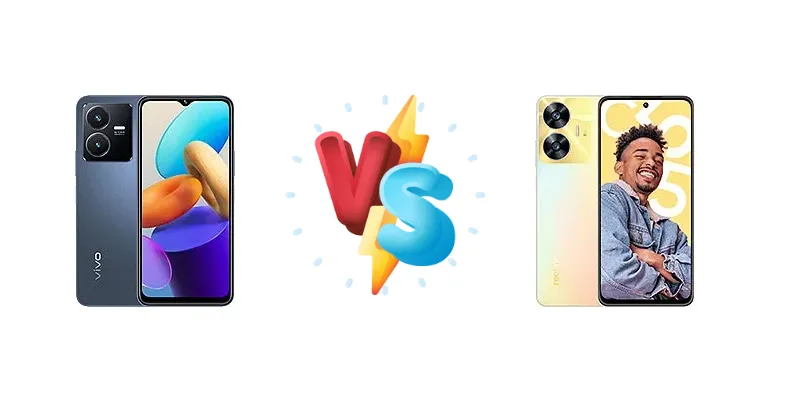
The budget smartphone market is fiercely competitive, and the vivo Y22s and Realme C55 are two strong contenders. Both offer compelling features at an affordable price, but which one reigns supreme? This comprehensive comparison will delve into their key aspects to help you make an informed decision.
🏆 Quick Verdict
The Realme C55 takes the lead thanks to its significantly faster charging, brighter display, and generally more modern chipset. While the vivo Y22s offers a decent experience, the C55's superior charging speed and display brightness make it the better overall value for most users.
| Network |
|---|
| 2G bands | GSM 850 / 900 / 1800 / 1900 | GSM 850 / 900 / 1800 / 1900 |
| 3G bands | HSDPA 850 / 900 / 2100 | HSDPA 850 / 900 / 2100 |
| 4G bands | 1, 3, 5, 7, 8, 20, 28, 38, 40, 41 | 1, 3, 5, 8, 38, 40, 41 |
| Speed | HSPA, LTE | HSPA, LTE |
| Technology | GSM / HSPA / LTE | GSM / HSPA / LTE |
| Launch |
|---|
| Announced | 2022, August 23 | 2023, March 07 |
| Status | Available. Released 2022, August 23 | Available. Released 2023, March 08 |
| Body |
|---|
| Build | Glass front, plastic frame, plastic back | Glass front, plastic frame, plastic back |
| Dimensions | 164.3 x 76.1 x 8.4 mm (6.47 x 3.00 x 0.33 in) | 165.6 x 75.9 x 7.9 mm (6.52 x 2.99 x 0.31 in) |
| SIM | Nano-SIM + Nano-SIM | Nano-SIM + Nano-SIM |
| Weight | 192 g (6.77 oz) | 189.5 g (6.70 oz) |
| | IP5X (dust), IPX4 (water) resistance | - |
| Display |
|---|
| Resolution | 720 x 1612 pixels, 20:9 ratio (~270 ppi density) | 1080 x 2400 pixels, 20:9 ratio (~392 ppi density) |
| Size | 6.55 inches, 103.1 cm2 (~82.4% screen-to-body ratio) | 6.72 inches, 109.0 cm2 (~86.7% screen-to-body ratio) |
| Type | IPS LCD, 90Hz | IPS LCD, 90Hz, 680 nits (peak) |
| Platform |
|---|
| CPU | Octa-core (4x2.4 GHz Kryo 265 Gold & 4x1.9 GHz Kryo 265 Silver) | Octa-core (2x2.0 GHz Cortex-A75 & 6x1.8 GHz Cortex-A55) |
| Chipset | Qualcomm SM6225 Snapdragon 680 4G (6 nm) | Mediatek MT6769H Helio G88 (12 nm) |
| GPU | Adreno 610 | Mali-G52 MC2 |
| OS | Android 12, upgradable to Android 13, Funtouch 13 | Android 13, Realme UI 4.0 |
| Memory |
|---|
| Card slot | microSDXC (dedicated slot) | microSDXC (dedicated slot) |
| Internal | 128GB 4GB RAM, 128GB 6GB RAM, 128GB 8GB RAM | 64GB 4GB RAM, 64GB 6GB RAM, 128GB 4GB RAM, 128GB 6GB RAM, 128GB 8GB RAM, 256GB 8GB RAM |
| Main Camera |
|---|
| Dual | 50 MP, f/1.8, (wide), PDAF
2 MP (macro) | 64 MP, (wide), 1/2.0", PDAF
Auxiliary lens |
| Features | Dual LED flash | LED flash, HDR, panorama |
| Single | 8 MP, f/2.0, (wide) | 8 MP, (wide) |
| Triple | 50 MP, f/1.8, (wide), PDAF
2 MP, f/2.4, (macro) | - |
| Video | 1080p@30fps | 1080p@30/60fps |
| Selfie camera |
|---|
| Features | - | HDR, panorama |
| Single | 8 MP, f/2.0, (wide) | 8 MP, (wide) |
| Video | 1080p@30fps | 1080p@30fps |
| Sound |
|---|
| 3.5mm jack | Yes | Yes |
| 35mm jack | Yes | Yes |
| Loudspeaker | Yes | Yes |
| Comms |
|---|
| Bluetooth | 5.0, A2DP, LE | 5.2, A2DP, LE |
| NFC | Yes (market/region dependent) | Yes, 360˚ (market/region dependent) |
| Positioning | GPS, GLONASS, GALILEO, BDS | GPS, GLONASS, GALILEO, BDS |
| Radio | FM radio | No |
| USB | USB Type-C 2.0, OTG | USB Type-C 2.0 |
| WLAN | Wi-Fi 802.11 a/b/g/n/ac, dual-band | Wi-Fi 802.11 a/b/g/n/ac, dual-band |
| Features |
|---|
| Sensors | Fingerprint (side-mounted), accelerometer, proximity, compass | Fingerprint (side-mounted), accelerometer, proximity, compass |
| Battery |
|---|
| Charging | 18W wired, 70% in 70 min
Reverse wired | 33W wired, 50% in 29 min |
| Type | 5000 mAh | 5000 mAh |
| Misc |
|---|
| Colors | Dark Blue, Yellow Green | Sun Shower, Rainy Night, Rainforest |
| Models | V2206 | RMX3710 |
| Price | About 250 EUR | ₹ 8,399 |
| Tests |
|---|
| Battery life | - |
Endurance rating 123h
|
| Camera | - |
Photo / Video |
| Display | - |
Contrast ratio: 1264:1 (nominal) |
| Loudspeaker | - |
-31.8 LUFS (Below average)
|
| Performance | - |
AnTuTu: 257263 (v9)
GeekBench: 1452 (v5.1), 1413 (v6)
GFXBench: 9fps (ES 3.1 onscreen) |
vivo Y22s
- Compact design
- Reverse wired charging
- Efficient chipset (6nm)
- Slower charging (18W)
- Dimmer display
- Older chipset architecture
Realme C55
- Faster charging (33W)
- Brighter display
- Slightly more powerful chipset
- Excellent battery life (claimed)
- Larger design
- Less efficient chipset (12nm)
Display Comparison
The Realme C55 boasts a significant advantage with its measured 659 nits max brightness, making it much easier to view in direct sunlight. Both phones share a 1264:1 contrast ratio, indicating good image depth, but the C55's brightness is the key differentiator. The Y22s display is adequate but noticeably dimmer.
Camera Comparison
Camera performance is likely comparable, with both phones offering decent image quality in good lighting conditions. Low-light performance will likely be a weakness for both, typical of this price range. Specific camera features and software optimizations will play a larger role in the final image quality.
Performance
The vivo Y22s' Snapdragon 680, built on a 6nm process, generally offers slightly better efficiency than the Realme C55's Helio G88 (12nm). However, the Helio G88 often demonstrates slightly better raw performance in real-world usage, especially in gaming. Both are adequate for everyday tasks.
Battery Life
The Realme C55 claims an impressive endurance rating of 123h, suggesting excellent battery life. While the vivo Y22s' battery capacity is similar, the Realme C55's 33W fast charging is a game-changer, charging to 50% in just 29 minutes compared to the Y22s' 18W charging (70% in 70 minutes).
Buying Guide
Who should buy the vivo Y22s? Users prioritizing a slightly more compact design and reverse wired charging might find the Y22s appealing. Who should buy the Realme C55? Those seeking faster charging, a brighter display for outdoor use, and a slightly more powerful processor should opt for the Realme C55.
Frequently Asked Questions
❓ Which phone has better battery life?
The Realme C55 is projected to have better battery life based on its endurance rating and faster charging capabilities.
❓ Is the Snapdragon 680 or Helio G88 better?
The Snapdragon 680 is more efficient due to its 6nm process, but the Helio G88 often offers slightly better raw performance, particularly in gaming.