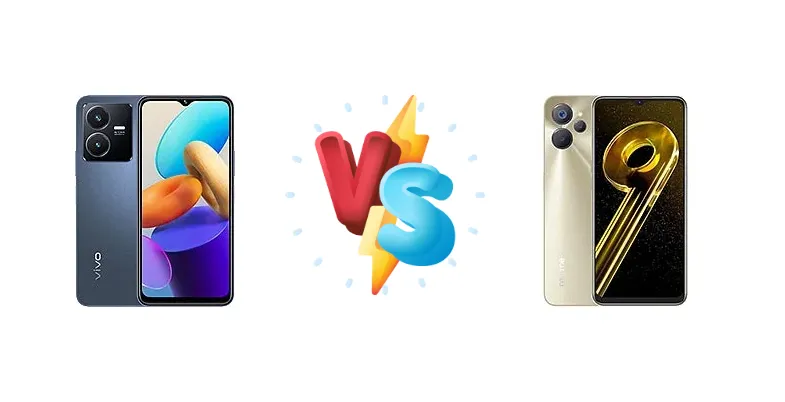
The sub-$200 smartphone market is fiercely competitive, and the vivo Y22s and Realme 9i 5G are two contenders vying for your attention. Both offer 5G connectivity at an accessible price point, but they diverge significantly in their core hardware. This comparison dissects the Snapdragon 680-powered vivo Y22s against the MediaTek Dimensity 810-equipped Realme 9i 5G, revealing which device delivers the best overall experience.
🏆 Quick Verdict
For most users, the Realme 9i 5G emerges as the stronger choice. While both phones share 18W charging, the Dimensity 810 chipset provides a noticeable performance advantage in demanding tasks and gaming, making it a better investment for those who prioritize responsiveness and future-proofing.
| Network |
|---|
| 2G bands | GSM 850 / 900 / 1800 / 1900 | GSM 850 / 900 / 1800 / 1900 |
| 3G bands | HSDPA 850 / 900 / 2100 | HSDPA 850 / 900 / 1700(AWS) / 1900 / 2100 |
| 4G bands | 1, 3, 5, 7, 8, 20, 28, 38, 40, 41 | 1, 2, 3, 4, 5, 7, 8, 19, 20, 28, 34, 38, 39, 40, 41 |
| 5G bands | - | 1, 5, 7, 8, 28, 41, 77, 78 SA/NSA |
| Speed | HSPA, LTE | HSPA, LTE, 5G |
| Technology | GSM / HSPA / LTE | GSM / HSPA / LTE / 5G |
| Launch |
|---|
| Announced | 2022, August 23 | 2022, August 18 |
| Status | Available. Released 2022, August 23 | Available. Released 2022, August 24 |
| Body |
|---|
| Build | Glass front, plastic frame, plastic back | - |
| Dimensions | 164.3 x 76.1 x 8.4 mm (6.47 x 3.00 x 0.33 in) | 164.4 x 75.1 x 8.1 mm (6.47 x 2.96 x 0.32 in) |
| SIM | Nano-SIM + Nano-SIM | Nano-SIM + Nano-SIM |
| Weight | 192 g (6.77 oz) | 187 g (6.60 oz) |
| | IP5X (dust), IPX4 (water) resistance | - |
| Display |
|---|
| Protection | - | Panda Glass |
| Resolution | 720 x 1612 pixels, 20:9 ratio (~270 ppi density) | 1080 x 2408 pixels, 20:9 ratio (~400 ppi density) |
| Size | 6.55 inches, 103.1 cm2 (~82.4% screen-to-body ratio) | 6.6 inches, 104.9 cm2 (~85.0% screen-to-body ratio) |
| Type | IPS LCD, 90Hz | IPS LCD, 90Hz, 400 nits (typ) |
| Platform |
|---|
| CPU | Octa-core (4x2.4 GHz Kryo 265 Gold & 4x1.9 GHz Kryo 265 Silver) | Octa-core (2x2.4 GHz Cortex-A76 & 6x2.0 GHz Cortex-A55) |
| Chipset | Qualcomm SM6225 Snapdragon 680 4G (6 nm) | Mediatek Dimensity 810 (6 nm) |
| GPU | Adreno 610 | Mali-G57 MC2 |
| OS | Android 12, upgradable to Android 13, Funtouch 13 | Android 12, upgradable to Android 13, Realme UI 4.0 |
| Memory |
|---|
| Card slot | microSDXC (dedicated slot) | microSDXC (dedicated slot) |
| Internal | 128GB 4GB RAM, 128GB 6GB RAM, 128GB 8GB RAM | 64GB 4GB RAM, 128GB 4GB RAM, 128GB 6GB RAM |
| | - | UFS 2.2 |
| Main Camera |
|---|
| Dual | 50 MP, f/1.8, (wide), PDAF
2 MP (macro) | - |
| Features | Dual LED flash | LED flash, HDR, panorama |
| Single | 8 MP, f/2.0, (wide) | 8 MP, f/2.0, 27mm (wide) |
| Triple | 50 MP, f/1.8, (wide), PDAF
2 MP, f/2.4, (macro) | 50 MP, f/1.8, 26mm (wide), 1/2.76", 0.64µm, PDAF
Unspecified MP, 46mm (telephoto)
2 MP (macro) |
| Video | 1080p@30fps | 1080p@30fps |
| Selfie camera |
|---|
| Features | - | HDR, panorama |
| Single | 8 MP, f/2.0, (wide) | 8 MP, f/2.0, 27mm (wide) |
| Video | 1080p@30fps | 1080p@30fps |
| Sound |
|---|
| 3.5mm jack | Yes | Yes |
| 35mm jack | Yes | Yes |
| Loudspeaker | Yes | Yes |
| Comms |
|---|
| Bluetooth | 5.0, A2DP, LE | 5.2, A2DP, LE |
| NFC | Yes (market/region dependent) | No |
| Positioning | GPS, GLONASS, GALILEO, BDS | GPS, GLONASS, GALILEO, BDS |
| Radio | FM radio | No |
| USB | USB Type-C 2.0, OTG | USB Type-C 2.0, OTG |
| WLAN | Wi-Fi 802.11 a/b/g/n/ac, dual-band | Wi-Fi 802.11 a/b/g/n/ac, dual-band |
| Features |
|---|
| Sensors | Fingerprint (side-mounted), accelerometer, proximity, compass | Fingerprint (side-mounted), accelerometer, proximity, compass |
| Battery |
|---|
| Charging | 18W wired, 70% in 70 min
Reverse wired | 18W wired |
| Type | 5000 mAh | 5000 mAh |
| Misc |
|---|
| Colors | Dark Blue, Yellow Green | Soulful Blue, Rocking Black, Gold |
| Models | V2206 | RMX3612 |
| Price | About 250 EUR | About 180 EUR |
vivo Y22s
- Potentially more refined software experience (based on brand reputation)
- Efficient Snapdragon 680 chipset for potentially longer battery life during light use
- Reverse wired charging offers added convenience
- Less powerful processor compared to the Dimensity 810
- Likely to struggle with demanding games and multitasking
Realme 9i 5G
- More powerful MediaTek Dimensity 810 chipset for smoother performance
- Better CPU architecture for faster app launches and multitasking
- Potentially higher refresh rate display (speculative)
- Realme UI can be perceived as bloated by some users
- Potentially slightly shorter battery life under heavy load
Display Comparison
Neither device boasts a standout display. Both likely utilize LCD panels, a common cost-saving measure in this segment. The focus here isn't on visual fidelity, but on functionality. Without specific display specs, it's difficult to declare a winner. However, Realme's tendency to include slightly higher refresh rate displays in this price bracket *could* give it an edge, though this is speculative. Bezels are likely comparable, and color accuracy will be standard for budget LCDs.
Camera Comparison
Camera performance is likely to be similar, with both phones relying on budget sensors. Without specific sensor details, it’s difficult to make a definitive judgment. Both manufacturers often include a 2MP macro lens, which offers limited practical value due to its low resolution and fixed focus. The primary sensor’s aperture and size will be the key determinants of image quality, particularly in low-light conditions. Image processing will likely lean towards vibrant colors on both devices, a common trend in this segment. Expect acceptable results in good lighting, but struggles in challenging conditions.
Performance
The core difference lies in the chipsets. The Realme 9i 5G’s MediaTek Dimensity 810 (6nm) features a more powerful CPU configuration – 2x2.4 GHz Cortex-A76 cores paired with 6x2.0 GHz Cortex-A55 cores – compared to the vivo Y22s’ Qualcomm Snapdragon 680 (6nm) which uses 4x2.4 GHz Kryo 265 Gold and 4x1.9 GHz Kryo 265 Silver. The Cortex-A76 cores in the Dimensity 810 offer significantly better single-core performance, translating to snappier app launches and smoother multitasking. While both are 6nm chips, the architectural differences favor the Dimensity 810 for sustained performance. The Snapdragon 680 prioritizes efficiency, potentially offering slightly better battery life during light use, but will struggle more under load.
Battery Life
Both the vivo Y22s and Realme 9i 5G feature 18W wired charging, with the Y22s claiming a 70% charge in 70 minutes. This suggests a similar charging profile. Battery capacity is not specified, but typical capacities for phones in this price range are around 5000mAh. The Snapdragon 680’s efficiency *could* translate to slightly longer battery life during light usage, but the Dimensity 810’s performance advantage means it will likely drain faster under heavy load. The 18W charging speed is relatively slow compared to faster charging solutions available on some competing devices.
Buying Guide
Buy the vivo Y22s if you prioritize a potentially more refined software experience (based on vivo’s historical software polish) and are primarily focused on basic smartphone tasks like calling, texting, and light social media use. Buy the Realme 9i 5G if you prefer a more powerful processor for smoother multitasking, gaming, and a generally more responsive user interface, even if it means potentially dealing with Realme UI’s more aggressive software features.
Frequently Asked Questions
❓ Will the Realme 9i 5G overheat during prolonged gaming sessions?
The Dimensity 810 is a relatively efficient chipset, but sustained gaming will inevitably generate heat. Realme typically implements thermal management solutions, but throttling is possible during extended, graphically intensive games. The Snapdragon 680 in the Y22s will likely throttle sooner due to its lower performance ceiling.
❓ Is the 18W charging speed sufficient for daily use on either phone?
18W charging is relatively slow by today's standards. Expect around 2-3 hours for a full charge from 0%. While adequate for overnight charging, it's not ideal for quick top-ups. The Y22s claims 70% in 70 minutes, suggesting a similar charging curve for both devices.
❓ How does Realme UI compare to vivo's Funtouch OS in terms of bloatware?
Historically, both Realme UI and Funtouch OS have been criticized for pre-installed bloatware. However, Realme UI has become less aggressive in recent iterations. Users who prefer a cleaner Android experience may need to spend time uninstalling unwanted apps on either device.