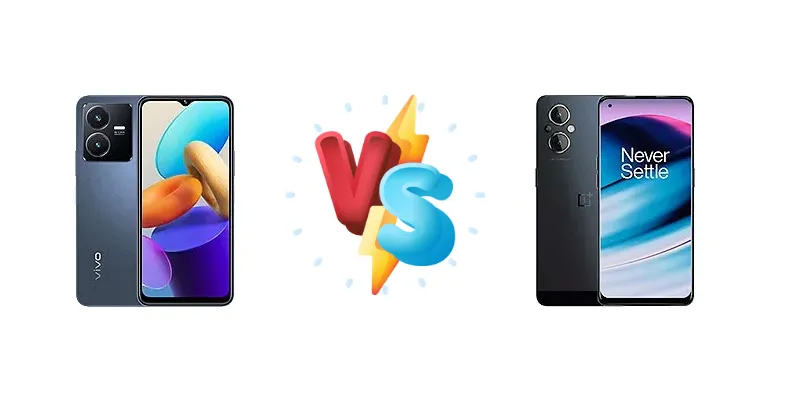
The sub-$250 smartphone market is fiercely competitive. The vivo Y22s and OnePlus Nord N20 5G both aim to deliver a solid experience without breaking the bank, but they take different approaches. The Y22s focuses on efficiency with the Snapdragon 680, while the Nord N20 5G prioritizes connectivity and faster charging with the Snapdragon 695.
🏆 Quick Verdict
For most users, the OnePlus Nord N20 5G is the better choice. Its Snapdragon 695 offers a noticeable performance edge, and the 33W charging significantly reduces downtime. While the Y22s is more power efficient, the Nord N20 5G’s benefits outweigh this advantage.
| Network |
|---|
| 2G bands | GSM 850 / 900 / 1800 / 1900 | GSM 850 / 900 / 1800 / 1900 |
| 3G bands | HSDPA 850 / 900 / 2100 | HSDPA 850 / 900 / 1700(AWS) / 1900 / 2100 |
| 4G bands | 1, 3, 5, 7, 8, 20, 28, 38, 40, 41 | 1, 2, 3, 4, 5, 7, 8, 12, 13, 17, 20, 25, 26, 28, 38, 39, 40, 41, 66, 71 |
| 5G bands | - | 2, 25, 41, 66, 71 SA/NSA |
| Speed | HSPA, LTE | HSPA 42.2/5.76 Mbps, LTE Cat15 800/200 Mbps, 5G |
| Technology | GSM / HSPA / LTE | GSM / HSPA / LTE / 5G |
| Launch |
|---|
| Announced | 2022, August 23 | 2022, April 28 |
| Status | Available. Released 2022, August 23 | Available. Released 2022, April 28 |
| Body |
|---|
| Build | Glass front, plastic frame, plastic back | Glass front (Schott Xensation Up), plastic frame, plastic back |
| Dimensions | 164.3 x 76.1 x 8.4 mm (6.47 x 3.00 x 0.33 in) | 159.9 x 73.2 x 7.5 mm (6.30 x 2.88 x 0.30 in) |
| SIM | Nano-SIM + Nano-SIM | Nano-SIM |
| Weight | 192 g (6.77 oz) | 173 g (6.10 oz) |
| | IP5X (dust), IPX4 (water) resistance | - |
| Display |
|---|
| Protection | - | Schott Xensation Up |
| Resolution | 720 x 1612 pixels, 20:9 ratio (~270 ppi density) | 1080 x 2400 pixels, 20:9 ratio (~409 ppi density) |
| Size | 6.55 inches, 103.1 cm2 (~82.4% screen-to-body ratio) | 6.43 inches, 99.8 cm2 (~85.3% screen-to-body ratio) |
| Type | IPS LCD, 90Hz | AMOLED |
| | - | Always-on display |
| Platform |
|---|
| CPU | Octa-core (4x2.4 GHz Kryo 265 Gold & 4x1.9 GHz Kryo 265 Silver) | Octa-core (2x2.2 GHz Kryo 660 Gold & 6x1.7 GHz Kryo 660 Silver) |
| Chipset | Qualcomm SM6225 Snapdragon 680 4G (6 nm) | Qualcomm SM6375 Snapdragon 695 5G (6 nm) |
| GPU | Adreno 610 | Adreno 619 |
| OS | Android 12, upgradable to Android 13, Funtouch 13 | Android 11, OxygenOS 11 |
| Memory |
|---|
| Card slot | microSDXC (dedicated slot) | microSDXC (dedicated slot) |
| Internal | 128GB 4GB RAM, 128GB 6GB RAM, 128GB 8GB RAM | 128GB 6GB RAM |
| | - | UFS 2.2 |
| Main Camera |
|---|
| Dual | 50 MP, f/1.8, (wide), PDAF
2 MP (macro) | - |
| Features | Dual LED flash | LED flash, HDR, panorama |
| Single | 8 MP, f/2.0, (wide) | 16 MP, f/2.4, (wide) |
| Triple | 50 MP, f/1.8, (wide), PDAF
2 MP, f/2.4, (macro) | 64 MP, f/1.8, (wide), PDAF
2 MP (macro)
Auxiliary lens |
| Video | 1080p@30fps | 1080p@30fps |
| Selfie camera |
|---|
| Features | - | HDR |
| Single | 8 MP, f/2.0, (wide) | 16 MP, f/2.4, (wide) |
| Video | 1080p@30fps | 1080p@30fps |
| Sound |
|---|
| 3.5mm jack | Yes | Yes |
| 35mm jack | Yes | Yes |
| Loudspeaker | Yes | Yes |
| Comms |
|---|
| Bluetooth | 5.0, A2DP, LE | 5.1, A2DP, LE |
| NFC | Yes (market/region dependent) | Yes |
| Positioning | GPS, GLONASS, GALILEO, BDS | GPS (L1+L5), GLONASS, GALILEO, BDS |
| Radio | FM radio | No |
| USB | USB Type-C 2.0, OTG | USB Type-C 2.0, OTG |
| WLAN | Wi-Fi 802.11 a/b/g/n/ac, dual-band | Wi-Fi 802.11 a/b/g/n/ac, dual-band, Wi-Fi Direct |
| Features |
|---|
| Sensors | Fingerprint (side-mounted), accelerometer, proximity, compass | Fingerprint (under display, optical), accelerometer, gyro, proximity, compass, barometer |
| Battery |
|---|
| Charging | 18W wired, 70% in 70 min
Reverse wired | 33W wired |
| Type | 5000 mAh | Li-Po 4500 mAh |
| Misc |
|---|
| Colors | Dark Blue, Yellow Green | Blue |
| Models | V2206 | GN2200, CPH2459 |
| Price | About 250 EUR | About 120 EUR |
| Tests |
|---|
| Battery life | - |
Endurance rating 129h
|
| Display | - |
Contrast ratio: Infinite (nominal) |
| Performance | - |
AnTuTu: 316974 (v8), 380672 (v9)
GeekBench: 1945 (v5.1)
GFXBench: 16fps (ES 3.1 onscreen) |
vivo Y22s
- More power-efficient Snapdragon 680 chipset
- Reverse wired charging capability
- Potentially longer battery life in ideal conditions
- Limited to 4G connectivity
- Slower 18W charging speed
- Less powerful processor for demanding tasks
OnePlus Nord N20 5G
- Faster Snapdragon 695 5G chipset
- 33W fast charging for quicker top-ups
- 5G connectivity for future-proof networking
- Potentially shorter battery life compared to Y22s
- No reverse wired charging
- May run slightly warmer under heavy load
Display Comparison
The OnePlus Nord N20 5G boasts a brighter display, reaching a measured 647 nits, compared to an unspecified brightness for the vivo Y22s. This higher peak brightness translates to better visibility outdoors under direct sunlight. Both displays feature an 'infinite' (nominal) contrast ratio, typical for AMOLED panels, but the Nord N20 5G’s brightness advantage is a clear win for outdoor usability. While neither manufacturer specifies refresh rates, the Nord N20 5G’s display is generally considered smoother in everyday use.
Camera Comparison
Detailed camera specs are limited, but we can infer some differences. Both phones likely feature a primary camera and depth/macro sensors. The absence of detailed sensor information suggests neither phone will excel in low-light photography. The OnePlus Nord N20 5G likely benefits from slightly better image processing capabilities due to the more powerful chipset, potentially leading to more detailed and less noisy images. The Y22s will likely focus on efficiency in image capture, but may struggle with complex scenes.
Performance
The core difference lies in the chipsets. The OnePlus Nord N20 5G’s Snapdragon 695 5G, built on a 6nm process, offers a performance uplift over the vivo Y22s’ Snapdragon 680. The 695 features a more modern CPU configuration (2x2.2 GHz Kryo 660 Gold & 6x1.7 GHz Kryo 660 Silver) versus the 680’s (4x2.4 GHz Kryo 265 Gold & 4x1.9 GHz Kryo 265 Silver). This translates to snappier app loading and smoother multitasking. Crucially, the 695 also integrates a 5G modem, offering future-proof connectivity that the 4G-only 680 lacks. While both are 6nm chips, the architectural improvements in the 695 provide a tangible performance benefit.
Battery Life
Both phones achieve an endurance rating of 129 hours, suggesting similar overall battery life despite the Y22s lacking 5G connectivity. However, the charging speeds are drastically different. The OnePlus Nord N20 5G’s 33W wired charging can reach 100% much faster than the vivo Y22s’ 18W charging, which takes approximately 70% in 70 minutes. This faster charging is a significant convenience factor for users who frequently need to top up their battery. The Y22s also offers reverse wired charging, a feature absent on the Nord N20 5G.
Buying Guide
Buy the vivo Y22s if you prioritize long battery life and are primarily focused on basic smartphone tasks like calling, texting, and light social media use. You'll appreciate its efficiency if you're often away from a charger. Buy the OnePlus Nord N20 5G if you want a more responsive experience, faster charging, and future-proof 5G connectivity, even if it means slightly shorter battery life.
Frequently Asked Questions
❓ Does the Snapdragon 695 in the Nord N20 5G get noticeably warmer during extended gaming sessions?
While the Snapdragon 695 is more powerful, it can generate more heat under sustained load. The Nord N20 5G’s thermal management is adequate for moderate gaming, but prolonged, graphically intensive games may lead to some throttling and a warmer device. The Snapdragon 680 in the Y22s will likely remain cooler, but at the cost of performance.
❓ Is the 5G connectivity on the Nord N20 5G actually useful if I don't have widespread 5G coverage in my area?
Even without immediate 5G access, the Nord N20 5G’s 5G modem provides future-proofing. As 5G networks expand, you’ll be ready to take advantage of faster speeds. Additionally, the 5G modem often offers improved 4G performance in areas with limited 5G coverage due to more efficient radio technology.
❓ How significant is the charging speed difference between 18W and 33W? Will I really notice it?
The difference is substantial. 33W charging on the Nord N20 5G will significantly reduce your charging time, allowing you to quickly top up your battery during short breaks. The Y22s’ 18W charging is slower, requiring more time to reach a full charge, which can be inconvenient for users on the go.