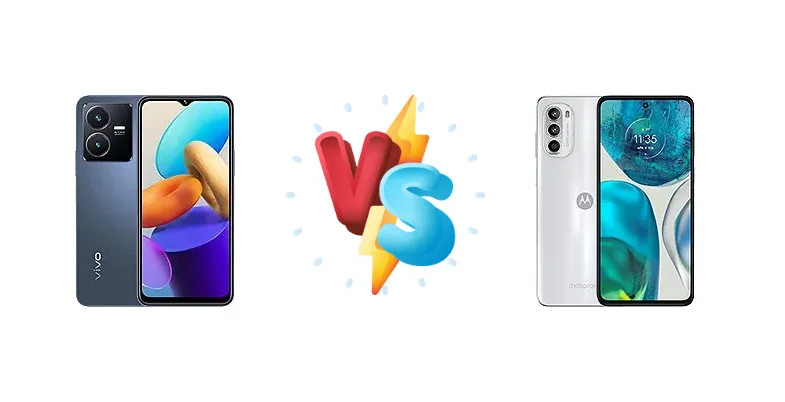
The vivo Y22s and Motorola Moto G52 occupy a similar price bracket, both powered by the Qualcomm Snapdragon 680. This comparison isn't about raw power – the chipset is identical – but about how each manufacturer optimizes around it, particularly in areas like charging speed and overall user experience. We'll dissect the nuances to determine which phone delivers the best value.
🏆 Quick Verdict
For the average user, the Motorola Moto G52 emerges as the slightly better choice. While both phones share the same Snapdragon 680 chipset, the Moto G52’s 30W charging significantly reduces downtime, making it ideal for those constantly on the go. The vivo Y22s remains a viable option, but the charging difference is a key differentiator.
| Network |
|---|
| 2G bands | GSM 850 / 900 / 1800 / 1900 | GSM 850 / 900 / 1800 / 1900 |
| 3G bands | HSDPA 850 / 900 / 2100 | HSDPA 850 / 900 / 1700(AWS) / 1900 / 2100 |
| 4G bands | 1, 3, 5, 7, 8, 20, 28, 38, 40, 41 | LTE |
| Speed | HSPA, LTE | HSPA, LTE |
| Technology | GSM / HSPA / LTE | GSM / HSPA / LTE |
| Launch |
|---|
| Announced | 2022, August 23 | 2022, April 12 |
| Status | Available. Released 2022, August 23 | Available. Released 2022, April 20 |
| Body |
|---|
| Build | Glass front, plastic frame, plastic back | - |
| Dimensions | 164.3 x 76.1 x 8.4 mm (6.47 x 3.00 x 0.33 in) | 160.1 x 74.5 x 8 mm (6.30 x 2.93 x 0.31 in) |
| SIM | Nano-SIM + Nano-SIM | Nano-SIM + Nano-SIM |
| Weight | 192 g (6.77 oz) | 169 g (5.96 oz) |
| | IP5X (dust), IPX4 (water) resistance | Water-repellent design |
| Display |
|---|
| Resolution | 720 x 1612 pixels, 20:9 ratio (~270 ppi density) | 1080 x 2400 pixels, 20:9 ratio (~402 ppi density) |
| Size | 6.55 inches, 103.1 cm2 (~82.4% screen-to-body ratio) | 6.6 inches, 103.6 cm2 (~86.9% screen-to-body ratio) |
| Type | IPS LCD, 90Hz | AMOLED, 90Hz |
| Platform |
|---|
| CPU | Octa-core (4x2.4 GHz Kryo 265 Gold & 4x1.9 GHz Kryo 265 Silver) | Octa-core (4x2.4 GHz Kryo 265 Gold & 4x1.9 GHz Kryo 265 Silver) |
| Chipset | Qualcomm SM6225 Snapdragon 680 4G (6 nm) | Qualcomm SM6225 Snapdragon 680 4G (6 nm) |
| GPU | Adreno 610 | Adreno 610 |
| OS | Android 12, upgradable to Android 13, Funtouch 13 | Android 12, planned upgrade to Android 13 |
| Memory |
|---|
| Card slot | microSDXC (dedicated slot) | microSDXC (uses shared SIM slot) |
| Internal | 128GB 4GB RAM, 128GB 6GB RAM, 128GB 8GB RAM | 64GB 4GB RAM, 128GB 4GB RAM, 128GB 6GB RAM, 256GB 6GB RAM |
| Main Camera |
|---|
| Dual | 50 MP, f/1.8, (wide), PDAF
2 MP (macro) | - |
| Features | Dual LED flash | LED flash, HDR, panorama |
| Single | 8 MP, f/2.0, (wide) | - |
| Triple | 50 MP, f/1.8, (wide), PDAF
2 MP, f/2.4, (macro) | 50 MP, f/1.8 (wide), 1/2.76", 0.64µm, PDAF
8 MP, f/2.2, 118˚ (ultrawide), 1/4.0", 1.12µm
2 MP (macro) |
| Video | 1080p@30fps | 1080p@30fps |
| Selfie camera |
|---|
| Single | 8 MP, f/2.0, (wide) | 16 MP, f/2.5, (wide), 1.0µm |
| Video | 1080p@30fps | 1080p@30fps |
| Sound |
|---|
| 3.5mm jack | Yes | Yes |
| 35mm jack | Yes | Yes |
| Loudspeaker | Yes | Yes, with stereo speakers |
| Comms |
|---|
| Bluetooth | 5.0, A2DP, LE | 5.0, A2DP, LE |
| NFC | Yes (market/region dependent) | Yes (market/region dependent) |
| Positioning | GPS, GLONASS, GALILEO, BDS | GPS, GLONASS, GALILEO |
| Radio | FM radio | Unspecified |
| USB | USB Type-C 2.0, OTG | USB Type-C 2.0 |
| WLAN | Wi-Fi 802.11 a/b/g/n/ac, dual-band | Wi-Fi 802.11 a/b/g/n/ac, dual-band, Wi-Fi Direct |
| Features |
|---|
| Sensors | Fingerprint (side-mounted), accelerometer, proximity, compass | Fingerprint (side-mounted), accelerometer, gyro, proximity, compass |
| Battery |
|---|
| Charging | 18W wired, 70% in 70 min
Reverse wired | 30W wired |
| Type | 5000 mAh | Li-Po 5000 mAh |
| Misc |
|---|
| Colors | Dark Blue, Yellow Green | Charcoal Gray, Porcelain White |
| Models | V2206 | XT2221-1, XT2221-2 |
| Price | About 250 EUR | About 470 EUR |
vivo Y22s
- Potentially refined software experience (regional variations apply)
- Reverse wired charging capability
- Snapdragon 680 provides efficient performance
- Slower 18W charging
- Limited display information available
Motorola Moto G52
- Faster 30W wired charging
- Clean Android experience (typically)
- Snapdragon 680 provides efficient performance
- Limited display information available
- May lack software features found on vivo devices
Display Comparison
Both devices lack detailed display specifications in the provided data. However, given their price point, we can assume both utilize LCD panels. The absence of information regarding refresh rates suggests a standard 60Hz experience on both. Bezels are likely comparable, and color accuracy will be typical for this segment – adequate for everyday use but not geared towards color-critical work. Without further data, a clear winner cannot be determined.
Camera Comparison
Camera details are sparse. Both phones likely feature a multi-camera setup, but the provided data doesn't reveal sensor sizes or lens apertures. The absence of OIS (Optical Image Stabilization) is almost certain at this price point. Image processing will likely differ between the two brands, with vivo often leaning towards more saturated colors and Motorola aiming for a more natural look. Any 2MP macro or depth sensors are unlikely to provide significant image quality improvements and should be considered supplementary features.
Performance
The core of both the vivo Y22s and Motorola Moto G52 is the Qualcomm Snapdragon 680 4G (6 nm) chipset, featuring an octa-core CPU configuration with 4x2.4 GHz Kryo 265 Gold and 4x1.9 GHz Kryo 265 Silver cores. This means performance will be virtually identical in CPU-bound tasks like web browsing and social media. The 6nm process node contributes to reasonable power efficiency. However, thermal management will be crucial; sustained loads could lead to throttling, and the effectiveness of each phone’s cooling solution is unknown. RAM configurations (not specified) will also impact multitasking performance.
Battery Life
The battery capacity isn't specified for either device, but both will likely fall in the 5000mAh range, typical for this segment. The critical difference lies in charging speed. The Motorola Moto G52 boasts 30W wired charging, while the vivo Y22s is limited to 18W. This translates to significantly faster charging times for the Moto G52 – potentially reaching 100% in under 70 minutes, compared to the Y22s’ stated 70% in 70 minutes. The Moto G52’s reverse wired charging is a useful addition for topping up accessories.
Buying Guide
Buy the vivo Y22s if you prioritize a potentially more refined software experience (depending on regional software builds) and are less concerned with rapid charging. It's a solid all-rounder for basic smartphone tasks. Buy the Motorola Moto G52 if you value fast charging above all else. The 30W charging is a game-changer for users who frequently need to top up their battery quickly, and the clean Android experience is a bonus.
Frequently Asked Questions
❓ Will the Snapdragon 680 in the Moto G52 struggle with demanding games like PUBG Mobile?
The Snapdragon 680 is a capable chipset for casual gaming, but demanding titles like PUBG Mobile will likely require reduced graphics settings to maintain a stable frame rate. Expect playable performance at medium settings, but don't anticipate a high-end gaming experience.
❓ How much faster is the 30W charging on the Moto G52 compared to the 18W charging on the vivo Y22s in real-world use?
The 30W charging on the Moto G52 will noticeably reduce charging times. While the Y22s takes 70 minutes to reach 70%, the Moto G52 should achieve a full charge in under 70 minutes, potentially closer to 60-65 minutes, depending on battery health and usage patterns. This difference is significant for users who frequently need to quickly top up their phone.
❓ Do either of these phones support 5G connectivity?
No, both the vivo Y22s and Motorola Moto G52 utilize the Snapdragon 680 4G chipset, meaning they are limited to 4G LTE connectivity. 5G support is not available on either device.