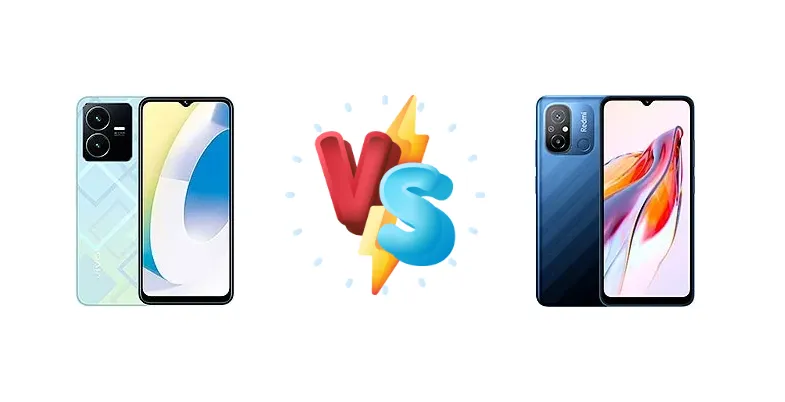
The sub-$150 smartphone market is fiercely competitive. Both the vivo Y22 and Xiaomi Redmi 12C aim to deliver essential smartphone functionality at an accessible price point. While both devices leverage the Mediatek Helio G85 chipset, a key differentiator emerges in their charging capabilities, making this a crucial comparison for users prioritizing convenience.
🏆 Quick Verdict
For most users, the vivo Y22 edges out the Redmi 12C. The 18W charging support significantly reduces downtime, a critical advantage for those relying on their phone throughout the day. While the core performance is identical, the faster charging makes the Y22 a more practical daily driver.
| Network |
|---|
| 2G bands | GSM 850 / 900 / 1800 / 1900 | GSM 850 / 900 / 1800 / 1900 |
| 3G bands | HSDPA 850 / 900 / 2100 | HSDPA 850 / 900 / 2100 |
| 4G bands | 1, 3, 5, 8, 40 | 1, 3, 5, 7, 8, 20, 28, 38, 40, 41 - International |
| Speed | HSPA, LTE | HSPA, LTE |
| Technology | GSM / HSPA / LTE | GSM / CDMA / HSPA / EVDO / LTE |
| | - | CDMA2000 1xEV-DO |
| Launch |
|---|
| Announced | 2022, September 05 | 2022, December 31 |
| Status | Available. Released 2022, September 05 | Available. Released 2023, January 01 |
| Body |
|---|
| Build | Glass front, plastic frame, plastic back | - |
| Dimensions | 164.3 x 76.1 x 8.4 mm (6.47 x 3.00 x 0.33 in) | 168.8 x 76.4 x 8.8 mm (6.65 x 3.01 x 0.35 in) |
| SIM | Nano-SIM + Nano-SIM | Nano-SIM + Nano-SIM |
| Weight | 190 g (6.70 oz) | 192 g (6.77 oz) |
| Display |
|---|
| Resolution | 720 x 1612 pixels, 20:9 ratio (~270 ppi density) | 720 x 1650 pixels (~268 ppi density) |
| Size | 6.55 inches, 103.1 cm2 (~82.4% screen-to-body ratio) | 6.71 inches, 106.5 cm2 (~82.6% screen-to-body ratio) |
| Type | IPS LCD, 530 nits (HBM) | IPS LCD, 500 nits (typ) |
| Platform |
|---|
| CPU | Octa-core (2x2.0 GHz Cortex-A75 & 6x1.8 GHz Cortex-A55) | Octa-core (2x2.0 GHz Cortex-A75 & 6x1.8 GHz Cortex-A55) |
| Chipset | Mediatek MT6769Z Helio G85 (12 nm) | Mediatek MT6769Z Helio G85 (12 nm) |
| GPU | Mali-G52 MC2 | Mali-G52 MC2 |
| OS | Android 12, Funtouch 12 | Android 12, MIUI 13 |
| Memory |
|---|
| Card slot | microSDXC (dedicated slot) | microSDXC (dedicated slot) |
| Internal | 64GB 4GB RAM, 128GB 4GB RAM, 128GB 6GB RAM | 32GB 2GB RAM, 32GB 3GB RAM, 32GB 4GB RAM, 64GB 3GB RAM, 64GB 4GB RAM, 128GB 3GB RAM, 128GB 4GB RAM, 128GB 6GB RAM |
| | - | eMMC 5.1 |
| Main Camera |
|---|
| Dual | - | 50 MP, (wide), PDAF
0.08 MP (depth) |
| Features | Dual-LED flash, panorama | LED flash, HDR |
| Single | - | 50 MP, f/1.8, (wide), 1/2.76", PDAF
Auxiliary lens |
| Triple | 50 MP, f/1.8, (wide), PDAF
2 MP (macro) | - |
| Video | 1080p@30fps | 1080p@30fps |
| Selfie camera |
|---|
| Single | 8 MP, f/2.0, (wide) | 5 MP, f/2.2, (wide) |
| Video | 1080p@30fps | 1080p@30fps |
| Sound |
|---|
| 3.5mm jack | - | Yes |
| 35mm jack | Yes | Yes |
| Loudspeaker | Yes | Yes |
| Comms |
|---|
| Bluetooth | 5.0, A2DP, LE | 5.1, A2DP, LE |
| NFC | No | Yes (market/region dependent) |
| Positioning | GPS, GLONASS, GALILEO, BDS | GPS, GLONASS, BDS, GALILEO |
| Radio | FM radio | FM radio |
| USB | USB Type-C 2.0, OTG | microUSB 2.0 |
| WLAN | Wi-Fi 802.11 a/b/g/n/ac, dual-band | Wi-Fi 802.11 a/b/g/n/ac, dual-band, Wi-Fi Direct |
| Features |
|---|
| Sensors | Fingerprint (side-mounted), accelerometer, proximity, compass | Fingerprint (rear-mounted), accelerometer |
| | - | Virtual proximity sensing |
| Battery |
|---|
| Charging | 18W wired | 10W wired |
| Type | 5000 mAh | Li-Po 5000 mAh |
| Misc |
|---|
| Colors | Starlite Blue, Metaverse Green, Summer Cyan | Graphite Gray, Ocean Blue, Mint Green, Lavender Purple |
| Models | V2207 | 22120RN86G, 22120RN86I, 22126RN91Y, 2212ARNC4L |
| Price | About 160 EUR | £ 132.99 / € 107.41 |
| SAR | - | 1.08 W/kg (head) 0.64 W/kg (body) |
| SAR EU | - | 0.98 W/kg (head) 0.99 W/kg (body) |
vivo Y22
- Faster 18W charging for quicker top-ups
- Identical processing power to Redmi 12C
- Potentially better thermal management (dependent on design)
- Price may be slightly higher than Redmi 12C
- Camera performance likely similar to Redmi 12C
Xiaomi Redmi 12C
- Likely the more affordable option
- Identical processing power to vivo Y22
- Potentially larger battery capacity (market trend)
- Significantly slower 10W charging
- Camera performance likely similar to vivo Y22
Display Comparison
Both the vivo Y22 and Redmi 12C likely feature LCD panels, typical for this price bracket. Specifics like resolution and peak brightness are not provided, but we can assume they are similar, aiming for a 720p+ experience. The absence of high refresh rates (90Hz or 120Hz) is expected. Bezels are likely comparable, prioritizing cost reduction over premium aesthetics. Color accuracy will likely be standard for budget LCDs, leaning towards warmer tones.
Camera Comparison
Camera performance is likely to be a weak point on both devices. While megapixel counts are not specified, the market segment suggests basic sensors. The Redmi 12C often includes a 50MP main sensor, which is a likely configuration for the Y22 as well. Image processing will be focused on enhancing colors and contrast, but low-light performance will be limited. The inclusion of 2MP macro or depth sensors on either device adds little practical value. The quality of the main sensor and software processing will be the determining factors, and without detailed samples, it's difficult to declare a clear winner.
Performance
The heart of both devices is the Mediatek Helio G85 (12 nm) chipset, paired with an identical CPU configuration: Octa-core (2x2.0 GHz Cortex-A75 & 6x1.8 GHz Cortex-A55). This means performance in everyday tasks – browsing, social media, and light app usage – will be virtually indistinguishable. Gaming performance will also be similar, capable of handling less demanding titles. However, thermal management will be crucial; the Helio G85 can throttle under sustained load, and the effectiveness of each phone's cooling solution (not specified) will impact long-term performance. RAM configurations are not provided, but will heavily influence multitasking capabilities.
Battery Life
Battery capacity is not specified for either device, but typical values for this segment range from 5000mAh. The crucial difference lies in charging speed. The vivo Y22 supports 18W wired charging, while the Redmi 12C is limited to 10W. This translates to a significantly faster 0-100% charge time for the Y22. For users who frequently find themselves needing a quick top-up, the Y22’s faster charging is a substantial advantage. The Redmi 12C will require considerably longer to fully recharge, potentially necessitating overnight charging.
Buying Guide
Buy the vivo Y22 if you need faster charging and value minimizing downtime. Its 18W charging is a tangible benefit for busy users. Buy the Xiaomi Redmi 12C if you prioritize absolute lowest cost and are willing to accept slower charging speeds. It's a solid option for users who primarily use their phone for basic tasks and charge overnight.
Frequently Asked Questions
❓ Will the Helio G85 in the Redmi 12C overheat during prolonged gaming sessions?
The Helio G85 is known to throttle under sustained load. While both phones share the same chipset, the effectiveness of their cooling solutions (which are not specified) will determine how well they manage heat. Expect some performance degradation during extended gaming, but it shouldn't be a showstopper for casual gaming.
❓ Is the 18W charging on the vivo Y22 compatible with any USB charger I already own?
The vivo Y22 supports 18W charging via the USB-C port. While it will charge with a lower wattage charger (like a 5W or 10W charger), it will take significantly longer. To achieve the fastest charging speeds, you'll need a USB-C Power Delivery (PD) charger capable of delivering 18W.
❓ How does the Redmi 12C's battery life compare to the vivo Y22, assuming similar battery capacities?
Assuming similar battery capacities (around 5000mAh), the Redmi 12C's slower 10W charging means you'll be tethered to a charger for a longer period. The Y22's 18W charging allows for quicker top-ups, providing more flexibility throughout the day, even with comparable battery life.