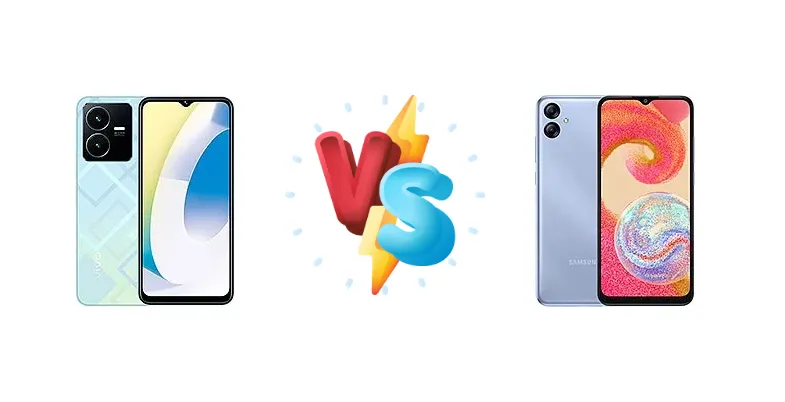
Both the vivo Y22 and Samsung Galaxy A04e occupy the ultra-budget smartphone segment, aiming to deliver essential functionality at the lowest possible price. However, beneath the similar price points lie significant differences in processing power, impacting everyday usability and gaming performance. This comparison dissects these differences to determine which device offers the best value.
🏆 Quick Verdict
For the average user prioritizing responsiveness and occasional gaming, the vivo Y22 emerges as the superior choice. Its Mediatek Helio G85 chipset provides a noticeable performance uplift over the Galaxy A04e’s Helio P35, making it better suited for multitasking and demanding applications. While both offer basic functionality, the Y22 delivers a smoother experience.
| Network |
|---|
| 2G bands | GSM 850 / 900 / 1800 / 1900 | GSM 850 / 900 / 1800 / 1900 |
| 3G bands | HSDPA 850 / 900 / 2100 | HSDPA 850 / 900 / 2100 |
| 4G bands | 1, 3, 5, 8, 40 | 1, 3, 5, 7, 8, 20, 28, 38, 40, 41 |
| Speed | HSPA, LTE | HSPA, LTE |
| Technology | GSM / HSPA / LTE | GSM / HSPA / LTE |
| Launch |
|---|
| Announced | 2022, September 05 | 2022, October 21 |
| Status | Available. Released 2022, September 05 | Available. Released 2022, November 07 |
| Body |
|---|
| Build | Glass front, plastic frame, plastic back | Glass front, plastic back, plastic frame |
| Dimensions | 164.3 x 76.1 x 8.4 mm (6.47 x 3.00 x 0.33 in) | 164.2 x 75.9 x 9.1 mm (6.46 x 2.99 x 0.36 in) |
| SIM | Nano-SIM + Nano-SIM | · Nano-SIM· Nano-SIM + Nano-SIM |
| Weight | 190 g (6.70 oz) | 188 g (6.63 oz) |
| Display |
|---|
| Resolution | 720 x 1612 pixels, 20:9 ratio (~270 ppi density) | 720 x 1600 pixels, 20:9 ratio (~270 ppi density) |
| Size | 6.55 inches, 103.1 cm2 (~82.4% screen-to-body ratio) | 6.5 inches, 102.0 cm2 (~81.8% screen-to-body ratio) |
| Type | IPS LCD, 530 nits (HBM) | PLS LCD |
| Platform |
|---|
| CPU | Octa-core (2x2.0 GHz Cortex-A75 & 6x1.8 GHz Cortex-A55) | Octa-core (4x2.3 GHz Cortex-A53 & 4x1.8 GHz Cortex-A53) |
| Chipset | Mediatek MT6769Z Helio G85 (12 nm) | Mediatek MT6765 Helio P35 (12 nm) |
| GPU | Mali-G52 MC2 | PowerVR GE8320 |
| OS | Android 12, Funtouch 12 | Android 12, One UI Core 4.1 |
| Memory |
|---|
| Card slot | microSDXC (dedicated slot) | microSDXC (dedicated slot) |
| Internal | 64GB 4GB RAM, 128GB 4GB RAM, 128GB 6GB RAM | 32GB 2GB RAM, 32GB 3GB RAM, 32GB 4GB RAM, 64GB 2GB RAM, 64GB 3GB RAM, 64GB 4GB RAM, 128GB 4GB RAM |
| Main Camera |
|---|
| Dual | - | 13 MP, f/2.2, (wide), AF
Auxiliary lens |
| Features | Dual-LED flash, panorama | LED flash |
| Single | - | 5 MP, f/2.2 |
| Triple | 50 MP, f/1.8, (wide), PDAF
2 MP (macro) | - |
| Video | 1080p@30fps | 1080p@30fps |
| Selfie camera |
|---|
| Single | 8 MP, f/2.0, (wide) | 5 MP, f/2.2 |
| Video | 1080p@30fps | Yes |
| Sound |
|---|
| 3.5mm jack | - | Yes |
| 35mm jack | Yes | Yes |
| Loudspeaker | Yes | Yes |
| Comms |
|---|
| Bluetooth | 5.0, A2DP, LE | 5.0, A2DP, LE |
| NFC | No | No |
| Positioning | GPS, GLONASS, GALILEO, BDS | GPS, GLONASS, GALILEO, BDS |
| Radio | FM radio | Unspecified |
| USB | USB Type-C 2.0, OTG | USB Type-C 2.0, OTG |
| WLAN | Wi-Fi 802.11 a/b/g/n/ac, dual-band | Wi-Fi 802.11 b/g/n, Wi-Fi Direct |
| Features |
|---|
| Sensors | Fingerprint (side-mounted), accelerometer, proximity, compass | Accelerometer, proximity |
| Battery |
|---|
| Charging | 18W wired | - |
| Type | 5000 mAh | Li-Po 5000 mAh |
| Misc |
|---|
| Colors | Starlite Blue, Metaverse Green, Summer Cyan | Black, Copper, Light Blue |
| Models | V2207 | SM-A042F, SM-A042F/DS, SM-A042M, SM-A042M/DS |
| Price | About 160 EUR | ₹ 7,999 |
| SAR EU | - | 0.29 W/kg (head) 1.11 W/kg (body) |
vivo Y22
- Superior processing power with the Helio G85
- Faster 18W charging
- Potentially better low-light camera performance
- May have less brand recognition than Samsung
- Software updates may be less frequent
Samsung Galaxy A04e
- Strong brand recognition and established service network
- Potentially lower price point (depending on region)
- Simple and user-friendly interface
- Significantly weaker performance with the Helio P35
- Slower charging speeds
- Less capable GPU for gaming
Display Comparison
Neither device boasts a standout display. Both likely utilize LCD panels, typical for this price bracket. Without specific brightness data, it's reasonable to assume both offer adequate visibility indoors, but struggle in direct sunlight. The focus here isn't on display quality, but rather on the underlying performance that drives the UI displayed on them.
Camera Comparison
Both phones likely feature basic camera setups. Without detailed sensor information, it’s safe to assume the image quality will be similar in good lighting conditions. However, the Helio G85’s superior ISP (Image Signal Processor) in the Y22 may offer slightly better image processing, particularly in low-light scenarios. The presence of a 2MP macro camera on both devices is largely a marketing tactic, offering limited practical benefit due to the small sensor size and lack of optical image stabilization.
Performance
The core difference lies in the chipsets. The vivo Y22’s Mediatek Helio G85, built on a 12nm process, features an octa-core configuration with 2x2.0 GHz Cortex-A75 cores and 6x1.8 GHz Cortex-A55 cores. This architecture prioritizes performance with the A75 cores providing a significant boost over the Samsung Galaxy A04e’s Helio P35. The A04e’s P35 uses a 4x2.3 GHz Cortex-A53 and 4x1.8 GHz Cortex-A53 configuration. While the P35 has a higher clock speed on its primary cores, the older A53 architecture is less efficient and offers lower IPC (Instructions Per Clock) than the A75. This translates to the Y22 feeling snappier in everyday use and handling graphically intensive tasks more effectively. The G85 also benefits from a more capable GPU, making it the better choice for mobile gaming.
Battery Life
Both devices feature similar battery capacities (likely around 5000mAh, based on market trends). The vivo Y22’s 18W charging is a slight advantage over the A04e’s likely 10W or 15W charging. While neither offers incredibly fast charging, the 18W support on the Y22 will result in noticeably quicker top-ups, reducing downtime. The more efficient Helio G85 may also contribute to slightly better battery life under moderate usage.
Buying Guide
Buy the vivo Y22 if you need a phone capable of handling more than just basic tasks – social media, light gaming, and multitasking will be noticeably smoother. It’s ideal for users who want a responsive experience without breaking the bank. Buy the Samsung Galaxy A04e if your primary needs are limited to calls, texts, and very light app usage, and you prioritize brand recognition and potentially a wider service network.
Frequently Asked Questions
❓ Will the Helio P35 in the Galaxy A04e struggle with modern app updates?
Yes, the Helio P35 is an older chipset and may exhibit slowdowns and compatibility issues with newer, more demanding app updates. While it can handle basic apps, resource-intensive applications may run sluggishly or experience crashes. The Y22’s Helio G85 is better equipped to handle these updates.
❓ Is the vivo Y22 a good option for playing games like PUBG Mobile or Call of Duty Mobile?
The vivo Y22 can run PUBG Mobile and Call of Duty Mobile, but you’ll likely need to lower the graphics settings to medium or low to achieve a playable frame rate. The Helio G85’s GPU is capable, but it’s not a high-end gaming chip. The Galaxy A04e will struggle significantly with these titles, even on the lowest settings.
❓ How long will it take to fully charge each phone from 0%?
With the 18W charging on the vivo Y22, a full charge from 0% will likely take around 2-2.5 hours. The Samsung Galaxy A04e, with its slower charging (estimated 10-15W), will likely take 3-4 hours to reach 100%.
❓ Does either phone support software updates beyond the initial Android version?
Software update support is often limited on ultra-budget phones. Samsung generally offers slightly better software support than vivo, but don't expect major Android version upgrades on either device. Expect security patches to be infrequent.