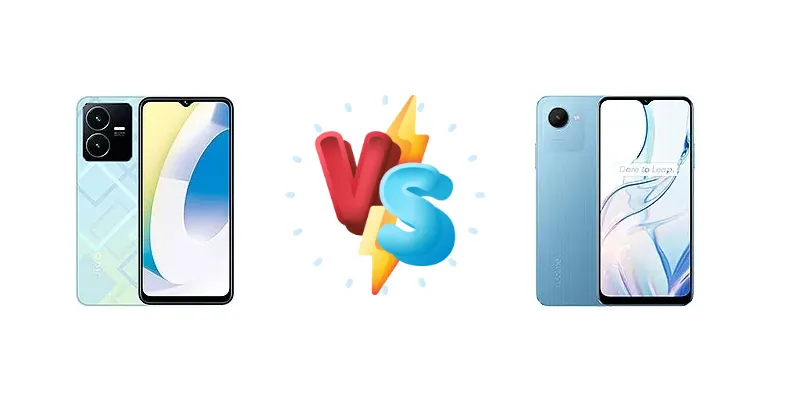
The sub-$150 smartphone market is fiercely competitive. Both the vivo Y22 and Realme C30s aim to deliver essential smartphone functionality at an accessible price. However, they take different approaches to achieving this, with the Y22 prioritizing processing power and the C30s focusing on a streamlined experience. This comparison dissects their key differences to help you choose the right device.
🏆 Quick Verdict
For users who prioritize responsiveness and occasional gaming, the vivo Y22 is the better choice thanks to its significantly more powerful Mediatek Helio G85 chipset. However, the Realme C30s offers a simpler experience and may appeal to those seeking a basic, reliable phone with longer battery life due to its less demanding processor.
| Network |
|---|
| 2G bands | GSM 850 / 900 / 1800 / 1900 | GSM 850 / 900 / 1800 / 1900 |
| 3G bands | HSDPA 850 / 900 / 2100 | HSDPA 850 / 900 / 2100 |
| 4G bands | 1, 3, 5, 8, 40 | 1, 3, 5, 8, 38, 40, 41 |
| Speed | HSPA, LTE | HSPA, LTE |
| Technology | GSM / HSPA / LTE | GSM / HSPA / LTE |
| Launch |
|---|
| Announced | 2022, September 05 | 2022, September 14 |
| Status | Available. Released 2022, September 05 | Available. Released 2022, September 23 |
| Body |
|---|
| Build | Glass front, plastic frame, plastic back | Glass front, plastic frame, plastic back |
| Dimensions | 164.3 x 76.1 x 8.4 mm (6.47 x 3.00 x 0.33 in) | 164.2 x 75.7 x 8.5 mm (6.46 x 2.98 x 0.33 in) |
| SIM | Nano-SIM + Nano-SIM | Nano-SIM + Nano-SIM |
| Weight | 190 g (6.70 oz) | 186 g (6.56 oz) |
| Display |
|---|
| Resolution | 720 x 1612 pixels, 20:9 ratio (~270 ppi density) | 720 x 1600 pixels, 20:9 ratio (~270 ppi density) |
| Size | 6.55 inches, 103.1 cm2 (~82.4% screen-to-body ratio) | 6.5 inches, 102.0 cm2 (~82.1% screen-to-body ratio) |
| Type | IPS LCD, 530 nits (HBM) | IPS LCD |
| Platform |
|---|
| CPU | Octa-core (2x2.0 GHz Cortex-A75 & 6x1.8 GHz Cortex-A55) | Octa-core 1.6 GHz Cortex-A55 |
| Chipset | Mediatek MT6769Z Helio G85 (12 nm) | - |
| GPU | Mali-G52 MC2 | IMG8322 |
| OS | Android 12, Funtouch 12 | Android 12, Realme UI Go |
| Memory |
|---|
| Card slot | microSDXC (dedicated slot) | microSDXC (dedicated slot) |
| Internal | 64GB 4GB RAM, 128GB 4GB RAM, 128GB 6GB RAM | 32GB 2GB RAM, 32GB 3GB RAM, 64GB 3GB RAM, 64GB 4GB RAM |
| Main Camera |
|---|
| Features | Dual-LED flash, panorama | LED flash, HDR, panorama |
| Single | - | 8 MP, (wide), 1/4.0", 1.12µm |
| Triple | 50 MP, f/1.8, (wide), PDAF
2 MP (macro) | - |
| Video | 1080p@30fps | 1080p@30fps |
| Selfie camera |
|---|
| Features | - | HDR |
| Single | 8 MP, f/2.0, (wide) | 5 MP, (wide), 1/5.0", 1.12µm |
| Video | 1080p@30fps | 720p@30fps |
| Sound |
|---|
| 3.5mm jack | - | Yes |
| 35mm jack | Yes | Yes |
| Loudspeaker | Yes | Yes |
| Comms |
|---|
| Bluetooth | 5.0, A2DP, LE | 4.2, A2DP |
| NFC | No | No |
| Positioning | GPS, GLONASS, GALILEO, BDS | GPS, GLONASS |
| Radio | FM radio | Unspecified |
| USB | USB Type-C 2.0, OTG | microUSB 2.0, OTG |
| WLAN | Wi-Fi 802.11 a/b/g/n/ac, dual-band | Wi-Fi 802.11 b/g/n |
| Features |
|---|
| Sensors | Fingerprint (side-mounted), accelerometer, proximity, compass | Fingerprint (side-mounted), accelerometer, proximity |
| Battery |
|---|
| Charging | 18W wired | 10W wired |
| Type | 5000 mAh | 5000 mAh |
| Misc |
|---|
| Colors | Starlite Blue, Metaverse Green, Summer Cyan | Stripe Blue, Stripe Black |
| Models | V2207 | RMX3690 |
| Price | About 160 EUR | About 100 EUR |
vivo Y22
- Significantly more powerful processor for smoother performance.
- Faster 18W charging for quicker top-ups.
- Potentially better image processing due to the Helio G85's ISP.
- May experience slightly faster battery drain due to the more powerful processor.
- Likely to be slightly more expensive than the Realme C30s.
Realme C30s
- Simpler, more streamlined user experience.
- Potentially longer battery life for light users.
- Likely to be more affordable.
- Significantly slower processor, leading to lag and slowdowns.
- Slower 10W charging takes longer to replenish the battery.
Display Comparison
Neither device boasts a standout display. Both are likely to feature LCD panels, typical for this price bracket. However, detailed display specs (resolution, brightness, color gamut) are unavailable. The focus here is on the internal hardware, as display quality is likely similar. Bezels are expected to be noticeable on both, prioritizing cost reduction over premium aesthetics.
Camera Comparison
Camera details beyond the presence of cameras are scarce. Given the price point, image quality will be heavily reliant on software processing. It's safe to assume both phones will feature a primary camera and potentially a depth or macro sensor. Without sensor size or aperture information, a direct comparison is impossible. However, the more powerful ISP (Image Signal Processor) within the Helio G85 of the Y22 *could* translate to slightly better image processing, particularly in low-light conditions, but this is speculative.
Performance
The core difference lies in the chipset. The vivo Y22’s Mediatek Helio G85 (12nm) features an octa-core configuration with 2x2.0 GHz Cortex-A75 and 6x1.8 GHz Cortex-A55 cores. This architecture provides a substantial performance advantage over the Realme C30s’ octa-core 1.6 GHz Cortex-A55 processor. The Cortex-A75 cores in the Y22 are significantly more powerful than the A55 cores found in the C30s, resulting in faster app loading times, smoother multitasking, and improved gaming performance. The 12nm process node of the Helio G85, while not cutting-edge, is optimized for efficiency, balancing performance with battery life. The C30s’ processor, while efficient, will struggle with demanding tasks.
Battery Life
Battery capacity is not specified for either device. However, the Realme C30s’ 10W charging is significantly slower than the vivo Y22’s 18W charging. While a larger battery on the C30s could offset this, the less demanding processor means it will likely consume less power overall. The Y22’s faster charging will be beneficial for users who need to quickly top up their battery, while the C30s may offer longer overall usage between charges for light users.
Buying Guide
Buy the vivo Y22 if you need a phone capable of handling multitasking, moderate gaming, and demanding apps without significant slowdown. It's ideal for students or users who frequently use social media and streaming services. Buy the Realme C30s if you prefer a straightforward, no-frills experience focused on core communication features – calls, texts, and basic app usage – and value simplicity over raw performance.
Frequently Asked Questions
❓ Will the Realme C30s struggle with popular apps like WhatsApp and Facebook?
While the Realme C30s can run these apps, users may experience noticeable lag and slowdowns when multitasking or using features that require more processing power. The Cortex-A55 processor is designed for basic tasks and may not provide a smooth experience with demanding applications.
❓ Is the 18W charging on the vivo Y22 a significant improvement over the 10W charging on the Realme C30s?
Yes, 18W charging is considerably faster. Expect the vivo Y22 to charge from 0-100% in approximately 2-2.5 hours, while the Realme C30s will likely take 3-4 hours. This difference is noticeable for users who frequently need to quickly recharge their phone.
❓ Can the vivo Y22 handle basic mobile gaming?
The Helio G85 in the vivo Y22 is capable of handling less demanding mobile games at medium settings. While it won't deliver a high-end gaming experience, it provides a playable experience for titles like PUBG Mobile (at lower settings) and Call of Duty Mobile.
❓ Does either phone support expandable storage via microSD card?
This information is not available in the provided specifications. However, given the target market, it's highly probable that both devices support microSD card expansion, allowing users to increase storage capacity.