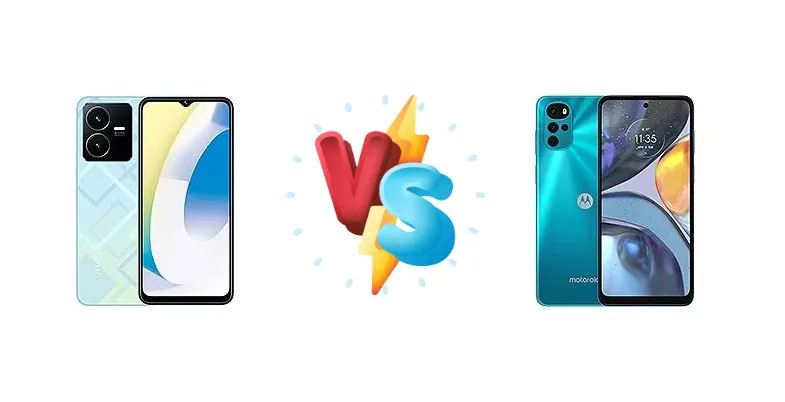
The vivo Y22 and Motorola Moto G22 represent compelling options in the crowded sub-$200 smartphone market. Both devices aim to deliver essential features at an accessible price point, but they diverge in their core processing power and charging capabilities. This comparison dissects the key differences between the Mediatek Helio G85-powered vivo Y22 and the Helio G37-equipped Motorola Moto G22, helping you determine which best suits your needs.
🏆 Quick Verdict
For users prioritizing sustained performance in demanding apps and light gaming, the vivo Y22 emerges as the better choice thanks to its Helio G85 chipset. While the Moto G22 offers potentially faster charging (depending on region), the Y22’s CPU architecture provides a noticeable advantage in overall responsiveness.
| Network |
|---|
| 2G bands | GSM 850 / 900 / 1800 / 1900 | GSM 850 / 900 / 1800 / 1900 |
| 3G bands | HSDPA 850 / 900 / 2100 | HSDPA 850 / 900 / 1900 / 2100 |
| 4G bands | 1, 3, 5, 8, 40 | 1, 3, 5, 7, 8, 20, 38, 40, 41 |
| Speed | HSPA, LTE | HSPA 42.2/5.76 Mbps, LTE Cat4 150/50 Mbps |
| Technology | GSM / HSPA / LTE | GSM / HSPA / LTE |
| Launch |
|---|
| Announced | 2022, September 05 | 2022, March 04 |
| Status | Available. Released 2022, September 05 | Available. Released 2022, March 04 |
| Body |
|---|
| Build | Glass front, plastic frame, plastic back | Glass front, plastic frame, plastic back |
| Dimensions | 164.3 x 76.1 x 8.4 mm (6.47 x 3.00 x 0.33 in) | 164 x 75 x 8.5 mm (6.46 x 2.95 x 0.33 in) |
| SIM | Nano-SIM + Nano-SIM | · Nano-SIM· Nano-SIM + Nano-SIM |
| Weight | 190 g (6.70 oz) | 185 g (6.53 oz) |
| | - | Water-repellent design |
| Display |
|---|
| Resolution | 720 x 1612 pixels, 20:9 ratio (~270 ppi density) | 720 x 1600 pixels, 20:9 ratio (~268 ppi density) |
| Size | 6.55 inches, 103.1 cm2 (~82.4% screen-to-body ratio) | 6.5 inches, 103.5 cm2 (~84.2% screen-to-body ratio) |
| Type | IPS LCD, 530 nits (HBM) | IPS LCD, 90Hz |
| Platform |
|---|
| CPU | Octa-core (2x2.0 GHz Cortex-A75 & 6x1.8 GHz Cortex-A55) | Octa-core (4x2.3 GHz Cortex-A53 & 4x1.8 GHz Cortex-A53) |
| Chipset | Mediatek MT6769Z Helio G85 (12 nm) | Mediatek MT6765V/CB Helio G37 (12 nm) |
| GPU | Mali-G52 MC2 | PowerVR GE8320 |
| OS | Android 12, Funtouch 12 | Android 12 |
| Memory |
|---|
| Card slot | microSDXC (dedicated slot) | microSDXC (dedicated slot) |
| Internal | 64GB 4GB RAM, 128GB 4GB RAM, 128GB 6GB RAM | 64GB 4GB RAM, 128GB 4GB RAM |
| Main Camera |
|---|
| Features | Dual-LED flash, panorama | LED flash, HDR, panorama |
| Quad | - | 50 MP, f/1.8, (wide), 0.64µm, PDAF
8 MP, f/2.2, 118˚ (ultrawide), 1/4.0", 1.12µm
2 MP (macro)
Auxiliary lens |
| Triple | 50 MP, f/1.8, (wide), PDAF
2 MP (macro) | - |
| Video | 1080p@30fps | 1080p@30fps |
| Selfie camera |
|---|
| Features | - | HDR |
| Single | 8 MP, f/2.0, (wide) | 16 MP, f/2.5, (wide), 1.0µm |
| Video | 1080p@30fps | 1080p@30fps |
| Sound |
|---|
| 3.5mm jack | - | Yes |
| 35mm jack | Yes | Yes |
| Loudspeaker | Yes | Yes |
| Comms |
|---|
| Bluetooth | 5.0, A2DP, LE | 5.0, A2DP, LE |
| NFC | No | Yes (market/region dependent) |
| Positioning | GPS, GLONASS, GALILEO, BDS | GPS, GLONASS, GALILEO |
| Radio | FM radio | Unspecified |
| USB | USB Type-C 2.0, OTG | USB Type-C 2.0 |
| WLAN | Wi-Fi 802.11 a/b/g/n/ac, dual-band | Wi-Fi 802.11 a/b/g/n/ac, dual-band, Wi-Fi Direct |
| Features |
|---|
| Sensors | Fingerprint (side-mounted), accelerometer, proximity, compass | Fingerprint (side-mounted), accelerometer, gyro, proximity, compass |
| Battery |
|---|
| Charging | 18W wired | 20W wired (India)
15W wired (Global) |
| Type | 5000 mAh | Li-Po 5000 mAh |
| Misc |
|---|
| Colors | Starlite Blue, Metaverse Green, Summer Cyan | Pearl White, Iceberg Blue, Cosmic Black, Mint Green |
| Models | V2207 | XT2231-1, XT2231-2, XT2231-5 |
| Price | About 160 EUR | About 120 EUR |
vivo Y22
- More powerful CPU for smoother multitasking
- Helio G85 offers better sustained performance
- Consistent 18W charging across all regions
- Charging speed is not the fastest in the segment
- Likely lacks advanced display features
Motorola Moto G22
- Potentially faster 20W charging (India)
- Competitive price point
- Motorola’s clean software experience
- Helio G37’s older CPU architecture limits performance
- Inconsistent charging speeds based on region
Display Comparison
Neither device boasts a standout display. Both likely utilize LCD panels, a common trait in this price bracket. The focus here is on processing power, not pixel density or refresh rates. While specific display specs (resolution, brightness) are unavailable, the user experience will likely be similar – adequate for everyday use but not ideal for media consumption in bright sunlight.
Camera Comparison
Without detailed camera sensor information, a direct comparison is difficult. However, both phones likely feature a primary camera accompanied by auxiliary lenses (often 2MP macro/depth sensors of limited utility). The image processing capabilities of the Mediatek chipsets are similar, so image quality will likely depend more on the primary sensor and software tuning. The absence of Optical Image Stabilization (OIS) on either device suggests image stabilization will be primarily digital, potentially resulting in softer images in low-light conditions.
Performance
The core difference lies in the chipsets. The vivo Y22’s Mediatek Helio G85 features a more sophisticated CPU configuration: two Cortex-A75 cores clocked at 2.0 GHz, paired with six Cortex-A55 cores at 1.8 GHz. This contrasts with the Moto G22’s Helio G37, which uses four Cortex-A53 cores at 2.3 GHz and four more A53 cores at 1.8 GHz. While the G37’s A53 cores have a slightly higher clock speed, the G85’s A75 cores offer significantly greater single-core performance, translating to snappier app launches and smoother multitasking. The G85’s architecture is a generation ahead, providing a tangible advantage in CPU-bound tasks. The G37's reliance on older A53 cores will show its limitations when handling more complex operations.
Battery Life
Both devices offer adequate battery capacity for all-day use with moderate usage. The Moto G22’s charging speed is region-dependent: 20W in India and 15W globally. The vivo Y22 is consistently rated at 18W. While 20W charging is faster on paper, the difference in real-world charging times may not be substantial, especially considering battery capacity isn’t specified. The Y22’s more efficient chipset might offset the slightly slower charging speed by extending battery life during use.
Buying Guide
Buy the vivo Y22 if you need a phone capable of handling multitasking and occasional gaming without significant slowdowns. Its more powerful CPU core configuration will benefit users who frequently switch between apps or play moderately demanding mobile games. Buy the Motorola Moto G22 if you prioritize quick top-ups and are primarily a casual user focused on basic tasks like calling, texting, and social media. The potentially faster charging (20W in India) is a boon for those who dislike waiting for their phone to charge.
Frequently Asked Questions
❓ Will the Motorola Moto G22’s 20W charging significantly reduce charging time compared to the vivo Y22’s 18W?
The difference in charging speed will be noticeable, but not dramatic. The 20W charger (available in India) will likely shave off 15-20 minutes from a full 0-100% charge compared to the 18W charger. However, the overall charging time will still be over 2 hours, and the Y22’s more efficient chipset may result in similar real-world usage time despite the slower charging.
❓ Is the Helio G37 in the Moto G22 sufficient for playing games like PUBG Mobile or Call of Duty Mobile?
The Helio G37 can run PUBG Mobile and Call of Duty Mobile, but you’ll likely need to lower the graphics settings to medium or low to maintain a stable frame rate. The older CPU architecture and GPU will struggle with demanding scenes and may exhibit occasional stuttering. The vivo Y22’s Helio G85 will provide a smoother gaming experience at similar settings.
❓ Does either phone support fast charging protocols like Power Delivery or Quick Charge?
Neither vivo nor Motorola explicitly advertise support for advanced fast charging protocols like Power Delivery or Quick Charge on these models. They likely utilize standard USB Power Delivery, but charging speeds will be limited by the charger’s wattage and the phone’s internal charging circuitry.