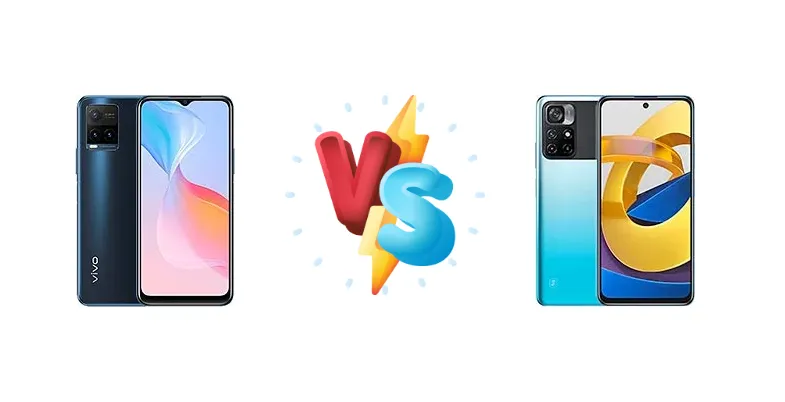
The sub-$200 smartphone market is fiercely competitive. The vivo Y21t (India) and Xiaomi Poco M4 Pro 5G both aim to deliver a compelling experience without breaking the bank, but they take different approaches. The Y21t focuses on a refined Qualcomm chipset, while the Poco M4 Pro 5G prioritizes 5G connectivity and faster charging. This comparison dissects their strengths and weaknesses to determine which device offers the best value.
🏆 Quick Verdict
For the average user prioritizing future-proofing and faster charging, the Xiaomi Poco M4 Pro 5G is the better choice. Its Dimensity 810 chipset and 33W charging offer a noticeable advantage, despite the Y21t's efficient Snapdragon 680. However, users heavily reliant on Qualcomm-specific features or seeking a potentially smoother experience with everyday tasks might find the Y21t appealing.
| Network |
|---|
| 2G bands | GSM 850 / 900 / 1800 / 1900 | GSM 850 / 900 / 1800 / 1900 |
| 3G bands | HSDPA 850 / 900 / 2100 | HSDPA 850 / 900 / 1700(AWS) / 1900 / 2100 - International |
| 4G bands | 1, 3, 5, 8, 38, 40, 41 | 1, 2, 3, 4, 5, 7, 8, 12, 17, 20, 28, 32, 38, 40, 41, 66 - International |
| 5G bands | - | 1, 3, 5, 7, 8, 20, 28, 38, 40, 41, 66, 77, 78 SA/NSA - International |
| Speed | HSPA, LTE | HSPA, LTE, 5G |
| Technology | GSM / HSPA / LTE | GSM / HSPA / LTE / 5G |
| | - | 1, 3, 5, 8, 28, 40, 78 SA/NSA - India |
| Launch |
|---|
| Announced | 2022, January 03 | 2021, November 09 |
| Status | Available. Released 2022, January 03 | Available. Released 2021, November 11 |
| Body |
|---|
| Build | Glass front, plastic frame, plastic back | Glass front (Gorilla Glass 3), plastic back, plastic frame |
| Dimensions | 164.3 x 76.1 x 8 mm (6.47 x 3.00 x 0.31 in) | 163.6 x 75.8 x 8.8 mm (6.44 x 2.98 x 0.35 in) |
| SIM | Nano-SIM + Nano-SIM | Nano-SIM + Nano-SIM |
| Weight | 182 g (6.42 oz) | 195 g (6.88 oz) |
| | - | IP53, dust and splash resistant |
| Display |
|---|
| Protection | - | Corning Gorilla Glass 3 |
| Resolution | 1080 x 2408 pixels, 20:9 ratio (~401 ppi density) | 1080 x 2400 pixels, 20:9 ratio (~399 ppi density) |
| Size | 6.58 inches, 104.3 cm2 (~83.4% screen-to-body ratio) | 6.6 inches, 105.2 cm2 (~84.8% screen-to-body ratio) |
| Type | IPS LCD, 90Hz | IPS LCD, 90Hz, 450 nits (typ) |
| Platform |
|---|
| CPU | Octa-core (4x2.4 GHz Kryo 265 Gold & 4x1.9 GHz Kryo 265 Silver) | Octa-core (2x2.4 GHz Cortex-A76 & 6x2.0 GHz Cortex-A55) |
| Chipset | Qualcomm SM6225 Snapdragon 680 4G (6 nm) | Mediatek Dimensity 810 (6 nm) |
| GPU | Adreno 610 | Mali-G57 MC2 |
| OS | Android 11, Funtouch 12 | Android 11, upgradable to Android 12, MIUI 13 |
| Memory |
|---|
| Card slot | microSDXC (dedicated slot) | microSDXC |
| Internal | 128GB 4GB RAM | 64GB 4GB RAM, 64GB 6GB RAM, 128GB 4GB RAM, 128GB 6GB RAM, 128GB 8GB RAM, 256GB 8GB RAM |
| | - | UFS 2.2 |
| Main Camera |
|---|
| Dual | - | 50 MP, f/1.8, 26mm (wide), PDAF
8 MP, f/2.2, 119˚ (ultrawide) |
| Features | LED flash | LED flash, HDR, panorama |
| Single | 8 MP, f/1.8, (wide) | 16 MP, f/2.5, (wide), 1/3.06" 1.0µm |
| Triple | 50 MP, f/1.8, (wide), PDAF
2 MP (macro)
Auxiliary lens | - |
| Video | 1080p@30fps | 1080p@30/60fps |
| Selfie camera |
|---|
| Features | HDR | Panorama |
| Single | 8 MP, f/1.8, (wide) | 16 MP, f/2.5, (wide), 1/3.06" 1.0µm |
| Video | 1080p@30fps | 1080p@30fps |
| Sound |
|---|
| 3.5mm jack | Yes | Yes |
| 35mm jack | Yes | Yes |
| Loudspeaker | Yes | Yes, with stereo speakers |
| Comms |
|---|
| Bluetooth | 5.0, A2DP, LE | 5.1, A2DP, LE |
| Infrared port | - | Yes |
| NFC | No | Yes (market/region dependent) |
| Positioning | GPS, GLONASS, GALILEO, BDS | GPS, GLONASS, GALILEO, BDS |
| Radio | FM radio | FM radio |
| USB | USB Type-C 2.0, OTG | USB Type-C 2.0, OTG |
| WLAN | Wi-Fi 802.11 a/b/g/n/ac, dual-band, Wi-Fi Direct | Wi-Fi 802.11 a/b/g/n/ac, dual-band, Wi-Fi Direct |
| Features |
|---|
| Sensors | Fingerprint (side-mounted), accelerometer, proximity, compass | Fingerprint (side-mounted), accelerometer, gyro, compass |
| Battery |
|---|
| Charging | 18W wired
2.5W reverse wired | 33W wired, 100% in 59 min |
| Type | 5000 mAh | Li-Po 5000 mAh |
| Misc |
|---|
| Colors | Midnight Blue, Pearl White | Poco Yellow, Power Black, Cool Blue |
| Models | - | 21091116AG, MZB0BGVIN |
| Price | About 200 EUR | About 150 EUR |
| SAR | - | 1.07 W/kg (head) 1.09 W/kg (body) |
| SAR EU | - | 0.59 W/kg (head) 1.00 W/kg (body) |
| Tests |
|---|
| Battery life | - |
Endurance rating 123h
|
| Camera | - |
Photo / Video |
| Display | - |
Contrast ratio: 1553:1 (nominal) |
| Loudspeaker | - |
-24.9 LUFS (Very good)
|
| Performance | - |
AnTuTu: 296721 (v8), 353663 (v9)
GeekBench: 1797 (v5.1)
GFXBench: 13fps (ES 3.1 onscreen) |
vivo Y21t (India)
- Efficient Snapdragon 680 chipset for good battery life
- Qualcomm's software optimization for smooth daily use
- Potentially more stable software experience
- Lacks 5G connectivity
- Slower 18W charging
- No reverse charging
Xiaomi Poco M4 Pro 5G
- Faster 33W charging (0-100% in 59 mins)
- 5G connectivity for future-proofing
- More powerful Dimensity 810 chipset for gaming
- Potentially slightly lower battery life under heavy load
- MediaTek chipset may have more bloatware
- Image processing may be less refined than Qualcomm
Display Comparison
Both devices feature a contrast ratio of 1553:1, suggesting similar visual pop. However, the Poco M4 Pro 5G boasts a measured peak brightness of 510 nits, which will translate to better visibility outdoors compared to the Y21t, whose brightness is not specified. While both likely utilize IPS LCD panels, the Poco's higher brightness gives it an edge in real-world usability. Bezels are expected to be comparable given the price points, and color accuracy is likely standard for this segment – adequate but not professional-grade.
Camera Comparison
Both phones list 'Photo / Video' capabilities, but lack specific details. Without sensor size or aperture information, a direct comparison is difficult. However, given the market positioning, it’s safe to assume both rely on primary sensors in the 50MP range. The Poco M4 Pro 5G likely benefits from MediaTek’s image signal processor (ISP) optimizations, potentially offering better dynamic range and noise reduction. The Y21t will leverage Qualcomm’s ISP, which is known for its fast autofocus and accurate color reproduction. The presence of a 2MP macro lens on both devices is largely a marketing gimmick and shouldn’t heavily influence purchasing decisions.
Performance
The core difference lies in the chipsets. The Poco M4 Pro 5G’s MediaTek Dimensity 810 (6nm) features a more powerful CPU configuration with 2x2.4 GHz Cortex-A76 cores and 6x2.0 GHz Cortex-A55 cores, compared to the vivo Y21t’s Qualcomm Snapdragon 680 (6nm) with 4x2.4 GHz Kryo 265 Gold and 4x1.9 GHz Kryo 265 Silver. This translates to a theoretical advantage for the Poco in CPU-intensive tasks and gaming. The Dimensity 810 also unlocks 5G connectivity, a feature absent in the Y21t. While both are 6nm chips, the Dimensity 810’s architecture is geared towards higher performance, potentially at the cost of slightly increased power consumption. The Y21t’s Snapdragon 680 prioritizes efficiency, potentially leading to longer battery life during lighter use.
Battery Life
Both devices achieve an endurance rating of 123 hours, suggesting similar overall battery life despite the Y21t’s unspecified battery capacity and the Poco M4 Pro 5G’s unspecified capacity. However, the charging speeds are drastically different. The Poco M4 Pro 5G supports 33W wired charging, achieving a full charge in just 59 minutes, while the Y21t is limited to 18W, taking considerably longer. The Poco also offers 2.5W reverse wired charging, a convenient feature for topping up accessories, absent on the Y21t. The faster charging of the Poco M4 Pro 5G is a significant advantage for users who prioritize convenience.
Buying Guide
Buy the vivo Y21t (India) if you need a reliable, power-efficient device for everyday tasks and value Qualcomm's software optimization. It's ideal for users who don't heavily game or require 5G connectivity. Buy the Xiaomi Poco M4 Pro 5G if you prefer faster charging, 5G capabilities for future network access, and a chipset geared towards slightly more demanding applications, even if it means potentially slightly lower battery endurance.
Frequently Asked Questions
❓ Does the Dimensity 810 in the Poco M4 Pro 5G get noticeably hot during extended gaming sessions?
While the Dimensity 810 is a capable chipset, it can generate more heat than the Snapdragon 680 under sustained load. Expect some throttling during prolonged gaming, but the Poco M4 Pro 5G's thermal design should prevent overheating to the point of performance degradation. Optimizing game settings can mitigate heat buildup.
❓ Is the 18W charging on the vivo Y21t slow compared to other phones in this price range?
Yes, 18W charging is relatively slow compared to the 33W charging offered by the Poco M4 Pro 5G and other competitors. Expect a full charge to take over 2 hours, which may be inconvenient for users who frequently need to top up their battery quickly.
❓ Will I see a significant difference in app loading times between the Snapdragon 680 and the Dimensity 810?
You will likely notice a difference in app loading times, particularly for larger and more demanding applications. The Dimensity 810's more powerful CPU cores and faster memory interface will result in quicker app launches and smoother multitasking.
❓ Does the Poco M4 Pro 5G support VoWiFi (Wi-Fi Calling)?
Support for VoWiFi varies by carrier and region. It's crucial to check with your mobile carrier to confirm if the Poco M4 Pro 5G is compatible with their VoWiFi service. The Y21t's VoWiFi support also depends on the carrier.